playai-gradio: The Glue Code for the Multimodal Era
How a minimalist Python bridge uses the Gradio registry pattern to turn complex streaming text-to-speech APIs into a single composable UI block.
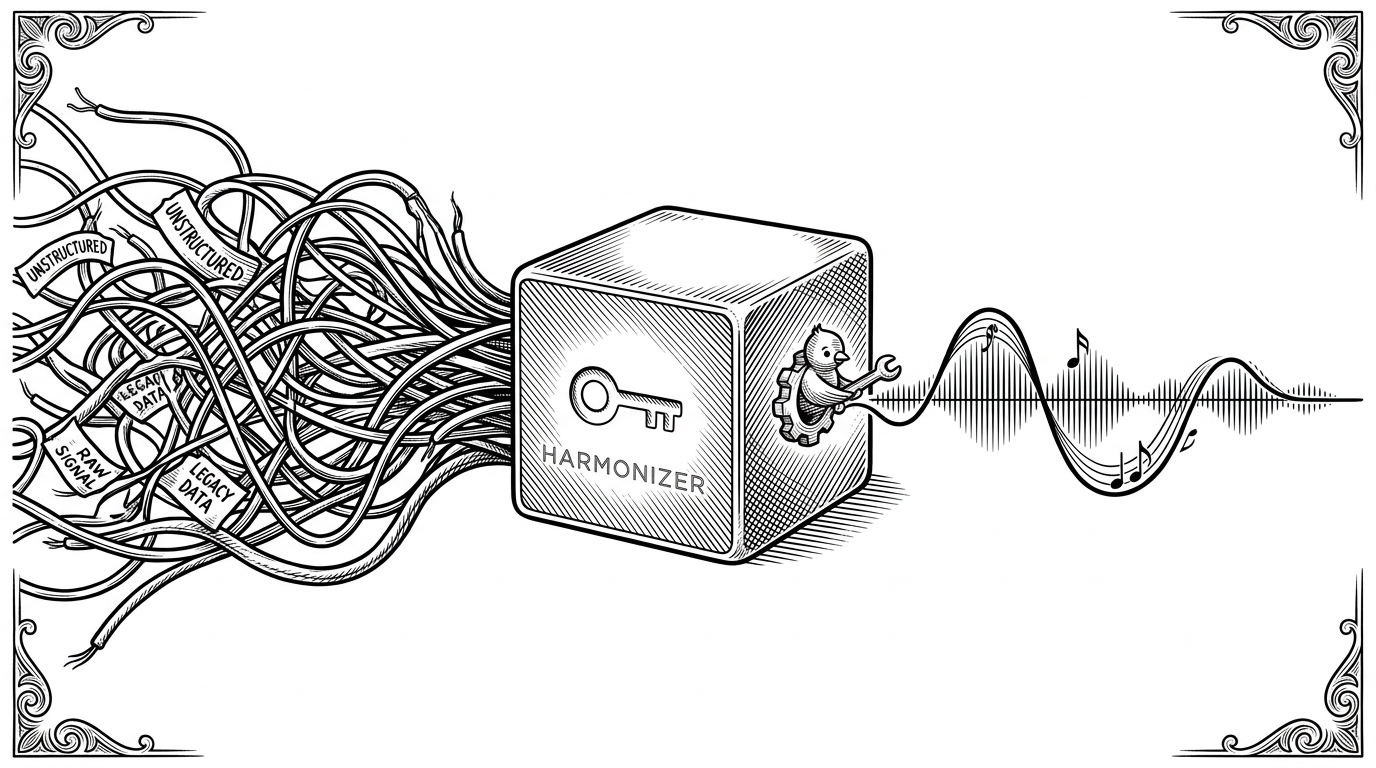 overall style evokes vintage newspaper editorial illustrations from The Economist or Wall Street Journal. No color, no gradients, no grey fills. Only black lines on white. The background MUST be pure white #FFFFFF. No paper texture, no cream, no off-white, no noise, no grain. Perfectly clean flat white background." loading="lazy">
- playai-gradio abstracts complex streaming audio APIs into a single composable UI block using the Gradio registry pattern.
- The library handles parameter polymorphism to seamlessly route both conversational multi-voice and high-speed single-shot audio requests.
- By hardcoding S3 URIs for voice manifests, the package trades flexibility for zero-latency metadata retrieval.
Assembling the Multimodal Chimera
The era of writing hundreds of lines of boilerplate to connect different AI models is over. Developers are increasingly relying on modular components to snap together complex multimodal applications. The real story of playai-gradio is not just that it plays audio. It is a masterclass in the Gradio registry pattern.
import gradio as gr
import openai_gradio
import playai_gradio

with gr.Blocks() as demo:
    with gr.Row():
        text_bot = gr.load(name='gpt-4o', src=openai_gradio.registry)
        voice_bot = gr.load(name='PlayDialog', src=playai_gradio.registry)

demo.launch()
This composition approach allows developers to drop a world-class text-to-speech engine right next to a language model inside a single application. The time to value drops from days to seconds.
The Boilerplate Tax
Historically, integrating a streaming text-to-speech API required managing a heavy tax. Developers had to build custom authentication headers, format nested JSON payloads, and manage audio buffer streams. Streaming audio in the browser is notoriously finicky, often requiring websockets or complex chunking logic.

Hijacking the UI with the Registry Pattern
The technical heart of the library is its implementation of the registry pattern. By exporting a custom registry function, the package intercepts Gradio's standard loading mechanism. It treats an external API exactly like a local model. The UI is dynamically generated based purely on the model name provided.
Routing the Audio Stream
The system relies on a higher-order function factory to route requests. This function handles parameter polymorphism, dynamically updating its base payload to accommodate vastly different requirements. The conversational PlayDialog model requires voice conditioning parameters, while the high-speed Play3.0-mini model prioritizes style guidance. Handling both in a single function requires careful conditional logic to avoid payload rejection.
The Pragmatism of Hardcoded Manifests
In a surprising but pragmatic move, the library hardcodes S3 URIs for voice profiles directly into the source code. This decision provides zero-latency metadata retrieval at a specific cost: if upstream storage paths change, the package will break until updated. It is a calculated trade-off favoring immediate performance over long-term stability without maintenance.