MedVault AI: The Hospital Stack That Treats Security and Insight as First-Class Features
A Spring Boot and React healthcare system that does more than store records. It separates patients, doctors, and admins with strict RBAC, logs everything, generates clinical documents, and adds AI-driven analytics on top.
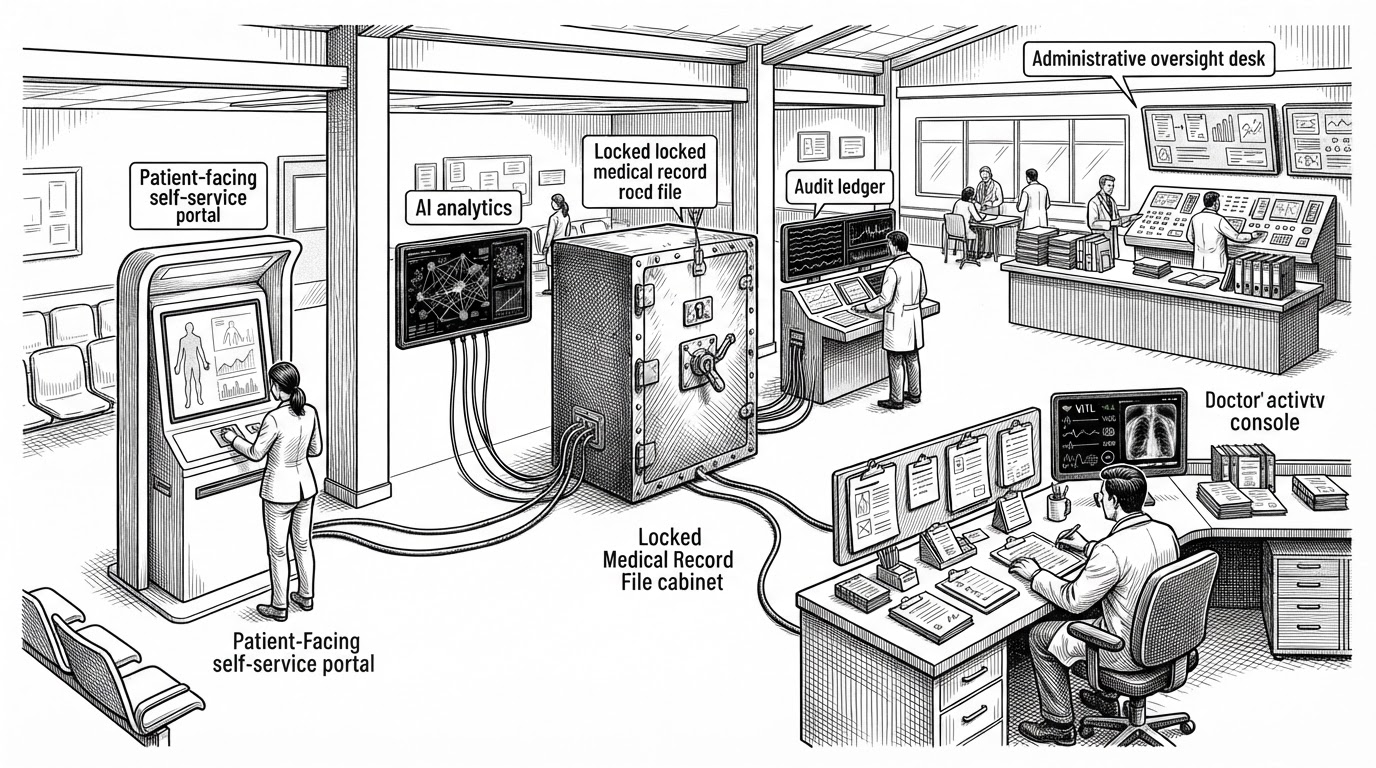
- MedVault AI is best understood as a trust system that also happens to generate healthcare insight, not just a records app with a chatbot bolted on.
- Its strongest idea is the combination of JWT, RBAC, and audit logging with AI analytics that only operate on approved data paths.
- The data model matters because it supports mixed ownership, letting patients upload records while doctors attach clinical context later.
- Compared with mature EHR platforms, MedVault AI is narrower, lighter, and more developer-accessible, which makes it feel like a blueprint rather than a finished enterprise suite.
Most healthcare software is good at storing facts and bad at turning them into action. MedVault AI tries to do both. It keeps the usual medical-record basics, then adds role-gated access, audit trails, document generation, and AI analytics so the system can support actual decisions, not just record lookup.
That combination is the whole story. The repo is not trying to outgrow OpenEMR or OpenMRS on breadth. It is trying to prove that a modern stack can make healthcare data both strictly controlled and operationally useful at the same time.
Why healthcare software is usually too static
Healthcare apps often stop at the storage layer. They hold lab results, appointments, prescriptions, and notes, then hand the burden of interpretation back to a human admin or clinician. MedVault AI pushes past that boundary by layering analytics and document generation on top of the record system.
The interesting part is not that it uses AI. It is that the AI layer is not the front door. It sits downstream of authentication, authorization, and auditability, which is the right order if the data is sensitive and the outputs matter.
MedVault is an advanced patient data management system designed to ensure data security, accessibility, interoperability, and privacy protection within the healthcare ecosystem.
What MedVault AI is actually trying to do
The product is organized around three roles: patient, doctor, and administrator. That sounds standard until you look at the implications. Each role changes what the system exposes, what it logs, and what kind of work the user can complete.
| Role | Primary job | What the system emphasizes |
|---|---|---|
| Patient | Upload and review personal health data | Self-service access, record visibility, and controlled sharing |
| Doctor | Attach clinical context and produce care outputs | Clinical workflow, prescriptions, and record review |
| Administrator | Oversee activity and operational health | Auditability, reporting, and system control |
This role split matters because it prevents the product from collapsing into one generic dashboard. A patient portal, a clinician tool, and an admin console all point at the same records, but they are not allowed to behave the same way.
The real differentiator: security is not bolted on
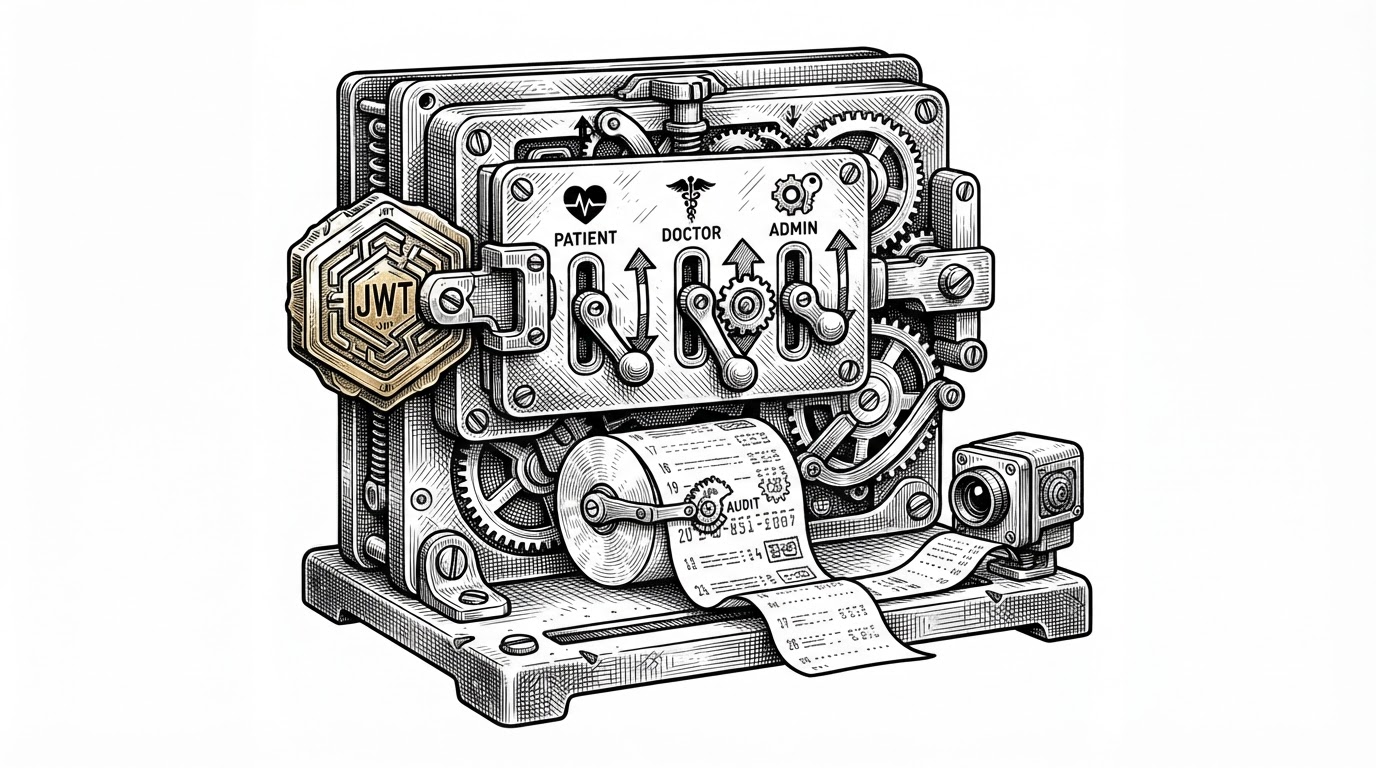
The backend stack makes that possible. The repository uses Spring Security with JWT, a layered controller-service-repository structure, and explicit route partitioning for `/api/admin/**`, `/api/doctor/**`, and `/api/patient/**`. That is a conservative security model, which is exactly what healthcare software needs.
The audit trail is just as important as the gate. If every login and data mutation is traceable, the system can answer a question that most dashboards cannot: who changed what, when, and under which role?
How the data model supports mixed ownership
A small schema choice tells you a lot about the product. The `MedicalRecord` entity allows `doctor_id` to be nullable, which means the system does not assume every record begins inside a clinic visit. Patients can bring data in first, then clinicians can attach context later.
| Ownership mode | What it means | Why it matters |
|---|---|---|
| Patient-first upload | A patient submits a record before a doctor sees it | Supports self-service intake and outside documents |
| Doctor-attached record | A clinician adds context or follow-up details | Keeps clinical workflow attached to the same object |
| Shared record with audit trail | Both sides can touch the record, but every change is logged | Preserves traceability without forcing a single origin story |
That is a useful model because healthcare data is messy. Not every useful document originates from a hospital system. By keeping ownership flexible and access strict, MedVault AI avoids the false choice between open intake and controlled workflow.
Why the AI layer matters more than it sounds
The AI side is not ornamental. `AIAnalyticsController`, `AIAnalyticsService`, and `GeminiAIService` suggest analytics for disease patterns, workload balancing, and chat-based assistance. The presence of `AIServiceFactory` also matters because it implies swappable intelligence backends, not a single hard-coded vendor path.
That structure turns AI into a service boundary instead of a novelty feature. If the rest of the system already enforces roles and auditability, then analytics can be useful without becoming a security leak or a product gimmick.
In practical terms, this is the shift from record system to decision system. A record system answers, “What happened?” A decision system tries to answer, “What should happen next?”
Reporting, prescriptions, and the unglamorous work of healthcare software
The repo also includes OpenPDF and Apache POI, which is a strong signal that the product is meant to leave the browser. Prescriptions, exports, and administrative reports are not glamorous, but they are where a healthcare app becomes operationally real.
| App type | Output | Operational value |
|---|---|---|
| Dashboard-only app | On-screen viewing | Good for browsing, weak for handoff |
| Document-generating system | PDFs and spreadsheets | Useful for clinics, admins, and records |
| MedVault AI | On-screen workflows plus generated documents | Bridges the gap between interaction and execution |
That matters because healthcare work rarely ends at the screen. Someone has to export the report, issue the prescription, or archive the result. MedVault AI is built with those boring but essential steps in mind.
How it compares to the open-source field
MedVault AI should not be read as a replacement for mature EHR platforms. It is a narrower project with a modern stack and a sharper product idea. That makes the comparison useful, because it shows where the repo is ambitious and where it is deliberately not trying to compete.
| Project | Primary stack | Scope | AI emphasis | Document generation | Likely audience |
|---|---|---|---|---|---|
| MedVault AI | Java 21, Spring Boot, React, MySQL | Focused healthcare management system | Built in | Yes | Developers and smaller healthcare teams |
| OpenEMR | PHP | Broad EHR and practice management | Limited | Yes | Clinics needing a mature platform |
| OpenMRS | Java | Modular medical record platform | Limited | Varies by implementation | Global health and implementation teams |
| GNU Health | Python, PostgreSQL | Public health and hospital management | Limited | Yes | Public health and institutional users |
| Bahmni | OpenMRS-based stack | Integrated hospital distribution | Limited | Yes | Hospitals and implementation partners |
The distinction is scope, not just stack. OpenEMR, OpenMRS, GNU Health, and Bahmni are broader and more mature. MedVault AI is lighter, more developer-friendly, and more explicit about combining role security with AI-assisted insight.
What this repo is really a blueprint for
The best way to read MedVault AI is as a pattern, not a finished enterprise suite. It shows how to structure a modern healthcare app around permission boundaries, audit logs, mixed ownership, document generation, and an AI layer that stays downstream of control.
That is a solid architectural instinct. In healthcare software, the hard parts are rarely the forms. They are trust, traceability, and the discipline to keep intelligence inside the fence. MedVault AI gets that part right.