Address_Book-C-: A Contact Manager That Teaches C the Hard Way, and the Right Way
A flat-file CLI address book that turns fixed memory, manual persistence, and careful input handling into a compact systems lesson.
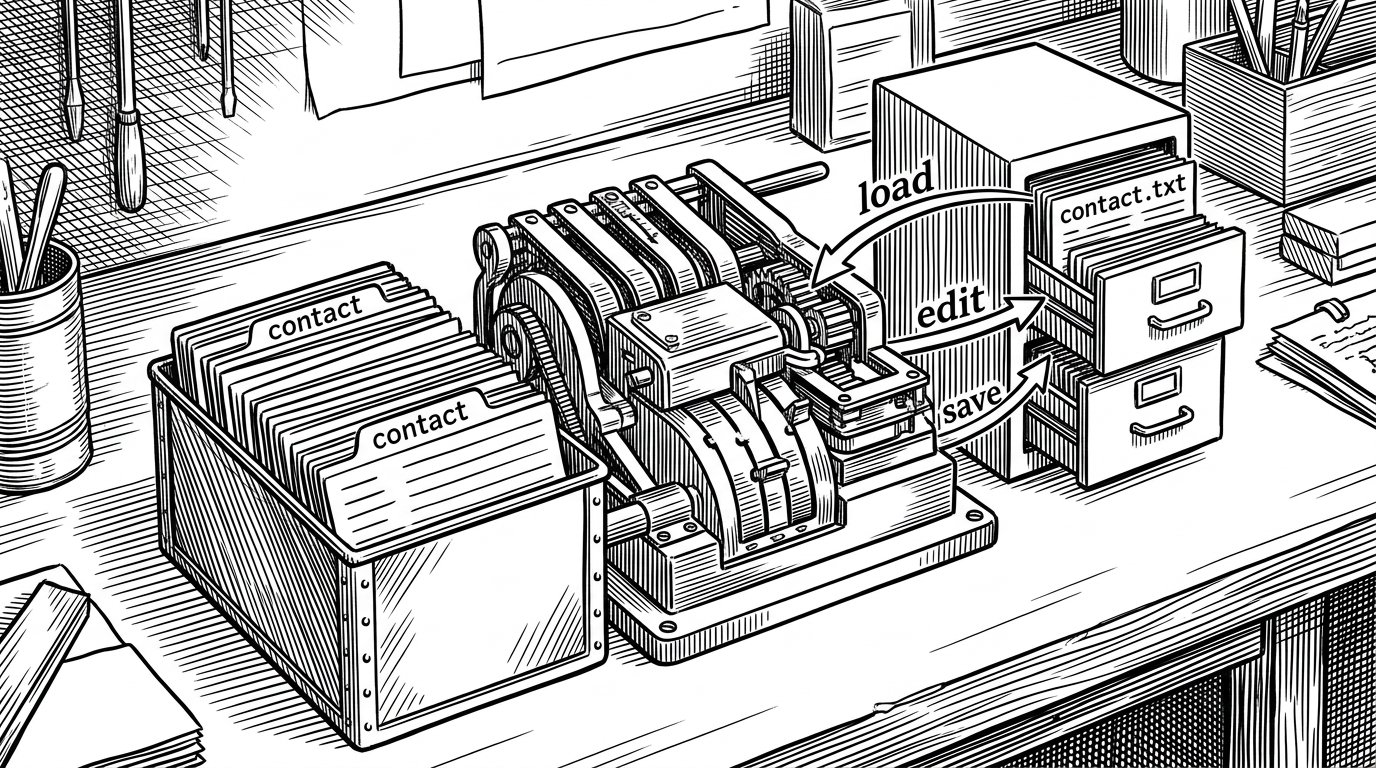
- The project’s main idea is not contact management, but constraint-driven design in C.
- Fixed-size memory and flat-file storage make the app predictable, bounded, and easy to reason about.
- The strongest product choice is search that handles duplicate names instead of pretending ambiguity does not exist.
- Validation and terminal polish make the program feel finished rather than merely functional.
Why a Simple Address Book Feels Like Embedded Systems
Most beginner CRUD projects reach for whatever is easiest: dynamic allocation, a library, a database, a quick framework. Address_Book-C- goes the other way. It keeps a fixed number of contacts in memory, stores them in a plain text file, and handles every mutation with explicit code.
That is why the repo is interesting. It is not trying to look modern. It is trying to make the rules visible: bounded storage, direct parsing, deliberate validation, and state that only changes when the program says it does.
The Core Data Model: Predictability Over Flexibility
The repo’s architecture starts with two structs: Contact and AddressBook. A contact stores fields like name, phone, and email. The address book stores a fixed array of contacts plus a count of how many are in use.
typedef struct {
    char name[50];
    char phone[20];
    char email[50];
} Contact;

typedef struct {
    Contact contacts[MAX_CONTACTS];
    int contactCount;
} AddressBook;
That design choice does two things at once. It makes the program fast and bounded, because every lookup walks a known amount of memory. It also makes the code easier to audit, because there is no heap allocation, no object graph, and no hidden ownership problem lurking in the background.
The tradeoff is obvious and intentional: MAX_CONTACTS is a ceiling, not a suggestion. This is not a scalable contact service. It is a small system that teaches you how to think before you optimize.
Persistence Is the Real Product
The most teachable part of the repo is not the menu loop. It is the persistence cycle. On startup, LoadContacts reads contact.txt into the in-memory address book. After create or edit actions, saveContacts rewrites the file from the current array state.
That architecture is simple, but it is not simplistic. The app separates runtime state from durable state. The user interacts with memory first. The file only matters at the boundaries, when the session begins and when it ends.
This is a strong teaching pattern because it exposes the full lifecycle instead of hiding it behind a database driver. You can see exactly where parsing happens, exactly when the file changes, and exactly how much state the program trusts at any moment.
How the file flow works
- Startup: read rows from contact.txt into AddressBook.
- Runtime: validate and mutate contacts in memory.
- Save: serialize the current array back to the flat file.
Search Is Where the Project Gets Smarter Than It Looks
A basic address book would stop at the first matching name. This one does not. The search flow collects multiple matches, then lets the user choose the right record when names collide. That is a small feature with a big implication: the author treated ambiguity as a real user problem.
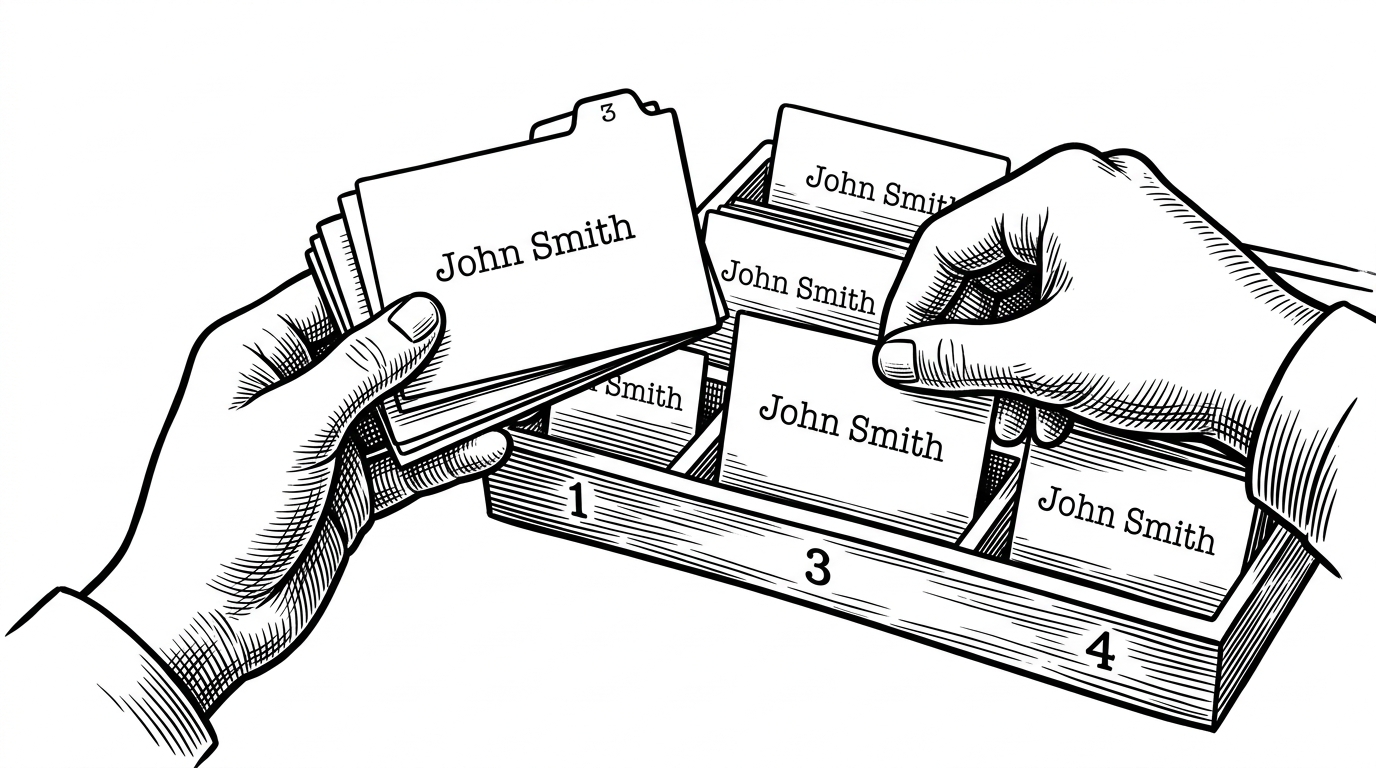
// Search returns multiple matches when names collide.
// The user chooses the correct contact from the list.
int searchContact(AddressBook *ab, const char *name) {
    int matches[MAX_CONTACTS];
    int matchCount = 0;

    for (int i = 0; i < ab->contactCount; i++) {
        if (strcmp(ab->contacts[i].name, name) == 0) {
            matches[matchCount++] = i;
        }
    }

    // present matches, then act on the chosen one
    return matchCount;
}| Dimension | Typical beginner CRUD app | Address_Book-C- |
|---|---|---|
| Storage | Often a database or dynamic list | Fixed-size array plus flat file |
| Memory model | Flexible, sometimes opaque | Bounded and explicit |
| Search | Usually first match wins | Multiple matches are surfaced to the user |
| UX | Functional first | Functional plus terminal polish |
| Scalability | Can be a selling point | Not the goal |
| Teaching value | Often abstract | Very concrete |
That table is the point in miniature. The repo is not competing with Google Contacts or a GUI address book. It is offering a tighter lesson: when the problem is small, you can make the rules legible enough to learn from.
Validation and Terminal UX Make It Feel Finished
The validation helpers do important work here. validate_name, validate_phone, and validate_email keep bad input out of the core data model. That matters because a program with bounded storage has less room to recover from sloppy data.
The UX helpers matter too. A loading animation built from simple terminal timing calls may seem minor, but it changes the tone of the tool. The app stops feeling like a classroom exercise and starts feeling like something a person would actually use.
That polish is not decorative. It signals that the developer understood a useful rule of terminal software: if the interface is plain, the feedback has to be precise.
What This Project Chooses Not to Be
This repo is not a cloud contact manager, not a GUI product, and not a scalable data platform. It does not try to hide its limits. Instead, it uses those limits to teach the shape of a clean C program.
That is why it works. A lot of student projects show that something can be built. This one shows how to think about the thing once it exists: where it lives, how it changes, how it survives a restart, and how the user finds the right record when reality gets messy.
| What it is | What it is not | |
|---|---|---|
| Purpose | A compact learning artifact | A production contact system |
| Architecture | Bounded memory and flat-file persistence | Distributed state or database orchestration |
| Audience | People learning disciplined C | Users expecting sync and multi-device features |
| Value | Systems thinking in a small package | Feature competition |