Containless: The Local-First Runtime Manager Built on PATH, Not Containers
How a TypeScript CLI turns project fingerprints into isolated runtimes, shadows global installs, and keeps developer machines fast without Docker.
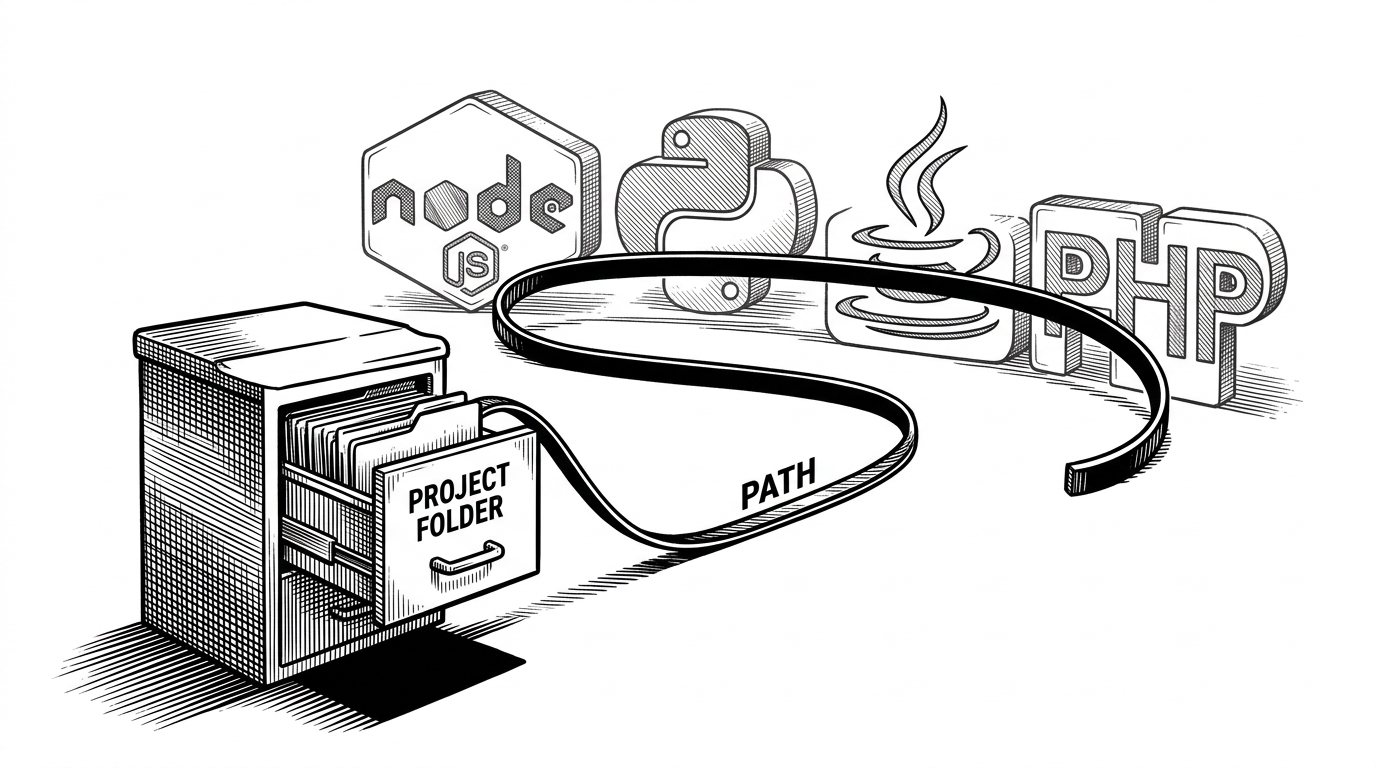
- Containless treats executable resolution as the real isolation layer, then uses PATH precedence to make project-local runtimes win without a container runtime.
- Its scanner is opinionated but practical, combining file fingerprints, package metadata, and fallback source-file detection to infer what a project needs.
- The runner is the center of gravity: it prepends local runtime bins, validates commands, and blocks unsafe shell patterns instead of handing execution to a shell.
- The project sits between version managers and containers, aiming for local-scoped orchestration rather than global switching or full virtualization.
The clever part of Containless is not that it installs runtimes. It is that it treats PATH like a local isolation boundary. If the right binary is first in line, the shell does the rest.
That sounds almost too simple, which is why the repo is interesting. Instead of asking developers to adopt a heavy container workflow or a global version manager, Containless scopes runtimes to the project itself and lets normal command lookup enforce the boundary.
The trick: isolation without a container
Containless starts from a blunt observation: most developer pain comes from conflicting executables, not from a need to virtualize the whole machine. Node 18 versus Node 22. Python 3.11 versus 3.12. Go installed globally, but not the one the repo expects.
The tool answers that with a local runtime cache and a runner that prepends project bins to PATH. That means the command you type resolves to the project-scoped runtime first, while the system install stays in the background as a fallback.
That is why the project feels more like a switchboard than a virtualization layer. It is organizing execution, not simulating a machine.
How Containless discovers what a project needs
The scanner is the repo’s first real opinion. It walks the project root and looks for fingerprints: .nvmrc, .node-version, go.mod, requirements.txt, package.json, and source files as a fallback.
The logic is deliberately layered. For Node, for example, the tool checks version files first, then package metadata, then falls back to source-file presence. That makes detection forgiving without becoming random.
// Simplified detection flow
const node = await detectNode(projectRoot)
const python = await detectPython(projectRoot)
const go = await detectGo(projectRoot)

if (!configExists) {
  await writeConfig({ node, python, go })
}

await installMissingRuntimes(config)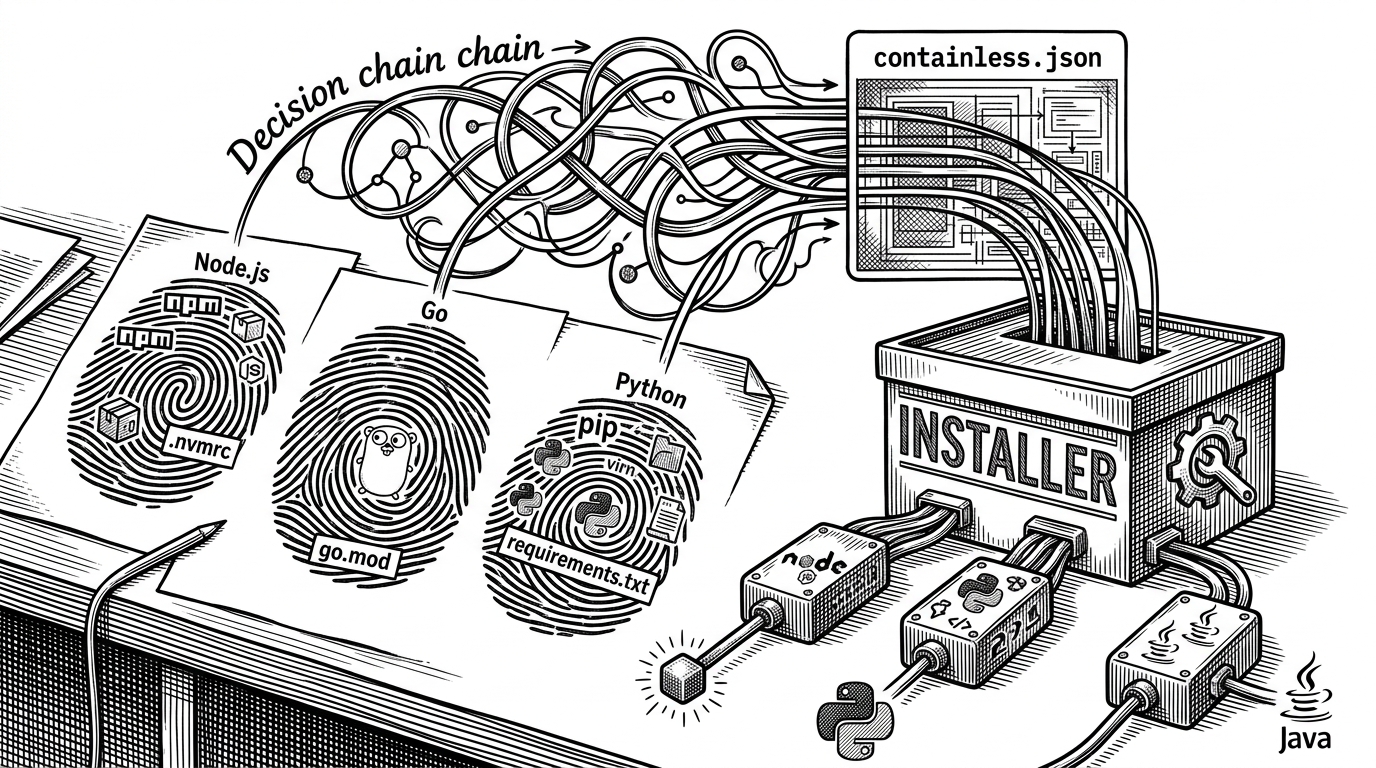
That fallback chain matters because it lowers the “blank repo” problem. A project does not need a perfect manifest to be legible. Containless can still infer a likely runtime and move.
The lazy-init config pattern makes that experience even smoother. If containless.json does not exist, the read path can trigger generation automatically, so the first useful action also becomes setup.
The installer is a language-specific bridge
Once a runtime is identified, the installer handles the awkward part: every language ships differently. Node arrives as archives. Python often wants a virtual environment. Java may need a distribution lookup. PHP on Windows brings its own practical landmines.
That is where Containless stops pretending the runtime ecosystem is uniform. The installer delegates to language-specific setup paths, including a Python virtualenv bootstrap and a Windows PHP php.ini fix so SSL does not break by default.
// Conceptual install flow
const info = getRuntimeInfo(language, version)
const url = resolveDownloadUrl(info)
const archive = await download(url)
await extract(archive, targetDir)

if (language === 'python') {
  await setupPythonVenv(targetDir)
}

if (language === 'php' && isWindows()) {
  await setupPhpIni(targetDir)
}
That is a useful design choice. The repo is not trying to erase the differences between runtimes. It is absorbing them at the edge so the developer does not have to think about them during everyday use.
Why the runner matters more than the installer
The installer gets attention because downloads feel concrete. The runner is more important. It is the part that makes Containless behave like a system, not just a cache.
Its job is to construct an execution environment where local runtime bins come first. Then it validates the requested executable and refuses to pass arbitrary shell strings through, which is the difference between a tool and a footgun.
That security posture is not decorative. The repo explicitly blocks shell metacharacters and uses allowlists so a shared config cannot become a shortcut to arbitrary code execution. In a CLI that runs project commands, that restraint is the feature.
| Dimension | Containless | Docker | nvm / pyenv style managers |
|---|---|---|---|
| Setup cost | Low. Project-local and automatic once detected. | High. Requires container images and orchestration. | Low to moderate. Fast to adopt, but mostly manual. |
| Isolation model | Executable resolution through PATH and local runtime bins. | Filesystem and process isolation through containers. | Global version switching across shells. |
| Runtime scope | Per project. | Per container or service boundary. | Per machine or shell session. |
| Speed and resource use | Lightweight and close to native. | Heavier. More overhead from the container stack. | Lightweight, but separate installs can pile up. |
| IDE friendliness | Strong. The repo includes VS Code integration. | Mixed. Often needs extra setup and volume mapping. | Varies. IDEs may still need extra configuration. |
| Security posture | Restrictive runner, allowlist, shell injection checks. | Strong isolation, but more moving parts. | Mostly operational, not execution-guarded. |
| Best use case | Local dev with conflicting runtimes and a desire to stay close to native tools. | Service parity and environment reproduction. | Simple runtime switching across projects. |
Containless does not replace Docker. It removes a different kind of friction. If your problem is running a whole stack in a controlled environment, Docker still makes sense. If your problem is "this repo needs a different runtime and I want it local," Containless is closer to the grain of the work.
The security trade-off is the point
There is a temptation to treat security measures in a developer tool as an afterthought. This repo does the opposite. It narrows what can run, blocks shell injection patterns, and avoids shell: true.
That means less magic and fewer convenience shortcuts. It also means fewer ways for a project config to turn into an execution primitive with surprising side effects. In local tooling, boring is often the right adjective.
The trade-off is that Containless asks you to stay inside its model. That is a fair price for a tool whose whole value proposition depends on predictable command resolution.
Where it sits in the local-dev stack
The cleanest way to think about Containless is as a middle layer. It is more automatic than a shell script, more local than a container, and more scoped than a global version manager.
That positioning matters because it explains both the appeal and the limits. It is best when runtime choice is the main problem. It is less interesting when you need service topology, network isolation, or production parity beyond the executable level.
| Tool | What it solves | What it keeps | What it leaves to you |
|---|---|---|---|
| Containless | Per-project runtime selection and command resolution. | Local files, local IDEs, native command flow. | Container-level isolation and infrastructure concerns. |
| Docker | Reproducible environments and service boundaries. | Strong isolation and deployment-like packaging. | Heavier setup, volume mapping, image management. |
| nvm / pyenv | Switching language versions across projects. | Simple runtime installs and shell integration. | Global scope, manual coordination across tools. |
| Ad hoc scripts | Custom local automation. | Total flexibility. | Consistency, security, and onboarding. |
That is a useful category to have. A lot of teams do not need a full container stack for every repo, but they do need something more disciplined than "install the right version and hope."
What this repo suggests about local tooling
Containless makes a broader argument: the hard part is often not isolation, but executable resolution plus per-project state. If you can detect the right runtime, install it locally, and put it first in line, you have solved most of the practical problem.
That is an appealing direction for local tooling because it is legible. Developers already understand folders, manifests, caches, and environment variables. Containless builds on those primitives instead of replacing them.
The result is a tool that feels conservative in the best way. It is not trying to redefine development. It is trying to make the path from project to command less noisy.