QuickServePOS: The Restaurant POS That Sends Only the Delta to the Kitchen
A .NET point of sale system built around real restaurant state, with audit trails, hybrid persistence, and an order lifecycle that prevents duplicate prep.
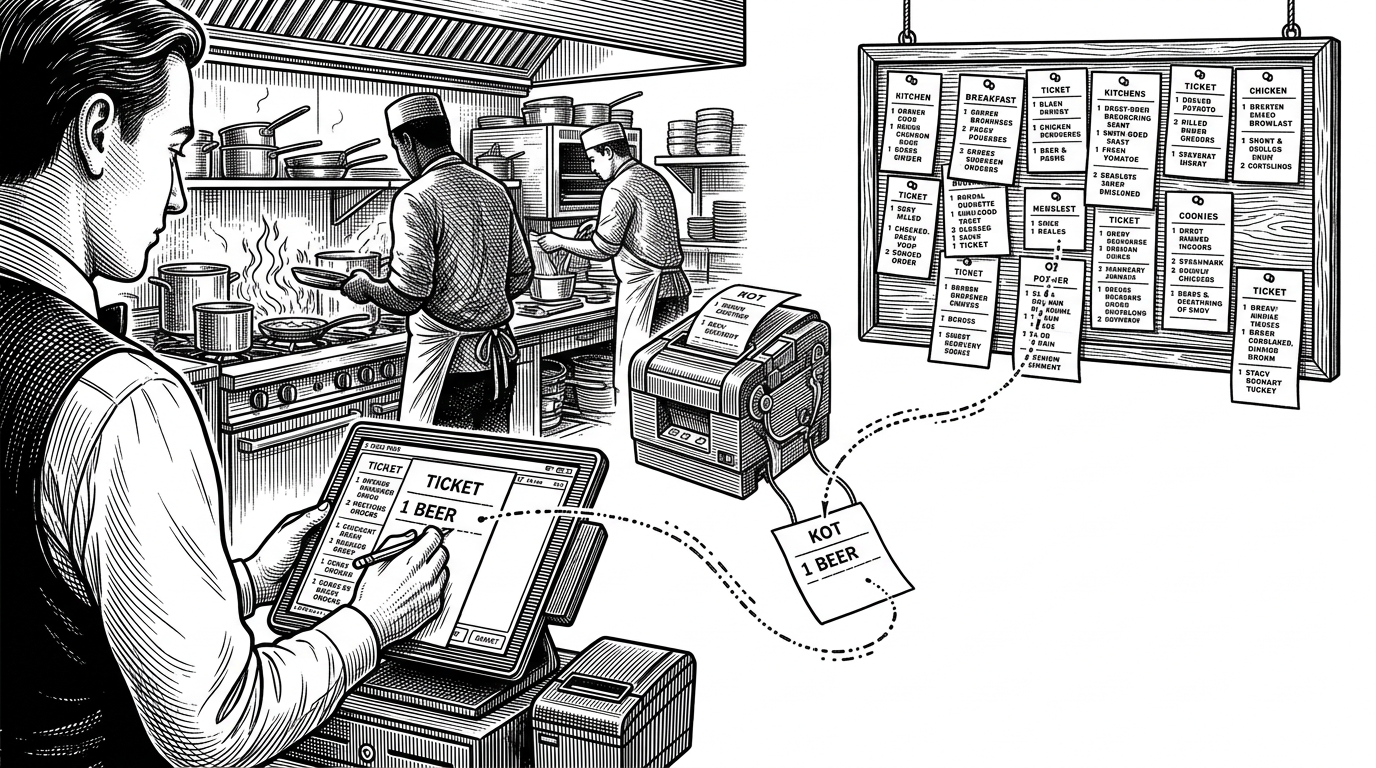
- QuickServePOS is most interesting because it treats order edits as deltas, so the kitchen only receives what has not already been confirmed.
- The repo’s strongest product idea is also its strongest domain model, with `Quantity` and `ConfirmedQuantity` turning a restaurant into a live state machine.
- Its architecture is pragmatic rather than flashy, combining EF Core, Dapper, audit fields, and layered validation to support real operational flow.
- Compared with ERP POS suites and legacy hospitality tools, the project is narrower but more explicit about how a restaurant actually works.
The small trick that changes everything
Most POS systems treat an order as a snapshot. QuickServePOS treats it as a living record of what has changed since the kitchen last saw it. That is the difference between sending a full ticket twice and sending only the delta.
The core idea is simple enough to explain in one line: Delta = Quantity - ConfirmedQuantity. If a table starts with two beers and a burger, the kitchen gets the full ticket. If the waiter adds one more beer later, the system sends only that extra beer.
Why restaurant software is really workflow software
Restaurants look like checkout software from a distance. Up close, they are a coordination problem. Tables move between states, orders change after they are sent, prep has timing constraints, and billing has to stay consistent with what the kitchen actually made.
That is why the most useful POS systems are not just sales tools. They are workflow engines with receipts attached. QuickServePOS leans into that reality instead of hiding it behind a generic cart model.
How QuickServePOS models the dining room
The repo’s model is built around a few connected entities: orders, order items, kitchen order tickets, and restaurant tables. Those pieces do not sit in isolation. They move together through a lifecycle that mirrors service on the floor.
| State | What it means | Operational effect |
|---|---|---|
| Available | The table is empty and ready. | The system can seat a new party. |
| Occupied | An order exists for the table. | Items can be added, edited, and tracked. |
| Served | The kitchen has completed the work. | The service flow is nearing closure. |
| Available again | The table has been cleared. | The cycle can begin again. |

The hybrid persistence layer
QuickServePOS uses a pragmatic split. EF Core handles the relational model and write paths. Dapper handles fast reads and report-like queries. That is not fashionable architecture. It is just the kind of compromise a real business system benefits from.
| Layer | What it is best at | Trade-off | Why it fits here |
|---|---|---|---|
| EF Core | Relationships and write-side consistency. | More abstraction overhead on complex reads. | Good for orders, tables, and transactional changes. |
| Dapper | Fast, direct SQL queries. | Less automatic mapping and more manual query work. | Good for dashboards and read-heavy screens. |
| Hybrid approach | Choosing the right tool per path. | More patterns to maintain. | Matches the mixed workload of a restaurant POS. |
The architecture suggests restraint. The repo does not try to make one persistence style solve every problem. It uses the slower, richer tool where the domain needs it and the faster, thinner tool where the screen only needs data.
The discipline behind the domain model
The codebase shows the kind of discipline that usually matters more than stack choice. `BaseEntity` carries audit fields. `SaveChangesAsync` fills timestamps automatically. DTOs and ViewModels stay separate. Validation is split between API-side and MVC-side models.
public override async Task<int> SaveChangesAsync(CancellationToken cancellationToken = default)
{
    foreach (var entry in ChangeTracker.Entries<BaseEntity>())
    {
        if (entry.State == EntityState.Added)
            entry.Entity.CreatedAt = DateTime.UtcNow;

        if (entry.State == EntityState.Modified)
            entry.Entity.UpdatedAt = DateTime.UtcNow;
    }

    return await base.SaveChangesAsync(cancellationToken);
}
That pattern does two things well. It keeps audit data consistent, and it keeps that concern out of the service layer. In a POS, that matters because every order edit and table transition becomes part of the business record.
Security and identity for a real business
The auth layer is also familiar in the best way. JWTs support API access. Refresh tokens support persistent sessions. Email verification keeps onboarding grounded. Nothing here is novel, but it is the right shape for a product that expects repeat users and role-based access.
This is another signal that the repo is thinking operationally, not just demonstratively. It is trying to behave like software a restaurant could actually run.
Where it sits in the POS landscape
The competitive picture is easy to read. ERP-backed systems like Odoo and ERPNext are broad and deeply integrated. Legacy hospitality tools like UniCenta and Floreant are durable and specialized. QuickServePOS sits between those worlds, with a modern .NET stack and a more explicit model of restaurant workflow.
| Project type | Primary strength | Typical trade-off | Fit for restaurant workflow | Stack feel |
|---|---|---|---|---|
| ERP POS | Breadth and business suite integration. | Heavy, broad, and sometimes opinionated. | Strong when POS is only one module among many. | Python or PHP enterprise suite. |
| Legacy hospitality POS | Proven durability and hardware support. | Older architecture and less modern ergonomics. | Strong on core front-of-house needs. | Java desktop-era feel. |
| QuickServePOS | Delta-aware order handling and clear domain modeling. | Narrower scope and smaller ecosystem. | Strong where order edits and kitchen coordination matter most. | Modern .NET application. |
| Generic web-native POS | Simple deployment and clean UX. | Often weaker on restaurant-specific workflow. | Good for checkout, weaker for kitchen nuance. | Frontend-first web stack. |
The point is not that QuickServePOS beats those systems on breadth. It does something more specific. It treats a restaurant like a live state machine, and that makes its workflow unusually legible.
What this repo suggests about the builder
The engineering signals are stronger than the public footprint. The model is disciplined, the workflow is specific, and the persistence choices are pragmatic. The weak signal is outside the code: there is little public context, and the repository metadata appears rough in places.
That combination is common in serious early systems. The interesting part is not polish for its own sake. It is whether the builder understands the domain well enough to encode the right constraints. QuickServePOS does.