agent-apprenticeship: Agent Apprenticeship Turns AI Agents Into Trainable Workers
Forsy-AI’s ecosystem treats every task run as a lesson: trace it, critique it, revise it, and feed the result back into a shared memory for future agents.
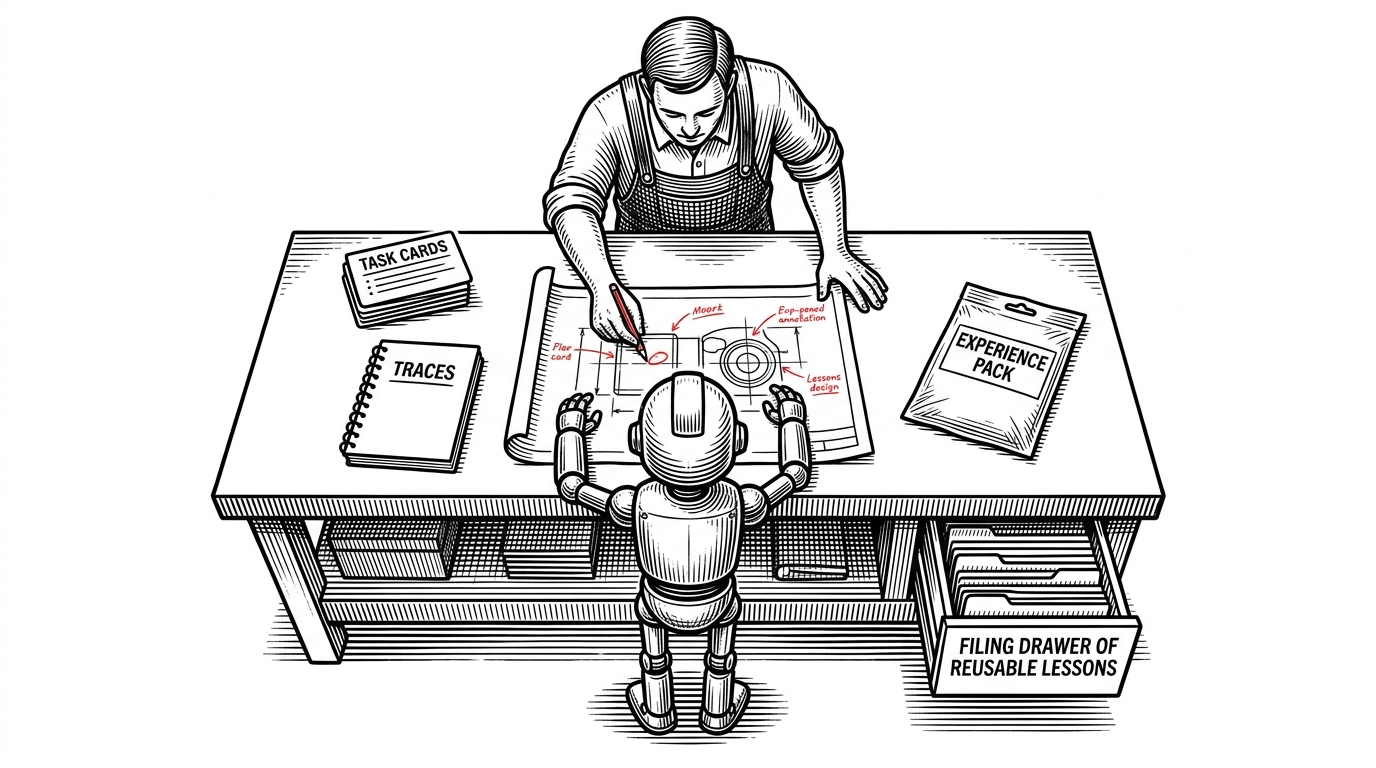
- Agent Apprenticeship treats the learning loop as the product, so the real artifact is not the answer but the trace, critique, and revision that can be reused later.
- The repo’s schema layer turns fuzzy agent behavior into governed data, which makes experience portable instead of trapped inside one run.
- Mentor modes make the system practical because the project is explicit about when supervision is model-assisted, expert-led, or hybrid.
- Compared with mainstream agent stacks, this project is less about building a smarter agent and more about building a memory layer for agent work.
Most agent frameworks chase autonomy. Forsy-AI/agent-apprenticeship chases teachability. That is the sharper bet, because real work rarely ends with one perfect response. It usually ends with a first attempt, a critique, a revision, and a record of what changed.
A living ecosystem where AI agents learn from real-world work through iterative workflow loops, reusable experience, and collective training signal exchange.
The machine does not just solve tasks. It stores the lesson.
That sentence is the project’s real thesis. A completed run only matters if it can be turned into training signal, and a training signal only matters if it can be reused by the next agent. The repo is trying to make experience a first-class asset, not a side effect.
That is why the repository reads less like a demo and more like a labor system. Its vocabulary is deliberate: tasks, traces, mentor critique, revised attempts, experience packs, and ecosystem contributions. The project is not asking whether an agent can do the work. It is asking whether the work can teach another agent to do it better.
What an apprenticeship loop actually looks like
The workflow is simple enough to explain in one breath. An apprentice agent starts with a task, produces a baseline attempt, gets mentored, revises, and then packages the result into a contribution bundle. What looks like a standard run is actually a multi-stage record of learning.
npx agent-apprenticeship init
npx agent-apprenticeship run
npx agent-apprenticeship bundle
That CLI shape matters because it lowers the cognitive load. You are not wiring up a bespoke research pipeline or inventing your own evaluation format. You are stepping into a contract: run work, capture traces, produce critique, publish the lesson.
The schema layer is the real product
The most consequential files in the repo are not the flashy ones. They are the JSON schemas. seed_task.schema.json and contribution_bundle.schema.json define what counts as a valid task, a valid trace set, and a valid learning artifact. That is governance, not decoration.
| Schema | Role | What it protects | Why it matters |
|---|---|---|---|
| seed_task.schema.json | Defines the task record | Trace counts, paths, and task metadata | Makes every run measurable and comparable |
| contribution_bundle.schema.json | Defines the reusable output | Traces, mentor checkpoints, follow-ups, manifest | Turns raw work into a portable learning unit |
| attempt_manifest.json | Documents a specific run | Inputs, exclusions, refs, learning signals | Preserves provenance without leaking messy local context |
This is the part of the project that feels closest to infrastructure. Schemas keep the system honest. They make it possible to exchange work between agents, compare attempts across tasks, and preserve provenance without collapsing into a pile of logs.
Why revision is the signal
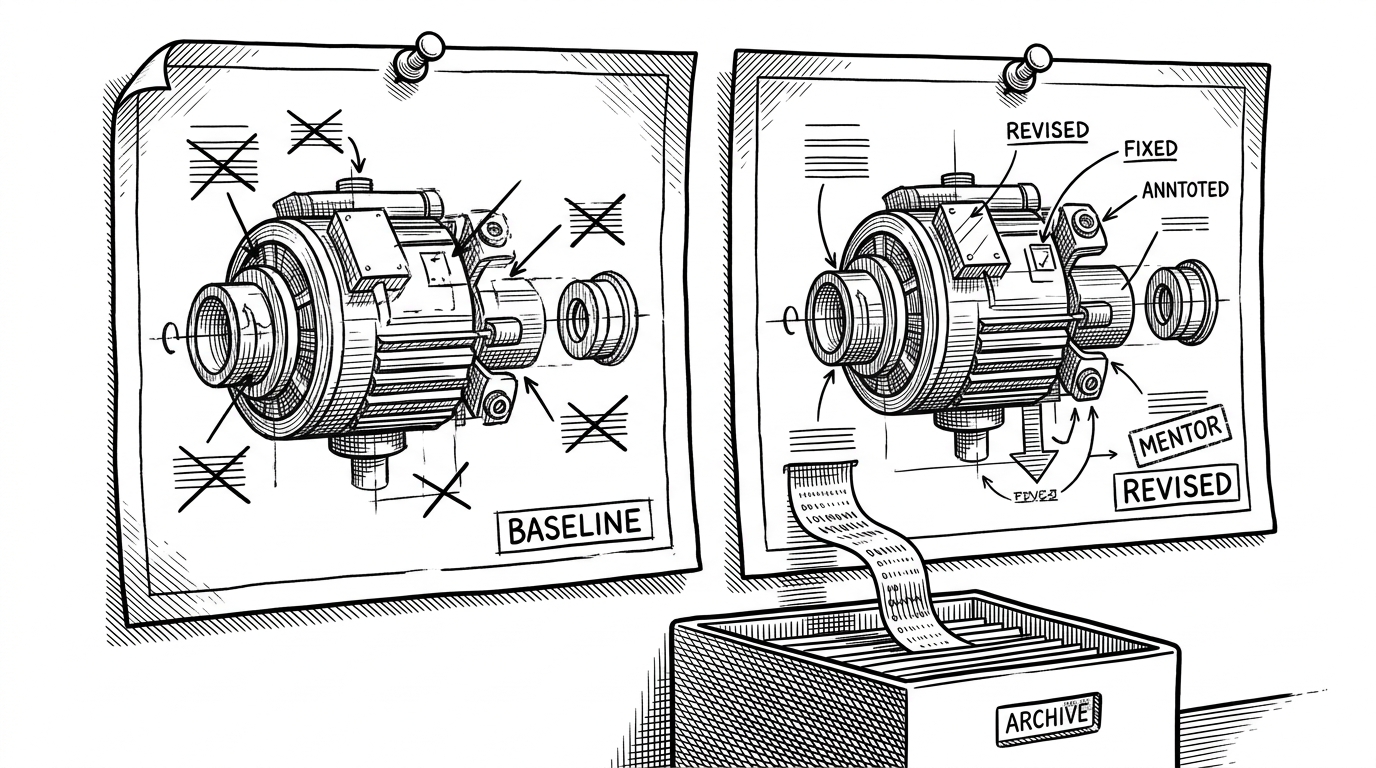
This is the repo’s strongest move. It does not pretend the first answer is enough. It promotes the delta between baseline and revision to the thing that matters, because that is where supervision, error analysis, and reuse all begin.
There is a practical reason this is more credible than one-shot agent theater. Most interesting work is not solved in a single pass. The project acknowledges that reality and converts iteration into structure instead of treating it as a mess to hide.
Mentor modes make the system practical
| Mode | Who supervises | Best at | Trade-off |
|---|---|---|---|
| model-assisted | A stronger model | Fast, repeatable critique | Can miss domain nuance |
| expert-led | A human expert | High-quality judgment | Costs more attention |
| hybrid | Model plus human | Balanced throughput and accuracy | Needs coordination |
The mentor modes matter because they make the project honest. It does not assume humans are unnecessary, and it does not assume every task deserves expert attention. Instead, it offers a range of supervision styles that map to different kinds of work.
That is a good sign. It suggests the repo is thinking about operational reality, not just model capability. A learning system is only useful if supervision can scale with the task, the team, and the stakes.
The dataset is the proof
The repository is not just a framework. It includes a seed dataset with many task attempts, manifests, traces, and learning signals. That gives the project a second identity: it is also a data product, with structure already baked into the corpus.
That matters because learning systems need evidence. If the repo only described a workflow, it would be aspirational. Because it already contains baseline and revised attempts, excluded references, and structured artifacts, it behaves like a working archive of agent labor.
How it compares to mainstream agent stacks
| Project | Primary goal | Learning model | Human supervision | Best use case |
|---|---|---|---|---|
| Agent Apprenticeship | Turn work into reusable experience | Baseline, critique, revision, bundle | Built in | Training an ecosystem of agents |
| LangChain | Build LLM-powered apps | Developer-defined | Optional | General agent and app composition |
| AutoGPT | Autonomous goal seeking | Task decomposition and tool use | Optional | Autonomous demo workflows |
| BabyAGI | Minimal task execution loop | Prioritize and execute tasks | Optional | Simple agent experiments |
| Semantic Kernel | LLM integration SDK | Pluggable skills and functions | Optional | Enterprise app integration |
| OpenAI Assistants API | Managed assistant platform | Persistent threads and tools | Platform-controlled | Hosted assistant workflows |
The comparison is not about feature count. It is about category. Most mainstream stacks help you build agents. This repo is trying to turn agent work into a reusable training economy. That is a different layer of the stack, and a more opinionated one.
If the project succeeds, the value will not come from a smarter prompt or a better wrapper. It will come from a shared memory of what worked, what failed, and what changed on the way to a better result.
The bigger bet: collective memory for agents
That is the real strategic claim here. Agent quality may improve less through isolated model upgrades than through structured exposure to prior work. The repo is betting that future agents will get better by absorbing lessons, not just outputs.
That makes the project feel unusually grounded for an AI repo. It replaces the fantasy of perfect autonomy with something more durable: apprenticeship, supervision, and accumulation. In a field full of one-shot demos, that is a serious idea.