OOSDK_LibLncUtil: The PS4 Wrapper That Turns a TitleID Into OS-Level Control
A compact OpenOrbis C library that scans the system, resolves AppIDs, loads internal modules on demand, and lets homebrew software act like a first-class launcher.

- OOSDK_LibLncUtil is interesting because it turns a TitleID-first workflow into a system-control workflow.
- The wrapper hides the unpleasant parts of PS4 homebrew, including module loading, filesystem discovery, and handle validation.
- Its value is not raw power alone, but the fact that it compresses several low-level steps into one repeatable API.
- The project looks more like infrastructure for other tools than a finished end-user product.
The strange power of a TitleID
Most utility libraries hide complexity. This one hides system-adjacent control. With OOSDK_LibLncUtil, a developer can start from a familiar PS4 TitleID such as CUSAxxxxx and still launch, suspend, resume, focus, or inspect an app. That is the real hook: not a wrapper around a library, but a wrapper around a piece of the operating system’s own behavior.
From string to AppID: the bridge that matters
The important move is simple to describe and nontrivial to implement. The caller provides a TitleID, the library discovers installed titles, resolves that identifier into an internal AppID, and then performs the requested action. That middle layer is the whole point of the repo. It converts an awkward multi-step PS4 workflow into a single intent-driven call.
That workflow shows up in helpers such as getTitleIdList and getAppIdByTitleId. The caller never has to care how the lookup happens, only that the lookup works. In practice, that means code that reads like policy: launch this title, suspend that one, ask whether this process is already live.
What the wrapper hides
The header exposes both low-level sceLncUtil... functions and higher-level helpers like launchAppByTitleId. That split matters. The low-level calls expose the PS4’s native vocabulary. The higher-level calls hide the ugly conversion work and make the API usable by someone who does not want to think in handles all day.
The implementation quietly handles bootstrapping too. Almost every public path funnels through initialize(), which ensures the required system modules are available before the wrapper tries to do anything meaningful. That is the part most desktop developers never see. On PS4 homebrew, the environment is not simply there. It has to be made ready.
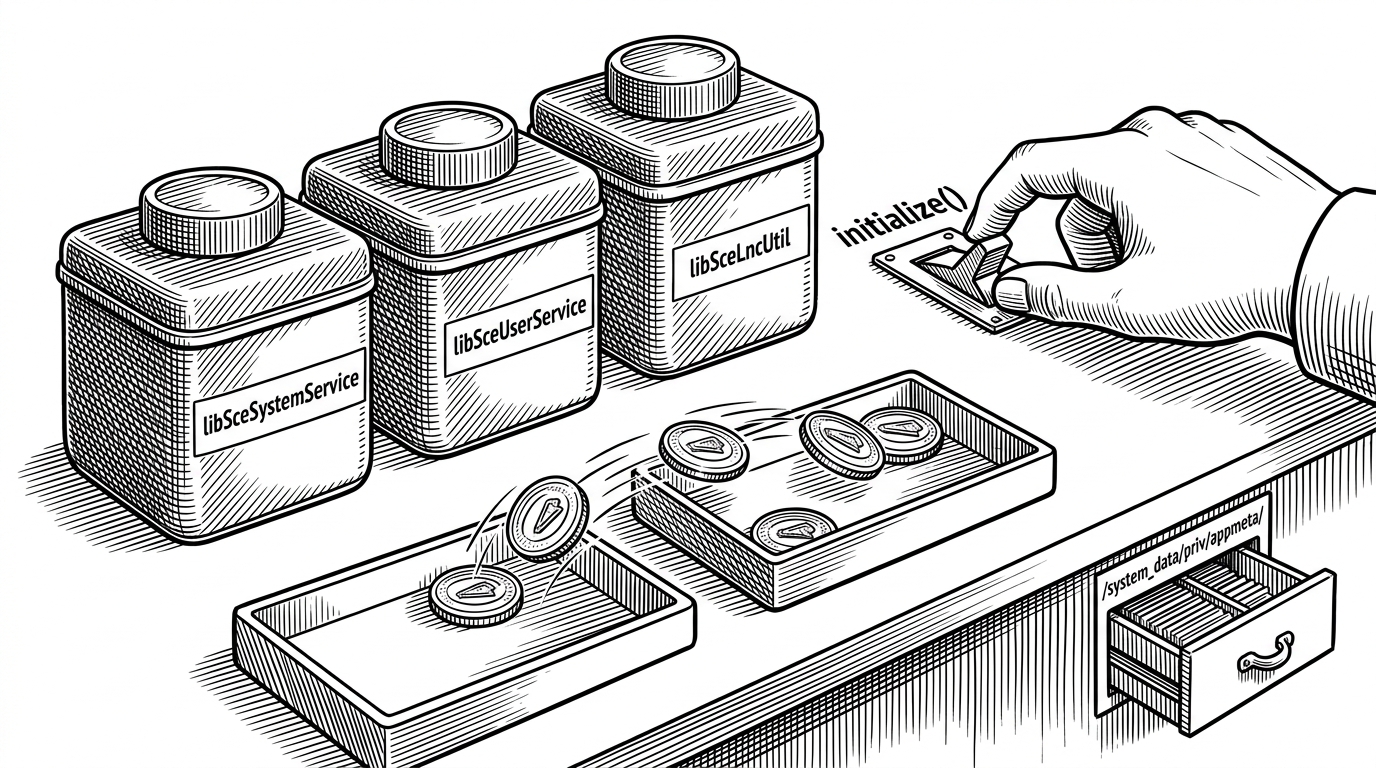
The part most PC developers never see
On a normal desktop, shared libraries feel automatic. Here, they are not. The wrapper explicitly loads internal modules such as libSceSystemService.sprx, libSceUserService.sprx, and libSceLncUtil.sprx before the useful calls can happen. That makes the library feel OS-like, even though it is still just a small C layer on top of Sony’s internal plumbing.
static bool initialize(void) {
    if (initialized) return true;

    sceKernelLoadStartModule("libSceSystemService.sprx", 0, NULL, 0, NULL, NULL);
    sceKernelLoadStartModule("libSceUserService.sprx", 0, NULL, 0, NULL, NULL);
    sceKernelLoadStartModule("libSceLncUtil.sprx", 0, NULL, 0, NULL, NULL);

    initialized = true;
    return true;
}
How it finds installed titles
The library does not guess. It crawls the filesystem. In the research snapshot, that means looking through paths such as /system_data/priv/appmeta/ and /system/vsh/app/ with the usual opendir and readdir loop, then building a dynamic list as it goes. The point is not elegance. The point is to discover what the system already knows.
// Conceptual sketch of the discovery flow
DIR *dir = opendir("/system_data/priv/appmeta/");
while ((entry = readdir(dir)) != NULL) {
    if (looks_like_title_id(entry->d_name)) {
        push_title_id(&list, entry->d_name);
    }
}
freeTitleIdList(list);
That dynamic array pattern matters because installed titles are not a fixed-size problem. The code expands as needed, then frees cleanly when it is done. It is a small detail, but it signals a library written to survive real system state rather than a demo that assumes everything will be neat.
| Task | Raw system reality | Wrapper behavior | Benefit |
|---|---|---|---|
| Launch by title | Find the title, resolve an AppID, then call the right internal functions. | Call one helper with a TitleID. | Less ceremony, fewer failure points. |
| Find installed apps | Walk system directories and assemble a list manually. | Expose a reusable discovery helper. | The lookup becomes reusable instead of one-off code. |
| Suspend or resume | Work with internal handles and state checks. | Accept a title-centric or AppID-centric call path. | The calling code stays readable. |
| Check whether a process is live | Inspect state bits and validate the handle shape. | Use a dedicated helper such as is launched checks. | The validation logic stays centralized. |
| Load required modules | Explicitly start internal .sprx modules first. | Hide that bootstrap in initialization. | The rest of the code can assume a ready environment. |
Why this is safer than hand-rolling the system calls
Safer here means less error-prone, not magically secure. When a wrapper centralizes handle checks, module loading, and cleanup, you remove repeated decision points from every caller. That matters in a system where a wrong assumption can turn into a broken launch flow or a dangling resource.
The code’s bitwise validation in sceLncUtilIsAppLaunched is a good example. The wrapper is not just forwarding calls. It is encoding the rules for what counts as a valid launched app and keeping that rule in one place. That is a real abstraction, not just a different function name.
Maturity: a useful tool, not a finished platform
This repo reads like a useful utility in active development. One function is explicitly marked unimplemented in the research notes, and the launch path appears incomplete in the provided snippet. That does not weaken the article’s premise. It sharpens it. This is infrastructure code, not a polished consumer app.
That distinction matters. The project is best understood as leverage for other tools. It gives homebrew developers a stable way to speak in TitleIDs while leaning on internal PS4 behavior under the hood. The library’s size is the clue. Small code, outsized control.
The deeper pattern: wrappers as leverage
Open-source reverse engineering usually matures the same way. First comes raw knowledge of the system. Then comes a wrapper that makes that knowledge usable. Then, eventually, that wrapper becomes the foundation for another tool. OOSDK_LibLncUtil sits at that second step, where utility starts turning into infrastructure.
That is why the project is worth attention even if it is tiny. It shows how a title-driven API can make a PS4 feel less like a locked box and more like a system with commands. The code does not remove the complexity. It hides just enough of it to let a developer move faster.