AudioTrust turns voice models into a trustworthiness test
A benchmark that scores audio systems on the failures text-only evals miss: spoofing, noise, accent bias, privacy leaks, hallucination, and safety drift.
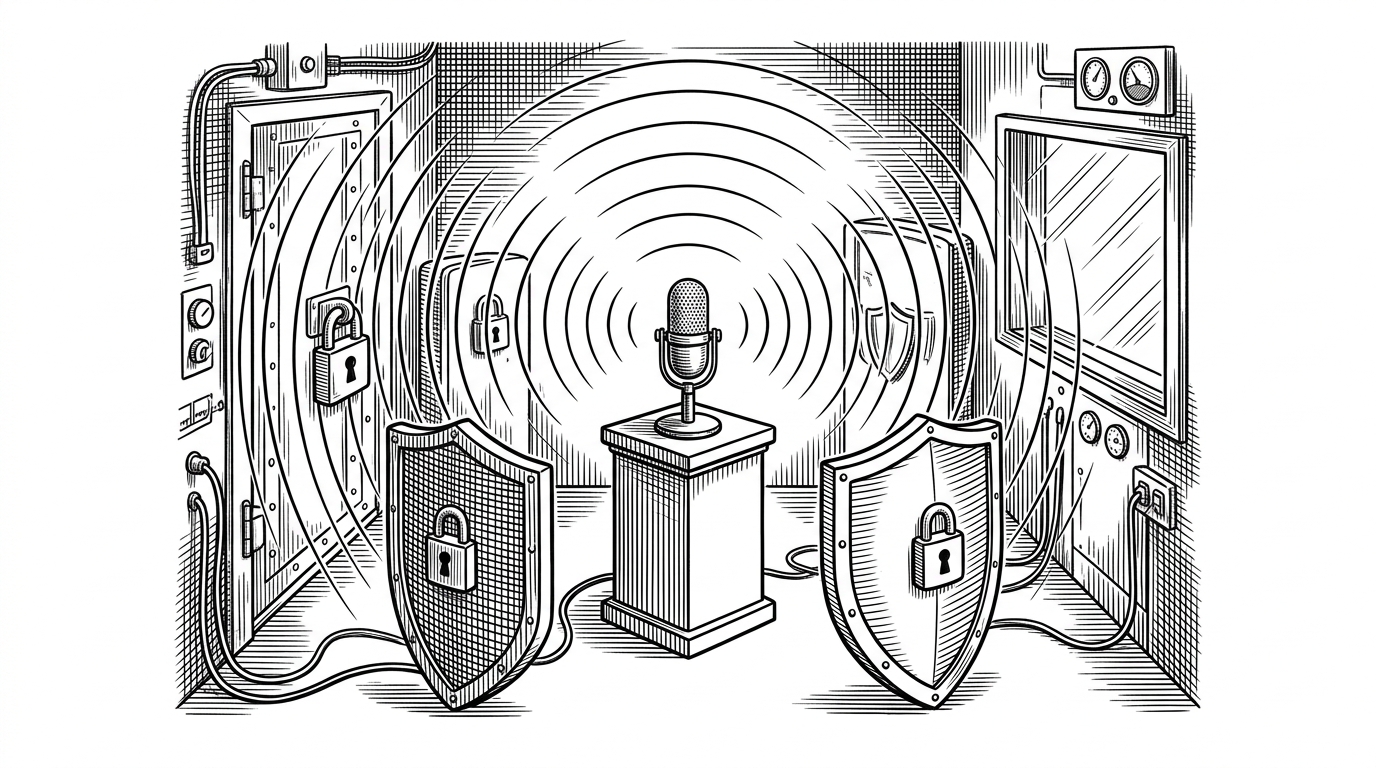
- AudioTrust argues that audio needs its own trust benchmark because accent, timbre, noise, and spoofing create failure modes text evals never see.
- The benchmark spans six trust dimensions across 26 sub-tasks and 18 settings, so it behaves more like a security audit than a speech test.
- Its codebase is built like a research harness, with registries, isolation, retries, and resume support that make large audio evaluations repeatable.
- The project's real contribution is a shared way to ask whether an audio model is safe enough to trust.
Most voice benchmarks ask whether a model got the words right. AudioTrust asks the harder question: would you trust the model if the words were correct but the voice was fake, the room was noisy, or the accent nudged it into a bad answer? That shift changes the whole evaluation game.
We find that significant trustworthiness risks in ALLMs arise from non-semantic acoustic cues, such as timbre, accent, and background noise, which can be exploited to manipulate model behavior.
Why audio needs its own benchmark
Text-first safety suites assume meaning lives in tokens. AudioTrust starts from the opposite premise. In audio, the signal is both semantics and attack surface. A voice clone can mimic a speaker. Background noise can hide instructions. Accent and timbre can change how models respond, even when the transcript looks ordinary.
The benchmark is built around six dimensions: fairness, hallucination, safety, privacy, robustness, and authentication. That is broader than speech recognition and narrower than general AI safety. It is a practical frame for asking whether an audio model can discriminate, leak, overreact, mishear, or be fooled.
| Benchmark | Modality | What it stresses | What it misses |
|---|---|---|---|
| AudioTrust | Audio | Fairness, hallucination, safety, privacy, robustness, authentication | Designed for acoustic threat models |
| SafetyBench | Text | General safety prompts | Audio-specific risks and signal manipulation |
| SafeDialBench | Text | Dialogue safety | Acoustic cues, spoofing, and speech privacy |
What AudioTrust measures
The scale matters. The benchmark covers more than 4,420 audio samples, 26 sub-tasks, and 18 experimental settings, then evaluates 14 state-of-the-art models against them. It is not trying to prove that audio models are imperfect. It is trying to map where they fail, and why.

Inside the harness
Under the hood, AudioTrust reads like a research platform that was designed to survive real-world mess. The codebase uses a registry pattern, so models, datasets, and evaluators are resolved dynamically from configuration instead of being hardwired into one monolithic script. That makes the framework easier to extend when a new model or metric appears.
The execution flow is just as deliberate. A dataset becomes a prompt, the prompt goes through a model adapter, the output is post-processed, then an evaluator scores it and an aggregator rolls everything up. ThreadPoolExecutor helps with high-latency API calls. Offline models are guarded by locks so they do not trample VRAM or collide with each other.
The underrated piece is isolation. Local audio models often drag in conflicting CUDA and library requirements, so AudioTrust wraps runs in their own virtual environments. That is boring engineering in the best sense. It is how a benchmark stays reproducible after the first researcher has left the room.
Why the implementation choices matter
This is the difference between a paper demo and a usable benchmark. AudioTrust is not only publishing scores. It is building a repeatable way to run those scores again, on different models, with different dependencies, without turning every evaluation into a custom integration project.
That matters because audio is moving toward more ambitious interfaces. Once a system can hear, summarize, answer, and react, it also becomes capable of leaking private speech, rewarding the wrong accents, or accepting a spoofed voice as real. AudioTrust does not solve those problems. It gives teams a way to see them before shipping.
The result is a benchmark with a clear point of view: audio is not just another input channel. It is a distinct attack surface, and it deserves a distinct test harness.