rl_directional_straddle: Teaching an AI Trader to Obey the Market
`rl_directional_straddle` is a deep RL options system for NIFTY50 that masks invalid actions, simulates margin pressure, and treats survivability as part of the objective.
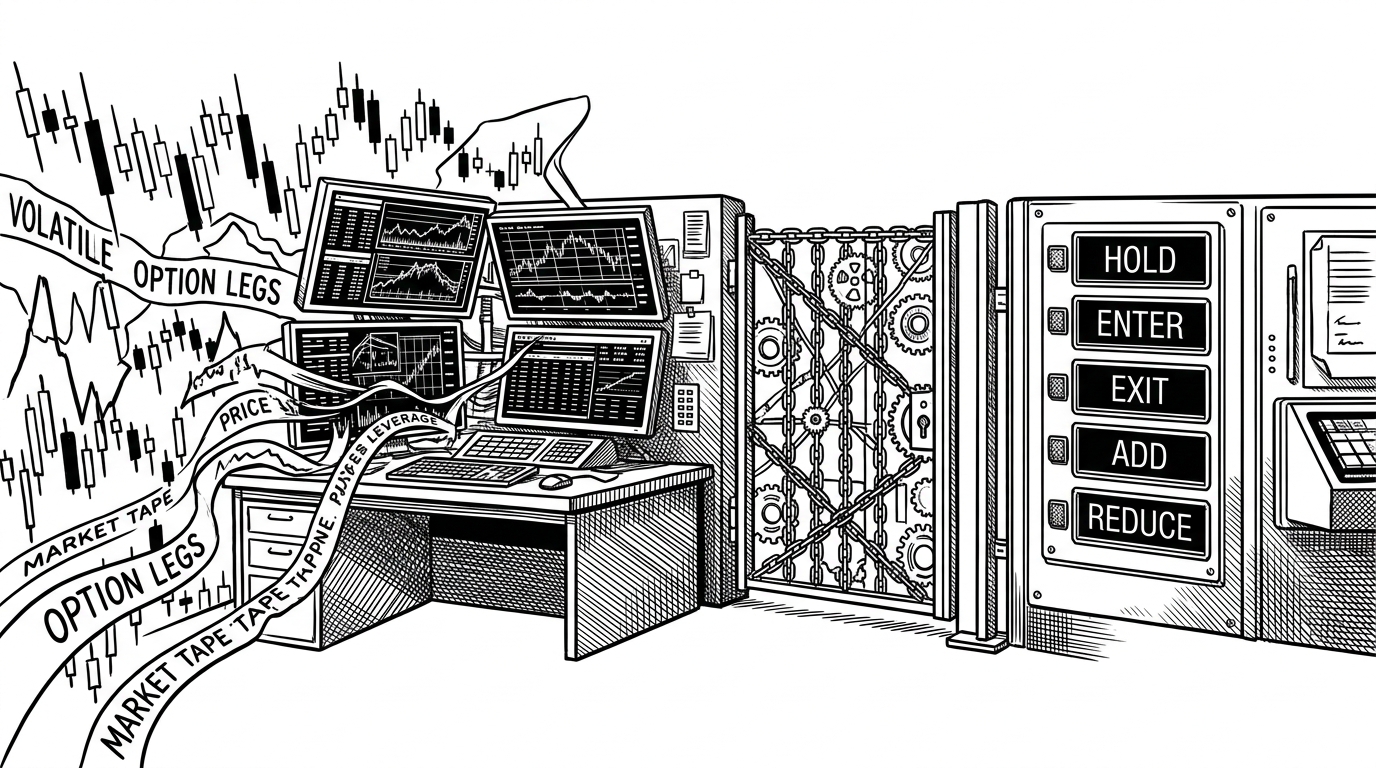
- The repo’s real innovation is not that it trains an agent to trade options, but that it makes the agent obey exchange-like constraints before it can act.
- Action masking turns invalid trades into impossible ones, which is cleaner than teaching the model to regret bad moves after the fact.
- Multi-horizon reward shaping pushes the policy toward patience, so it can avoid both frantic overtrading and frozen inaction.
- Explainability and walk-forward validation are not garnish here, they are the only way to tell whether the agent learned a strategy or a shortcut.
The Market Says No First
Most RL trading projects start with the model. This one starts with the market’s refusal. The agent is not allowed to wander through a fantasy exchange where leverage is free and every trade is legal. It has to operate inside margin rules, position limits, and option-specific constraints that make the environment feel closer to a desk than a toy simulator.
That matters because options are not just another asset class. A directional call on NIFTY50 can become a position in volatility, theta decay, and margin exposure in the same minute. If the environment ignores those frictions, the policy learns a story that cannot survive contact with the tape.
Why Options RL Is Harder Than Stock RL
A stock trader can often get away with a simpler loop: observe price, choose buy or sell, learn from PnL. A straddle or strangle is more demanding. The agent has to manage multi-leg exposure, the effect of implied volatility, and the capital cost of holding or adding to a position. One bad assumption about margin can turn a clever policy into a backtest artifact.
That is why the repo leans on a Gymnasium-style environment rather than a standard supervised pipeline. The environment is the market model. It defines what can be seen, what can be done, and what each choice costs.
Inside the Environment: 69 Features, 8 Actions, 1 Capital Constraint
The core environment lives in envs/intraday_option_env_maskPPO_v3.py. It ingests 1-minute OHLC data plus India VIX, then expands that stream into a 69-feature observation vector through the feature calculator. That makes the state much richer than a simple price series. It includes volatility estimates and option-specific signals that matter when the asset itself is a derivative of another asset.
The action space is discrete and compact: hold, enter, exit, add, and reduce across call and put legs. That sounds small, but in options it is enough to express a useful trading grammar. The environment also models SPAN-like margin behavior, so a short position is not just a line item. It is a live constraint that affects whether the next action is even possible.
# Conceptual shape of the environment
observation = 69  # features from price, volatility, Greeks, and market context
action_space = 8   # hold, enter, exit, add, reduce across CE / PE legs

# The environment checks capital and position state before execution
if not enough_margin or position_limit_hit:
    action = mask_invalid_action(action)

reward = blended_reward(pnl_1m, pnl_30m, pnl_120m)
This is the important shift. The repo is not asking an agent to predict a label. It is asking a policy to navigate a simulated trading desk where every action has a balance sheet consequence.
The Trick: The Policy Never Sees Invalid Moves

| Approach | Invalid actions | Constraint handling | Options-specific realism | What it optimizes for |
|---|---|---|---|---|
| Plain PPO | Policy can sample illegal moves | Usually punished after the fact | Low | Shortcut learning |
| MaskablePPO in this repo | Illegal moves are removed before sampling | Enforced at the action layer | High | Legal, capital-aware decisions |
| General RL trading framework | Often generic or extensible | Depends on the user | Medium | Broad experimentation |
| Traditional options bot | Usually rule-based or signal-driven | Often external to the model | Varies | Directional signal quality |
That difference sounds technical, but it changes the learning dynamics. If the model can never choose an invalid move, it stops wasting updates on nonsense. The agent spends its capacity learning when to wait, when to enter, and when not to scale a position further.
Reward Shaping Is How the Agent Learns Patience
The repo uses blended reward horizons. Instead of only scoring the next minute, it mixes 1-step, 30-step, and 120-step outcomes. That creates a stronger signal for timing. A policy that grabs tiny gains every minute can look busy while doing poorly. A policy that never moves can look safe while missing the entire opportunity set.
Multi-horizon reward shaping fights both failure modes. The short horizon catches immediate execution quality. The medium and longer horizons push the policy to care about follow-through, drawdown, and whether a position survives the next stretch of noise. In practice, that is how you teach a trader to hold through turbulence without turning into a perpetual holder.
This is one of the more subtle parts of the design. The system is not rewarding bravery. It is rewarding disciplined persistence under uncertainty.
Why the Dashboard Matters
The explainability layer is not decoration. In a domain with Greeks, implied volatility, and hidden margin interactions, a policy that only prints PnL is not enough. The repo’s dashboard and SHAP analysis try to answer a narrower, better question: which features were actually driving the decision at this moment?
That matters especially in out-of-sample testing. A strategy can appear sharp in a backtest because it learned a quirk in one market regime. Feature-level attribution and walk-forward reporting are the first steps toward noticing when the model is seeing risk, not just noise.
What This Project Is Really Building Toward
This is a research-grade architecture, not a polished trading product. But it is pointed in an interesting direction. The repo suggests a template for constraint-aware financial RL systems: encode legality in the action space, encode patience in the reward, and encode trust through explainability.
Compared with broad frameworks like FinRL or TradeMaster, this project is narrower and more opinionated. That is a feature. It is not trying to cover every asset class or every agent. It is trying to make one difficult market problem honest enough that an RL policy can actually learn from it.
| Project type | Strength | Weakness | Best use case |
|---|---|---|---|
| General-purpose RL framework | Broad coverage and community tooling | Often abstracted away from exchange detail | Fast prototyping across many assets |
| Traditional options bot | Simple execution logic | Can miss capital realism and learning dynamics | Rule-based deployment |
| This repo | Options-specific constraints and legal action masking | Narrower scope and higher domain complexity | Research into constraint-aware intraday trading |