self-learning-skills Turns Agent Mistakes Into Repo-Resident Wisdom
A meta-framework that teaches coding agents to harvest golden paths, reject lucky guesses, and write only the lessons worth keeping.

- This repo turns successful debugging into versioned instruction files, so future sessions inherit proven workflows instead of re-discovering them.
- Its central discipline is a promotion gate that refuses lucky guesses and only preserves lessons backed by a green build, a named failure, and a ruled-out dead end.
- The project is less a memory layer than a triage system, separating durable skills from one-line facts and one-off skips.
- Its real bet is that coding agents should maintain their own playbooks the same way teams maintain CI, Dockerfiles, and repo conventions.
The strange idea at the center of the repo
Most agent memory tools ask a simple question: what should we retrieve later? self-learning-skills asks a sharper one: what deserves to survive at all? That shift matters because the average coding session is full of false positives, local quirks, and lucky guesses that should die with the run.
I built self-learning-skills because I noticed my agents often spent time poking around and guessing at things I had already solved in previous runs. I used to manually copy-paste those fixes into future prompts or backport them into my skills. This repo streamlines that workflow.
That is the project’s real promise. It does not just remember. It teaches an agent to recognize when a solution has earned the right to become part of the repo, so the next run starts with something better than hope.
How an agent decides what deserves to be remembered
The repository’s triage logic lives in SKILL.md and related adapter files. The distinction is simple but strict: a multi-step procedure becomes a skill, a narrow fact becomes memory, and a one-off or noisy detail gets skipped. That is anti-bloat logic disguised as instruction engineering.
## Triage

- **Skill**: a repeatable, multi-step procedure worth codifying.
- **Memory**: a compact fact or constraint worth recalling.
- **Skip**: a one-off detail that should not pollute the repo.

## Capture rule

Only promote knowledge that is proven, specific, and reusable.
The promotion gate is the real product
The sharpest part of the system is not the storage format. It is the gate. Before a lesson gets written back into the repo, the agent has to show a green build, name the failure that motivated the fix, and rule out at least one dead end. That is how the project blocks hallucinated certainty from becoming permanent policy.
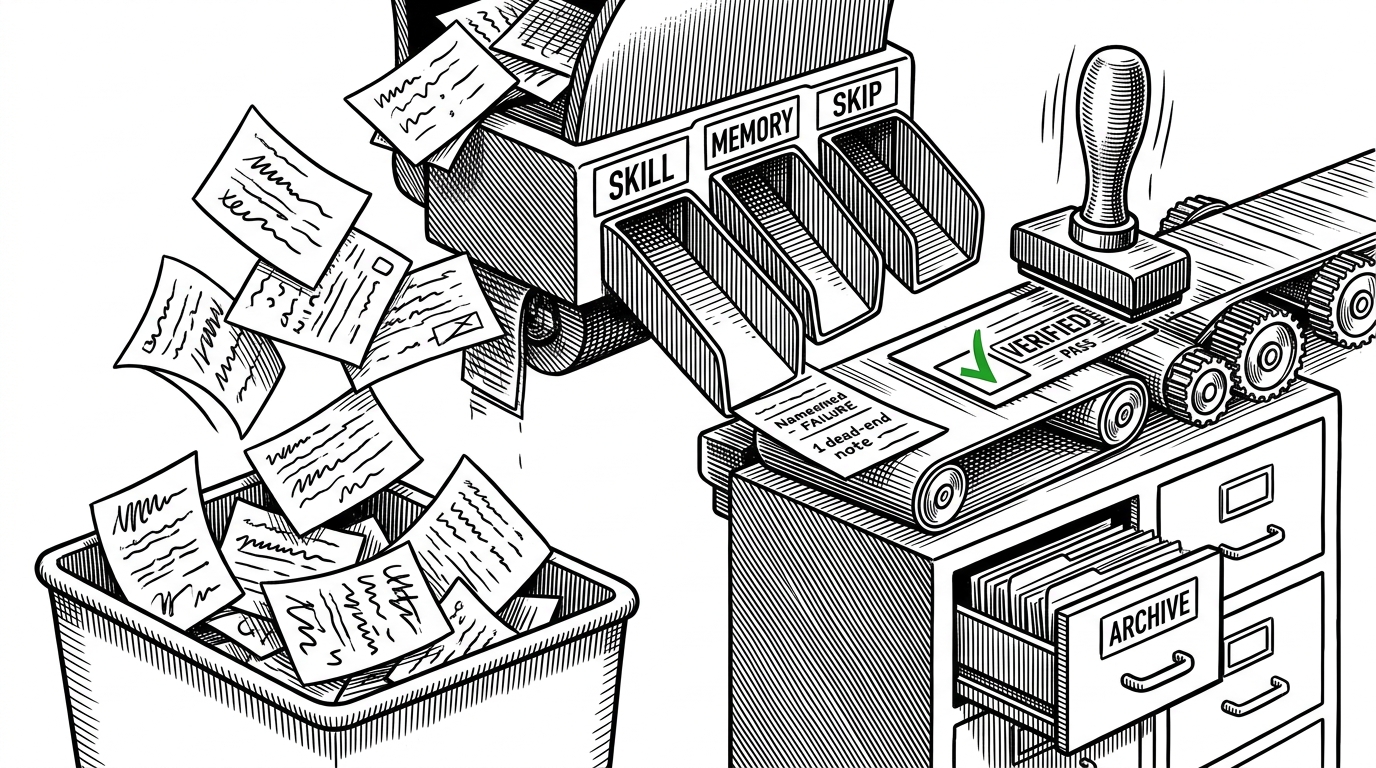
That matters because agent memory is otherwise too eager to generalize from a single success. This repo insists on proof, not vibes. It is trying to encode judgment, not just text.
Why the template matters more than the rule
The template file is where the idea becomes durable. Instead of dumping prose into a note, it separates procedure, gotchas, and what did not work. That structure makes the learned output readable to humans and actionable for future agents.
# Procedure
1. Run the verified commands.
2. Check the result.
3. Capture the reusable path.

# Gotchas
- Non-obvious environment details.
- Project-specific quirks.

# What didn't work
- Failed commands.
- Dead ends that should not be repeated.
That schema is doing more than documentation. It is compressing experience into a format that can be copied across adapters without losing the point. The repo is teaching an agent how to write for its future self.
The interoperability story: one idea, four adapters
| Surface | What it is | Why it matters |
|---|---|---|
| Cursor rules | .mdc files that stay always on | Good for persistent editor-level behavior |
| Agent Skills | Standards-based SKILL.md packaging | Makes the idea portable across supported agents |
| AGENTS.md | Plain repo-level instruction file | Lowest-friction fallback for broad compatibility |
| Claude plugin | Manifest-driven distribution | Turns the same idea into an installable package |
This is the distribution strategy hidden inside the repo. The same discipline can be delivered through Cursor, Agent Skills, plain AGENTS.md usage, or a Claude plugin. That makes the project less like a single tool and more like a portable operating pattern.
Why this beats generic memory frameworks
| Approach | What it optimizes for | What it misses |
|---|---|---|
| Generic memory frameworks like Mem0, Letta, Zep, and Cognee | Retrieval, personalization, broad long-term context | They can preserve too much and still not guarantee the right lesson lands in the right place |
| Manual rules like Cursor Rules or AGENTS.md | Static persistence | They depend on humans remembering to curate them |
| self-learning-skills | Promotion of proven workflows at the moment they become useful | It is narrower than a full memory layer, but stricter about quality |
The distinction is subtle but important. Generic memory systems try to help agents recall later. This repo tries to make sure the thing worth recalling gets committed in the first place. That is a much smaller surface area, but a much stronger editorial filter.
The bigger bet: agents that maintain their own playbooks
The long-term idea here is bigger than prompting. It is repo culture for agents. If a workflow was hard to discover, it should be written down. If it was only accidentally correct, it should be discarded. If it is reusable, it should become part of the operating manual.
That is a familiar pattern in software teams. CI encodes trust. Dockerfiles encode environment. Repo conventions encode taste. self-learning-skills argues that agent learning should be treated the same way: as a governed artifact, not a private hallucination in a chat window.