Bank-Loan-Prediction: A Tiny Notebook That Tries to Make Loan Rejection Explainable
Inside a compact credit-risk pipeline that stages a model showdown, confronts class imbalance, and uses SHAP to turn predictions into defensible reasons.
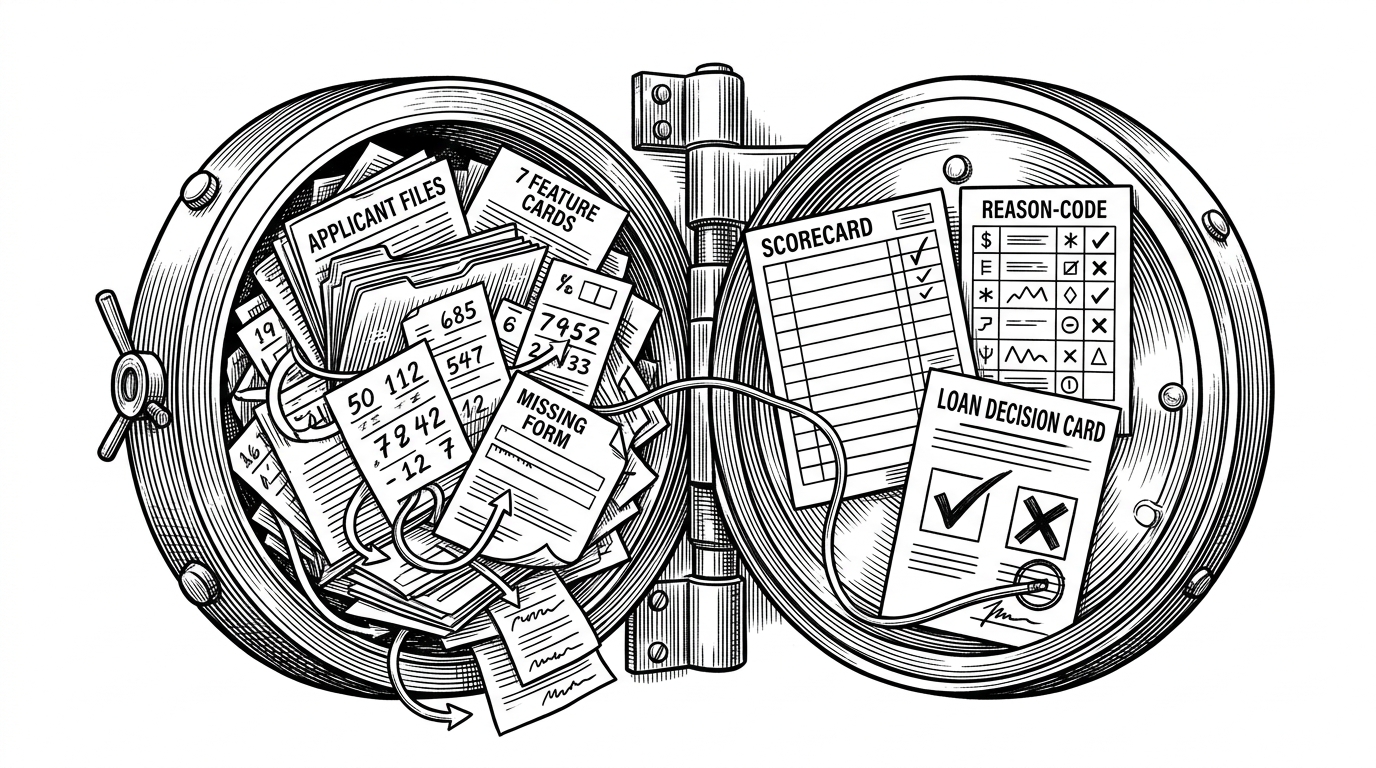
- This repo treats loan prediction as a trust problem, not a leaderboard problem.
- Its real value is the combination of model comparison, imbalance handling, and SHAP-based explanation in one compact notebook.
- The notebook is strongest as a research prototype because it makes the decision path visible, not as a production system with polished deployment layers.
- In credit risk, a model that cannot explain itself is usually incomplete, even when it predicts well.
Why Loan Prediction Is Really an Explainability Problem
In lending, a correct prediction is not the finish line. A bank needs to know why the model said no, and it needs that answer in a form a human can defend to a manager, an auditor, or a regulator. That is what makes this repository more interesting than a standard classification notebook.
The code is doing ordinary machine learning work on the surface. Underneath, it is trying to answer a harder banking question: can you turn a black-box score into a decision that feels legible enough to use?
What This Notebook Actually Built
Bank-Loan-Prediction is a compact, notebook-first project built around a single end-to-end workflow. The repo centers on one Colab-friendly notebook, a dataset-driven pipeline, and a handful of modern ML libraries rather than a multi-service application.
That simplicity is part of the appeal. The project does not hide the work behind a web app or an overbuilt framework. It puts the pipeline in the open: load data, clean it, compare models, explain the result.
# Rough shape of the notebook stack
imputer -> scaler -> imbalance handling -> model comparison -> SHAP explanation

models = [
    "LogisticRegression",
    "RandomForestClassifier",
    "XGBoost",
    "LightGBM",
    "KerasSequential"
]
The Stack Is a Tournament, Not a Single Model
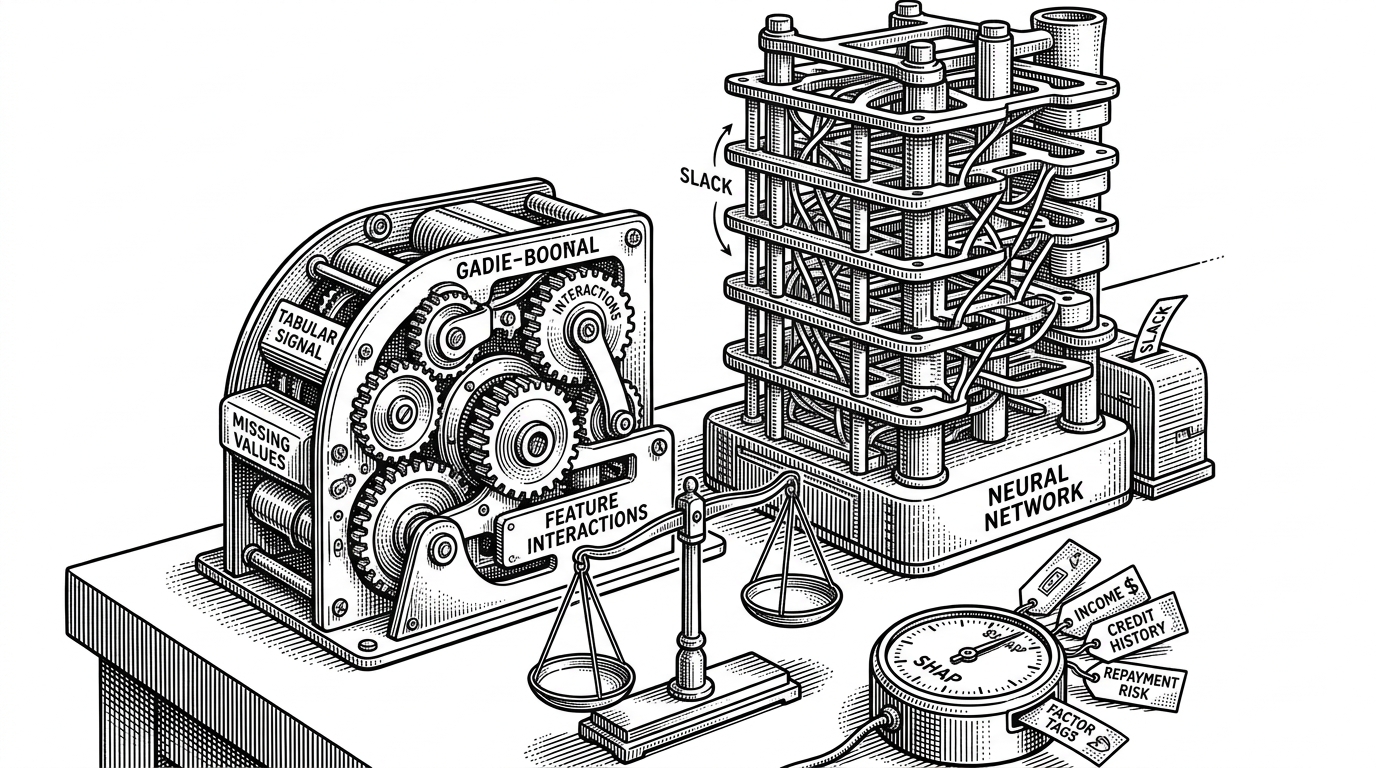
The notebook does not marry one algorithm and call it done. It stages a small tournament: logistic regression, random forest, XGBoost, LightGBM, and a Keras neural net all get a turn. That matters because tabular credit data usually rewards disciplined benchmarking more than faith in one fashionable model.
| Dimension | This repo | Typical beginner notebook | More mature demo |
|---|---|---|---|
| Model count | Multiple models compared | Usually one baseline | Often a chosen model plus app layer |
| Class imbalance | Explicitly handled | Often ignored | Sometimes handled |
| Explainability | SHAP included | Rare or absent | Sometimes included |
| Presentation layer | Notebook only | Notebook only | Streamlit or Flask |
| Best use case | Research prototype | Learning exercise | Demo or pilot |
The Hidden Problem Is Class Imbalance
Loan default is a rare event. That means a model can look accurate while still being bad at the thing that matters. If most borrowers repay, a naive classifier can coast on the majority class and miss the people the bank most needs to identify.
That is why the imbalance tooling matters. Imports from imbalanced-learn are not cosmetic here. They are the difference between a model that learns the shape of risk and a model that mostly learns how to ignore it.
This is also why recall deserves more attention than raw accuracy in this kind of work. False negatives are expensive when the minority class is the one you care about.
SHAP Turns Scores Into Reasons
SHAP is the project’s most financially relevant decision. It moves the notebook from prediction to justification. Instead of only producing a yes or no, it can show which features pushed a specific applicant toward approval or rejection.
That matters because banking decisions are rarely judged on statistical elegance. They are judged on whether the explanation is stable, understandable, and plausible enough to stand up in a real workflow.
In that sense, SHAP is not decoration. It is the bridge between model output and institutional trust.
How It Compares to the Usual Loan-Prediction Notebook
Most loan-prediction notebooks stop at the obvious milestone: train a classifier, print a metric, move on. Some polished demos go further with Streamlit or Flask, but they often trade away the research trail that shows how the decision was made.
This repo sits in a useful middle. It is lighter than a product demo, but more thoughtful than a throwaway tutorial. The emphasis is on the modeling problem itself, not on packaging.
That makes it a good fit for a portfolio, a learning exercise, or a quick prototype. It is not trying to be a production lending system. It is trying to show that the builder understands the shape of the problem.
What the Project Gets Right, and What It Still Leaves on the Table
The project gets the essentials right. It acknowledges imbalance, compares several model families, and uses SHAP to make the output defensible. For a compact repo, that is a strong set of choices.
Its limits are the same ones you would expect from a notebook-bound experiment. The workflow is monolithic, the structure is not modular, and the project still reads like a prototype rather than a system.
But as a prototype, it is honest. It does not pretend that credit risk is solved by one clever model. It treats the harder problem as what it is: a pipeline that has to balance performance, rarity, and explanation.