NLEx: The Repo Building a Translator for Black-Box NLP Models
A fine-tuned LLM, classic interpretability methods, and a deliberately structured research workflow aimed at turning model internals into explanations people can read.

- NLEx treats explainability as translation, not exposure, by turning raw model signals into prose a human can read.
- The repo matters less as a finished product than as a disciplined research scaffold with a clear pipeline, evaluation intent, and modular boundaries.
- Its real challenge is not generating fluent text, but keeping that text faithful to what the model actually did.
- In the explainability landscape, NLEx sits above Captum, SHAP, and LIME as a semantic layer rather than a replacement.
NLEx is not trying to make NLP models less opaque by adding another heatmap. It is trying to make them legible by narrating what they did. That shift sounds small until you compare it with the usual interpretability stack, where the user still has to do the last mile of reasoning.
That is why the repo is interesting even in an early state. The public footprint is tiny, but the intent is unusually crisp: use a fine-tuned LLaMA-2-style explainer to convert model behavior into a human-readable explanation. In other words, the explanation itself is the product.
The odd job NLEx wants to do
NLEx is an Open Source Large Language Model (LLM) based Explainer for Natural Language Processing (NLP) models. It provides detailed, context-aware, and human-understandable explanations for the predictions made by NLP models, helping to demystify the 'black box' of deep learning in NLP.
That README line tells you almost everything. NLEx is not positioning itself as a replacement for interpretability methods. It is a narration layer on top of them, aimed at the moment when a user has the signal but not the meaning.
That matters because most explainability tools stop at technical visibility. They can tell you which tokens mattered, which features moved the score, or which local surrogate model approximated the behavior. They do not automatically tell you what to do with that information.
Why saliency is not the same as explanation
| Tool | What it outputs | Who does the final interpretation | Human readability |
|---|---|---|---|
| Captum | Attribution scores and saliency methods | The reader | Low to medium |
| SHAP | Feature contributions and local explanations | The reader | Medium |
| LIME | Local surrogate model outputs | The reader | Medium |
| NLEx | Natural-language explanation grounded in model signals | The explainer LLM | High, with verification still required |
A saliency map can be correct and still be annoying to use. A SHAP bar chart can be useful and still force the user to translate visual numbers into a story. NLEx is betting that the story should be generated for you, but not invented from scratch.
That is the important distinction. NLEx is not trying to make interpretability prettier. It is trying to add a semantic layer between raw explanation artifacts and human judgment.
The pipeline: from model signal to readable prose
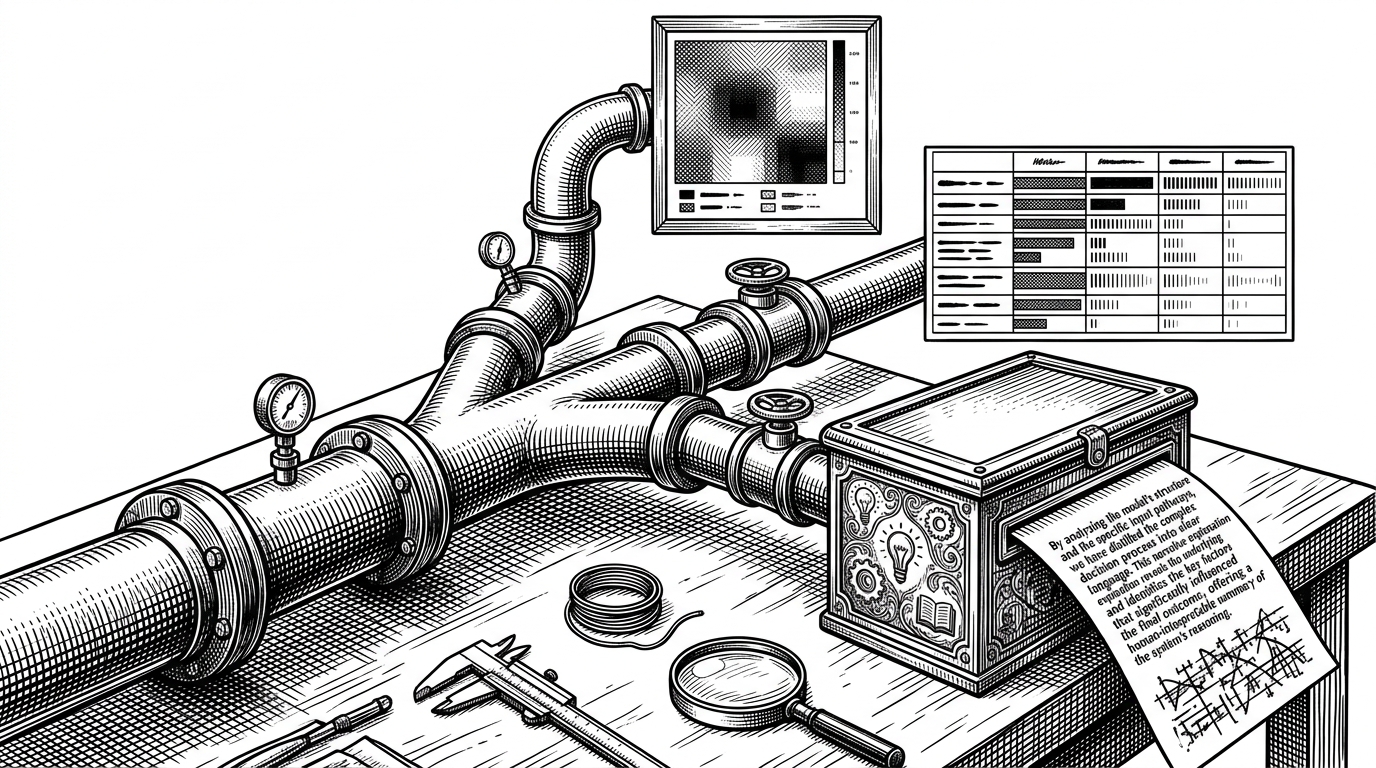
The technical shape is straightforward, which is part of the appeal. User text enters a target NLP model. An interpretability method, such as a gradient-based or perturbation-based approach, surfaces what appears to matter. Then the explainer LLM turns those signals into an explanation sentence or paragraph.
The key is that the LLM is not operating in a vacuum. It is sitting on top of model signals, which gives the output a chance to be both readable and grounded. That grounding is where the project can succeed or fail.
Why the repo feels like research, not a wrapper
The repository structure reads like a team trying to make a system repeatable before it becomes messy. The emphasis on modular pieces, evaluation language, and integration points suggests more than a demo. It suggests a research program with a path to implementation.
That is reinforced by the project's own framing around fine-tuning. A generic prompt wrapper can produce explanations, but a fine-tuned explainer is a different bet. It says the authors believe explanation quality can be specialized, trained, and improved rather than improvised.
That discipline matters because explanation work is easy to hand-wave. Once the repo starts treating explanation as a pipeline with inputs, outputs, and evaluation, it stops looking like a toy and starts looking like infrastructure.
What NLEx gets right about explanation quality
The hardest part of this category is that fluency is not faithfulness. A clean paragraph can be wrong. A technically ugly attribution can be right. NLEx lives in the tension between those two facts.
The project's advantage is that it can potentially balance plausibility with grounding. If the explanation reads well and lines up with the underlying signal, the tool becomes useful to people who do not want to inspect model internals by hand.
If it fails, it will fail in a familiar way. The explanation will sound convincing while drifting away from what the model actually did. That is the core risk for any LLM-based explainer, and it is the reason evaluation is not optional.
Where it sits in the explainability landscape
| Approach | Primary job | Output form | NLEx relation |
|---|---|---|---|
| Captum | Expose gradients and attributions | Technical scores and saliency views | Foundational signal source |
| SHAP | Estimate feature contribution | Feature importance values | Possible upstream input |
| LIME | Fit a local surrogate | Local approximation model | Possible upstream input |
| NLEx | Narrate the explanation | Natural-language prose | Semantic layer on top of signals |
That placement is the cleanest way to read the repo. NLEx does not replace the interpretability tools everyone already knows. It sits above them and changes the unit of output from numbers to language.
That is also why it is interesting to product people. A team that can turn explanation into prose can put interpretability in front of more users, not just more experts. The trade-off is obvious: once you generate language, you have to defend every sentence.
The repo's real signal is its discipline
The most persuasive thing about NLEx is not the model choice. It is the shape of the work. The repo is already organized around a serious question: how do you make an explanation system that can be maintained, evaluated, and extended without collapsing into prompt spaghetti?
That is the right question for this kind of project. If NLEx becomes useful, it will not be because it made model introspection exciting. It will be because it made explanation output feel like something a human can trust, inspect, and reuse.