NOFX: The AI Trading Terminal Where the Model Can Suggest, But the Runtime Decides
A self-hosted, Go-powered trading system that turns LLMs into strategy engines, then clamps every decision with hard risk controls, encrypted keys, and exchange-aware execution.
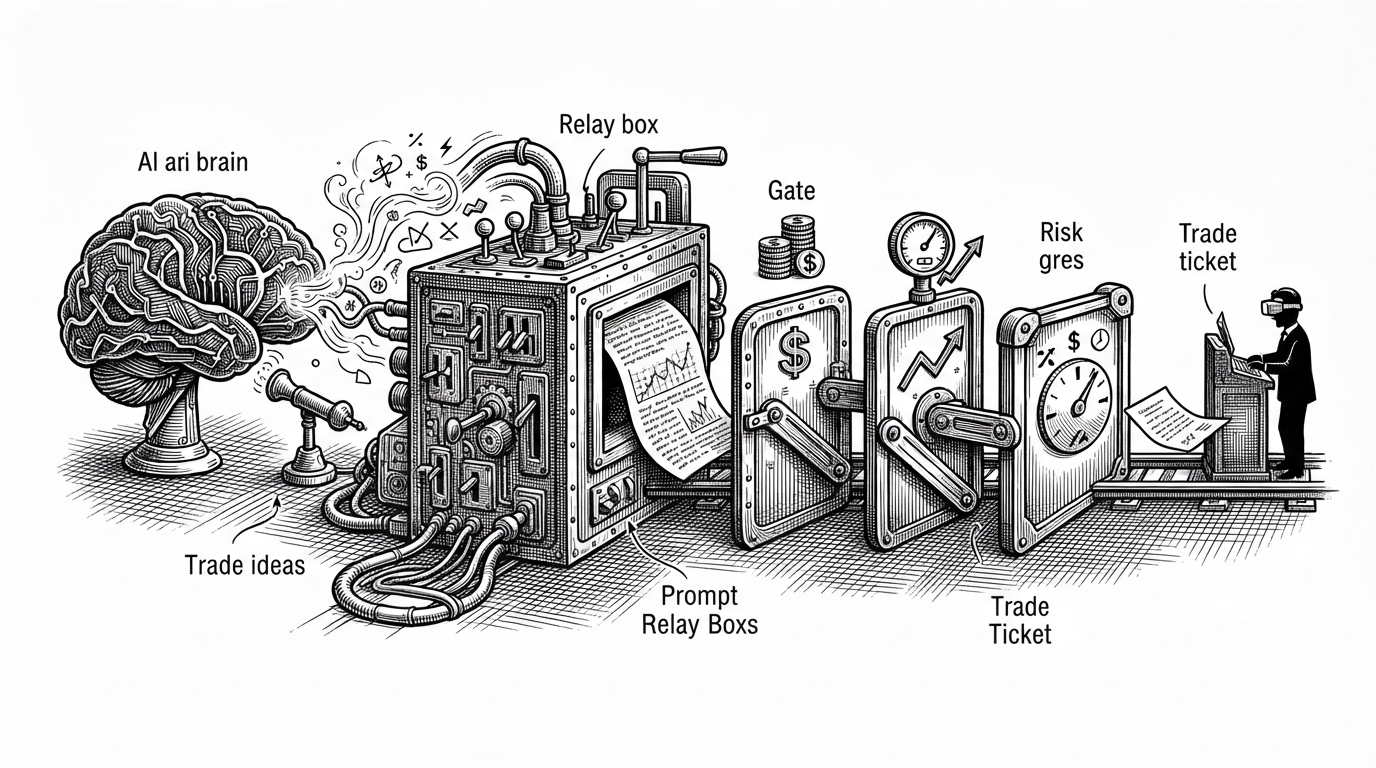
- NOFX’s defining move is to separate intelligence from authority, so the model can suggest a trade without being able to force one.
- The prompt is assembled like software, with schema, risk settings, and language rules baked into a stable contract.
- Security is part of startup order, not a settings panel, because encryption and secret checks happen before the trading loop runs.
- The project’s real comparison point is not another AI demo, but the older world of Python bots that let the strategy layer sit much closer to execution.
The most interesting thing about NOFX is not that it uses AI. It is that the AI is not trusted with the last word. The Go runtime enforces the boundary, and that boundary is the product.
NOFX is an open-source trading terminal where the strategy is a language model. Each trader runs a continuous loop — read market structure, decide, execute, record the reasoning — while a Go runtime clamps every order to hard risk limits the model cannot override.
The AI is not the boss here
NOFX starts from a simple refusal: do not let an LLM talk directly to money. The model can interpret context, propose an action, and explain its reasoning. The runtime decides whether that proposal survives contact with risk rules, account state, and exchange constraints.
That makes the system feel less like a chatbot with a brokerage account and more like a supervised control loop. The interesting part is the veto. If the model wants to size up too far, the runtime can trim the order or reject it outright before anything reaches an exchange.
This is why NOFX feels distinct from many AI trading demos. It does not sell autonomy. It sells bounded autonomy.
The prompt is compiled, not improvised
Inside NOFX, the prompt is treated like an artifact. Risk settings, schema expectations, and language rules are assembled into a stable system prompt instead of being hand-written ad hoc for each run. That is a subtle but important shift: the model is not being asked to freestyle, it is being asked to operate inside a contract.
systemPrompt := BuildSystemPrompt(riskSettings, schema, accountState)
context := BuildContext(account, positions, markets, gridState)
rawDecision := llm.Generate(systemPrompt, context)
decision := ValidateAndClamp(rawDecision, riskLimits)
if decision.Approved {
    exchange.Execute(decision.Order)
}
The code path matters here. The kernel builds the conversation, then turns the response back into structured intent. That keeps the model in a narrow lane and gives the runtime something it can validate.
Safety starts before the database
NOFX’s security posture is architectural, not cosmetic. The crypto layer is initialized before persistence so secrets can be encrypted at rest, and the system refuses to proceed with weak authentication settings. That order matters. It means safety is wired into startup, not bolted on afterward.
For a trading terminal, that is the right instinct. A system that handles exchange keys and live orders should not treat secret management as a config checkbox. It should treat it as a prerequisite for launch.
Sense, plan, act, then clamp
The loop is straightforward once you strip away the AI branding. First the engine gathers account state, positions, market data, and grid context. Then it asks the model for a decision. Then the runtime checks that decision against hard constraints before any exchange call is made.
Grid trading makes this more interesting. NOFX is not only trying to place isolated buy and sell orders. It can manage a mesh of levels, pause the grid in volatile conditions, and adjust boundaries as market structure changes. The model helps with strategy, but the runtime still governs the shape of exposure.
That distinction is the project’s center of gravity. NOFX is not trying to make the LLM omnipotent. It is trying to make the LLM useful inside a supervised execution loop.
{
  "sense": ["account equity", "positions", "market data", "grid state"],
  "plan": ["prompt builder", "LLM proposal", "schema validation"],
  "act": ["risk clamp", "size trim", "reject or execute"],
  "rule": "The runtime may reduce, block, or approve the order. The model cannot override it."
}
Multi-agent trading is the social layer
NOFX also turns trading into a comparison system. Multiple traders can run side by side, which makes the terminal feel like a lab. You can compare prompts, models, and strategy settings against the same market inputs and see which one survives the strongest under identical conditions.
| Dimension | NOFX | TradingAgents | AI Hedge Fund | Freqtrade |
|---|---|---|---|---|
| Runtime language | Go for the execution layer | Python | Python | Python |
| LLM role | Strategy engine inside a clamp | Research and analysis agents | Debate and persona simulation | Usually not LLM driven |
| Risk control | Hard runtime veto and size trimming | Research oriented, lighter execution focus | Depends on experiment design | Traditional bot controls and rules |
| Self-hosting | Yes, with local custody focus | Yes, mainly research | Yes, mainly research | Yes |
| Best fit | Bounded autonomous execution | Academic multi-agent research | Persona-based stock exploration | Rule-based crypto automation |
That makes the leaderboard idea practical, not just gamified. The terminal is not asking which model sounds smartest. It is asking which model survives the same enforcement layer most cleanly.
Why Go matters here
Language choice is part of the thesis. Go fits the job because NOFX needs concurrency, low operational friction, and a strong boundary between proposal and execution. The heavy lifting is not natural-language generation. It is safe, deterministic control.
Python remains a better sandbox for research-heavy iteration. But when the system is expected to run live orders, enforce limits, encrypt keys, and keep the runtime predictable, Go is doing more than choosing syntax. It is choosing discipline.
The bigger lesson
NOFX points to a broader pattern in agentic systems: the winning design is not full autonomy. It is bounded autonomy with visible constraints. The model handles judgment calls. The runtime handles money, limits, and failure modes.
That is a more durable idea than “AI can trade.” It is also a more honest one. The future of these systems will belong to the projects that make control explicit.
| Question | Naive AI bot | NOFX |
|---|---|---|
| Who decides the trade? | The model | The runtime, after model input |
| What protects the account? | Prompts and hopes | Hard clamps and validation |
| What is the model for? | Direct execution | Strategy and proposal |
| What is the core product? | Autonomy | Bounded autonomy |