CareQueue: The Hospital Queue That Treats Intake Like a Gate, Not a Line
A Spring Boot and React system that lets patients register from home, forces receptionist approval before queue entry, and sketches out a multi-hospital SaaS model.
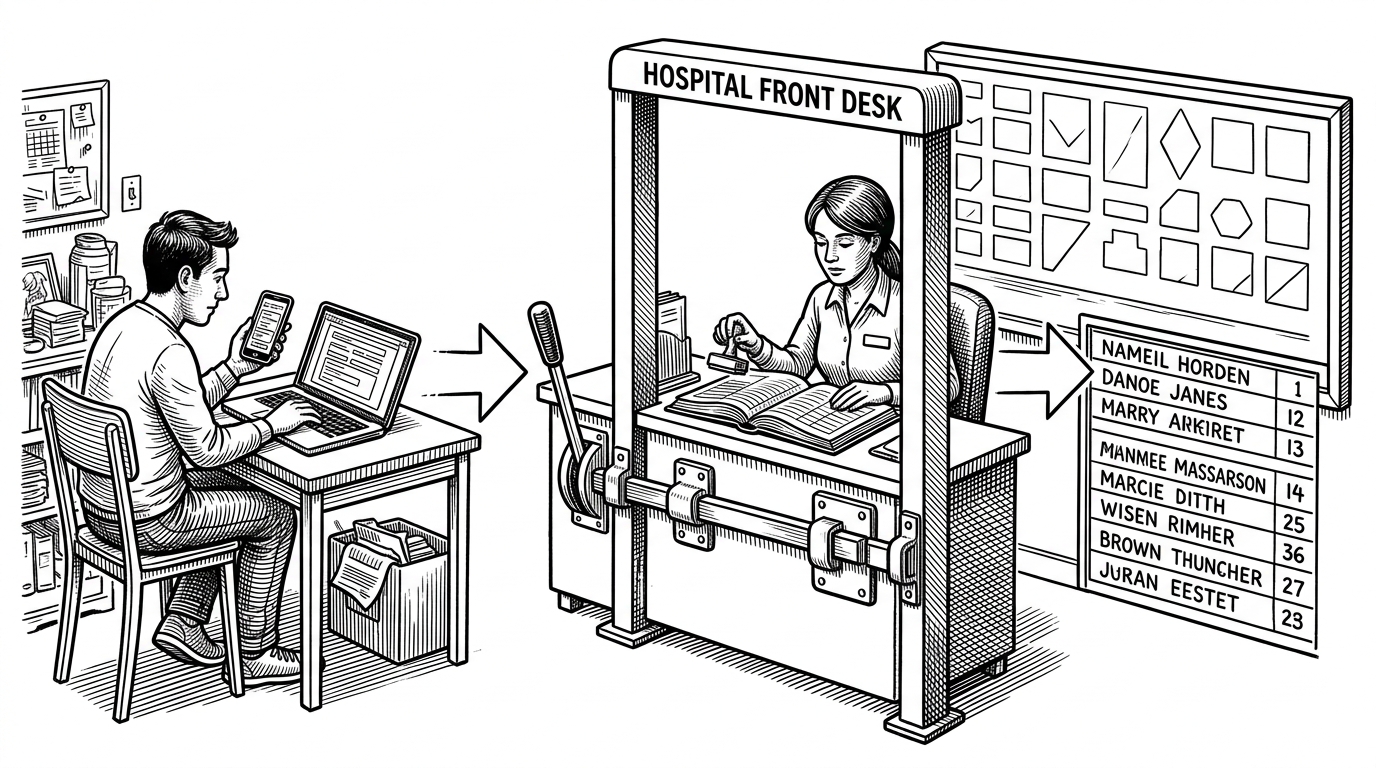
- CareQueue’s smartest move is to encode front-desk judgment into the data model, so a patient can exist without yet entering the live queue.
- The repo is really a workflow system with a queue attached, not a scheduling app with a few status fields.
- Its hospitalId design points toward multi-clinic SaaS, even though the rest of the stack still reads like an alpha build.
- The security shortcuts are not incidental, because in healthcare they define the line between prototype and deployable software.
The front desk is the product
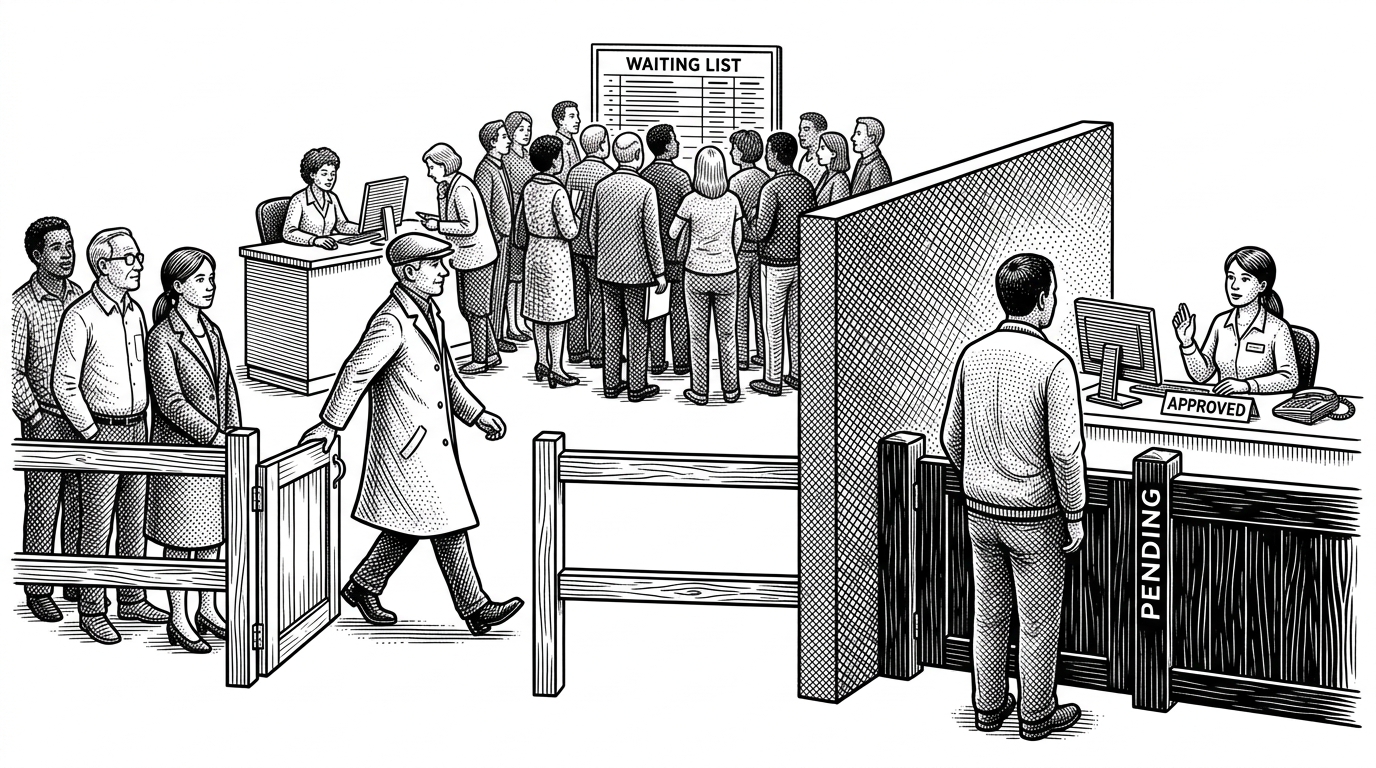
CareQueue’s most interesting idea is brutally simple: a patient can register from home and still not be in line. Self-registration lands them in PENDING, and only a receptionist can promote them into WAITING. That makes the front desk a gate, not a passive inbox.
That distinction changes the whole mental model. The software is not just recording demand. It is deciding when demand becomes operational reality.
Two intake modes, one queue
The repo’s workflow is built around two entry points. registerSelf creates a patient record without letting them cut into the active queue. registerWalkIn does the opposite: a receptionist places the patient directly into WAITING because they are already standing at the desk.
| Intake path | Queue entry | Who triggers it | Typical meaning |
|---|---|---|---|
| Self-registration | Delayed until approval | Patient | Remote intake that still needs front-desk review |
| Walk-in registration | Immediate | Receptionist | Physical arrival that is already validated |
| Approval step | Moves PENDING to WAITING | Receptionist | Manual triage gate |
| Emergency priority | Can outrank standard order | Staff | A route for urgent cases |
Hospital-first architecture
CareQueue is not organized around a single clinic. It is organized around hospitalId. That matters because it hints at a SaaS shape from the start: one deployment, many hospitals, separate records, shared code.
The repository’s entity model reinforces that idea. HospitalAdmin sits at the top, and staff and patients inherit the hospital boundary through relational links rather than separate installs. That is a practical multi-tenant pattern for a small system that wants to grow up later.
What the backend already knows how to do
The backend follows a standard Spring pattern: controllers, JPA entities, MySQL persistence, and enum-driven status changes. That is not flashy, but it is coherent. The queue logic lives where you would expect it to live, in the controller and entity layer rather than buried in a tangle of UI state.
public enum PatientStatus {
    PENDING,
    WAITING,
    COMPLETED
}

// Conceptually, the controller flow looks like this:
// self registration -> PENDING
// receptionist approval -> WAITING + doctor assignment
// visit finished -> COMPLETED
That tiny state model does a lot of work. It captures the exact moment when a request becomes an active clinic obligation, which is the whole point of the product.
The production gaps are as revealing as the features
CareQueue also reads like an alpha system, and that is useful context rather than a flaw to hide. Plaintext password checks, no JWT or OAuth2, and Hibernate schema updates in place all signal a build that is still proving the workflow before hardening the platform.
In healthcare, those shortcuts are not cosmetic. They define how far the system sits from a real deployment. The idea is strong, but the trust model still needs the hard work.
| Area | CareQueue today | Production expectation |
|---|---|---|
| Authentication | Plaintext password comparison | Hashed passwords with token-based auth |
| Database management | Schema updates in place | Versioned migrations |
| Queue access | Manual receptionist gate | Auditable workflow with permissions |
| Tenant isolation | hospitalId boundaries | Clear access controls and policy enforcement |
| Deployment posture | Demo or educational | Compliance-aware production system |
What it is competing with
CareQueue is not trying to out-feature Qmatic, Clockwise.MD, or Waitwhile. Those products are mature, proprietary, and built for broad operational coverage. CareQueue is narrower and more interesting in a different way: it is an open, workflow-first sketch of the same problem.
| System | Model | Strength | Trade-off |
|---|---|---|---|
| CareQueue | Open-source clinic workflow | Transparent intake gate and simple multi-tenant shape | Early-stage security and operational maturity |
| Qmatic | Enterprise patient flow | Deep deployment history and broad feature set | Proprietary and heavier |
| Clockwise.MD | Urgent care access platform | Strong patient-facing convenience | Less open and less customizable |
| Waitwhile | General queue SaaS | Flexible waitlist and virtual queue tools | Not built as a clinic-specific workflow model |
That makes the repo valuable even if it never becomes a large product. It shows one clean idea: the front desk is not just where patients wait. It is where the system decides what waiting means.
Why CareQueue matters
CareQueue matters because it turns a messy human ritual into software rules without flattening the ritual itself. Patients can arrive remotely, staff can still make a judgment call, and the live queue stays under control. That is the right abstraction for clinic software.
The repo is strongest when you read it as an argument. A good healthcare system does not merely count people. It governs access, preserves context, and makes the handoff from intent to care explicit.