DiffusionBlocks: When Transformer Depth Becomes a Noise Schedule
This research repo treats training as denoising, splits ViT into independently trainable blocks, and uses diffusion math to rethink the memory wall.
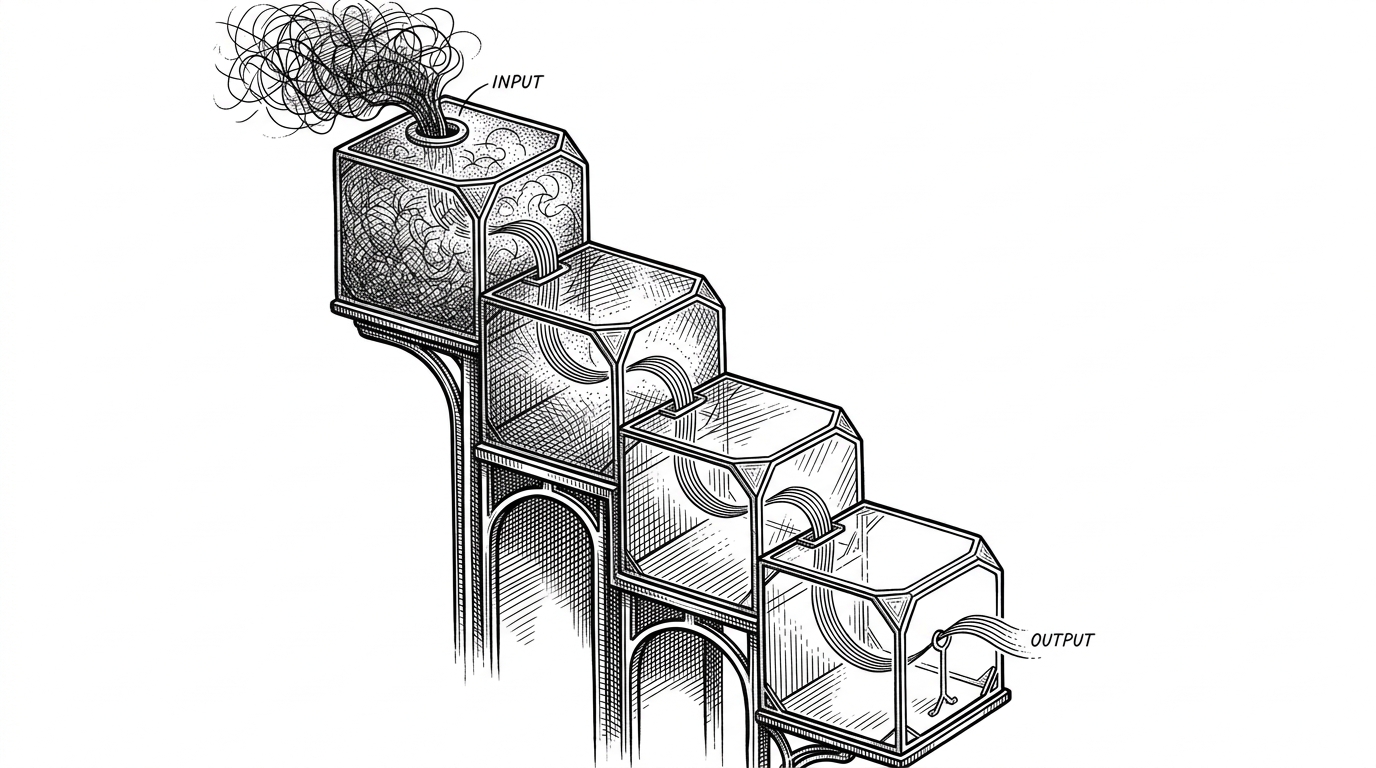
- DiffusionBlocks treats neural network depth as a diffusion schedule, which turns block-wise training from a compromise into the point of the method.
- The repo’s main trick is to train one sigma-conditioned block at a time, so memory pressure drops without abandoning the diffusion interpretation.
- AdaLN and timestep embeddings give each block enough context to behave like a denoising step instead of an arbitrary layer slice.
- The project is interesting because it reframes training itself, not just model architecture, and that makes the comparison to standard backprop unusually sharp.
The memory wall that makes this project matter
The useful way to read DiffusionBlocks is not as a clever optimization hack. It is a response to a very old constraint: deep networks get expensive because training wants to remember too much at once. Activations, not just parameters, become the bill you pay for backprop.
That is why the repo matters. It asks a strange but productive question: what if the unit of training was not the whole network, but a block whose job is to move a representation from one noise level to the next? Once you ask it that way, memory savings stop looking incidental.
The project is small and researchy on purpose. It is not trying to become a general training framework. It is trying to prove that a different mental model for depth can produce a different training loop.
DiffusionBlocks turns depth into a sigma schedule
The central move is conceptual. A Transformer is usually read as a stack of layers. DiffusionBlocks reads it as a path through noise levels, where each block is tied to a sigma interval and learns how to clean up a representation at that stage.
That is the reason the idea is more interesting than standard block-wise training. A greedy layer scheme says, "train a piece, then move on." DiffusionBlocks says, "train a denoising step that belongs at a particular place in the noise distribution." The block boundary is doing theoretical work.
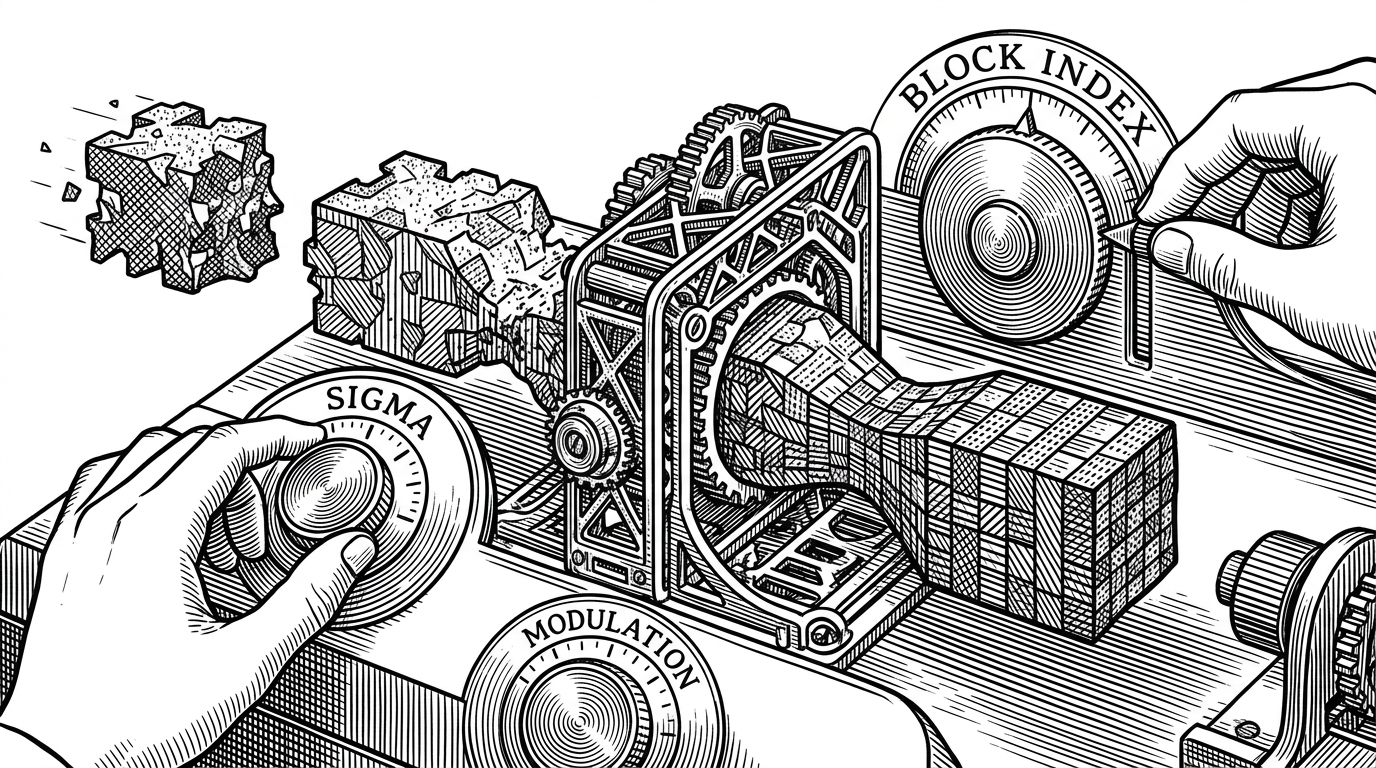
How the repository makes block-wise training possible
The codebase is tidy enough to read like an argument. main.py sets up the run, model.py wraps the training logic, dblock_modules.py defines the sigma schedule, and vit.py gives the Vision Transformer the conditioning machinery it needs.
The important detail is that the blocks are not isolated by accident. The model is aware of its place in the diffusion process through timestep embeddings and adaptive layer norm. In other words, the block does not just receive an input tensor. It receives context about how noisy that tensor is supposed to be.
That is where AdaLN matters. A plain layer would be blind to the schedule. A modulated layer can shift and scale its behavior based on sigma, which makes the block act like a stage in a denoising pipeline rather than a static part of a feedforward chain.
# Conceptual flow in the repo
block_idx = random.choice(range(num_blocks))
sigma = get_block_sigmas(block_idx, num_blocks)
t = timestep_embedder(sigma)
x = block(x, t)

# Each block is conditioned by where it sits in the schedule
x = modulate(x, scale, shift)
In training, only one block is active for a given step. That is the practical memory play. The forward graph is smaller, the backward pass is narrower, and the model gets updated through a block-specific slice of the diffusion path instead of a full end-to-end pass.
Why sigma boundaries matter more than layer counts
The schedule is not a cosmetic detail. In dblock_modules.py, block boundaries come from sigma ranges derived from a log-normal diffusion distribution. That means the partitioning reflects the geometry of diffusion training, not an even split of layers for convenience.
This is the subtle thing that makes the repo feel principled. A naive block count is arbitrary. A sigma interval says something about how the model should traverse uncertainty. The block is no longer just the third chunk of eight. It is the chunk that lives in a particular region of the denoising trajectory.
That matters for both training and inference. During inference, the discrete sigma schedule lets the model step through blocks in a way that mirrors the diffusion interpretation. The same structure that saves memory during training also defines the path the representation takes at test time.
What DiffusionBlocks is replacing, and what it is not
| Approach | Core idea | Training unit | Memory behavior | Main trade-off |
|---|---|---|---|---|
| Standard backprop | Optimize the whole network end to end | All layers at once | Highest activation storage | Simple and universal, but memory heavy |
| Greedy layer-wise training | Train a layer or block before moving on | One local module at a time | Lower activation storage | More modular, but often feels heuristic |
| DiffusionBlocks | Treat depth as a diffusion schedule | A sigma-conditioned block | Lower activation storage with schedule-aware structure | More principled, but still a research prototype |
The cleanest distinction is this: DiffusionBlocks is not just sequential training. It is diffusion-shaped training. That distinction is the whole paper in miniature.
It also explains the limits. This is a research repo, not a settled standard. The point is not that end-to-end training is obsolete. The point is that one can build a different training geometry, and that geometry can be useful when memory is the bottleneck.
The people and context behind the repo
DiffusionBlocks comes out of Sakana AI, and the repository sits in the familiar research-to-open-source lane: a paper idea, a clean implementation, and a clear attempt to make the mechanism legible to other researchers. The public code is designed to test the thesis, not hide it behind abstraction.
That is also why the repo is easy to admire even if you are skeptical. The structure is flat, the dependencies are modern, and the design choices track the claim closely. If the argument is that diffusion math can organize training, the code looks like it was written to prove exactly that.
The best way to read the project is as a reframing exercise. It borrows one of the most successful ideas in generative AI, then points it at a different problem: not how to sample data, but how to train a network under memory pressure.