UiPath ReFrameWork: The Template That Teaches Robots How to Fail
A look at the state machine, queue logic, and recovery patterns that made ReFrameWork the default operating model for enterprise RPA.
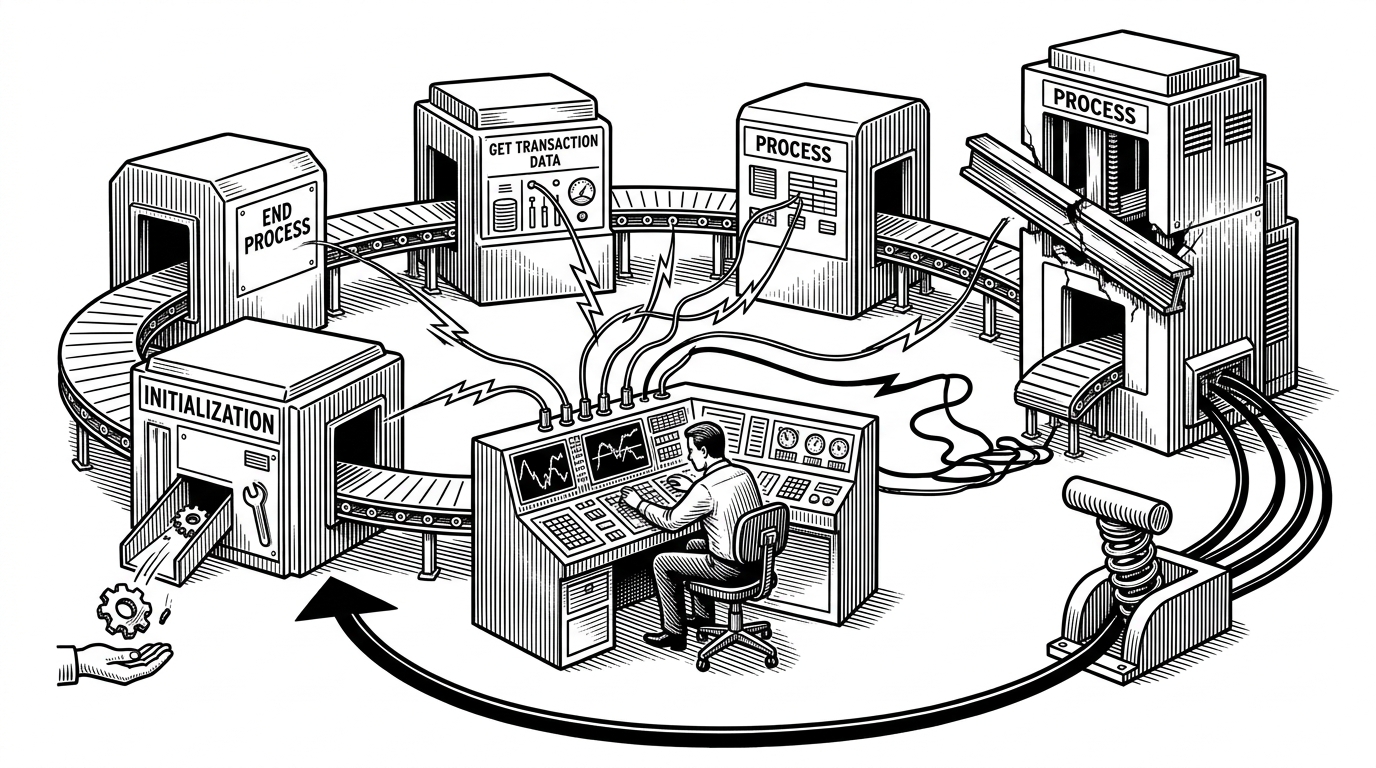
- ReFrameWork is less a starter template than an operating model for bots that must keep moving through messy enterprise systems.
- Its real breakthrough is the split between business exceptions and system exceptions, which turns failure into a routing decision instead of a generic crash.
- The state machine in Main.xaml gives UiPath a disciplined loop for initialization, transaction processing, and recovery without rewriting the control logic for every project.
- Configuration and transaction abstractions let teams change behavior, swap sources of work, and hand projects across developers without rebuilding the framework.
Most automation templates are built to make the happy path easier. ReFrameWork is built to make the unhappy path survivable. That is why it became the default answer for serious UiPath projects: it turns failure into a first-class design problem, not an afterthought.
The bot does not just process work. It classifies failure.
The framework’s sharpest idea is the split between business rule exceptions and system exceptions. A bad record does not mean the bot should restart the whole application. A crashed app does not mean the bot should pretend the item is invalid. Those are different failures, so they get different responses.
That distinction is not cosmetic. It saves time, avoids needless restarts, and keeps one bad input from poisoning the rest of the queue. In enterprise RPA, that matters because the environment is rarely stable enough for a linear script to survive long.
Hi everyone! This is the link to the official version of the UiPath ReFramework. It's purpose is to provide a template which handles the basic needs of any business process automation, like reading and storing a configuration file, retrying Transactions that fail with an Application Exception and logging the status of all processed transactions, failed or successful. The best way to get it is by pulling from our github, located at GitHub - UiPath/ReFrameWork: Robotic Enterprise Framework Template.
The state machine is the real product
`Main.xaml` is the center of gravity. It is not a script that runs from top to bottom. It is a controlled loop with distinct states: initialization, transaction retrieval, processing, and end handling. That sounds subtle until a bot needs to recover from a broken session without losing its place.
The value of a state machine here is not elegance. It is control. Once the bot knows which state it is in, it can restart applications, re-read settings, pick up the next transaction, or exit cleanly. The framework is designed for transitions, not just execution.
Configuration is loaded from two places, then deliberately overwritten
`InitAllSettings.xaml` reads the local `Config.xlsx` first, then pulls runtime values from Orchestrator assets. That precedence is the point. Local settings give the project a baseline. Assets let operations teams change behavior without redeploying the workflow.
| Layer | What it stores | Why it matters |
|---|---|---|
| Config.xlsx | Settings and constants for the project | Gives the bot a portable baseline and keeps environment-specific details out of code |
| Orchestrator Assets | Live runtime values and secrets | Lets operations override local settings without a new release |
| Credential Manager | Protected credentials | Keeps passwords out of workflow files and supports enterprise security controls |
This is a small mechanic with a big organizational effect. It means the bot can change its target URL, toggle a mode, or swap credentials while the template stays untouched. For teams running dozens of automations, that is the difference between a framework and a maintenance burden.
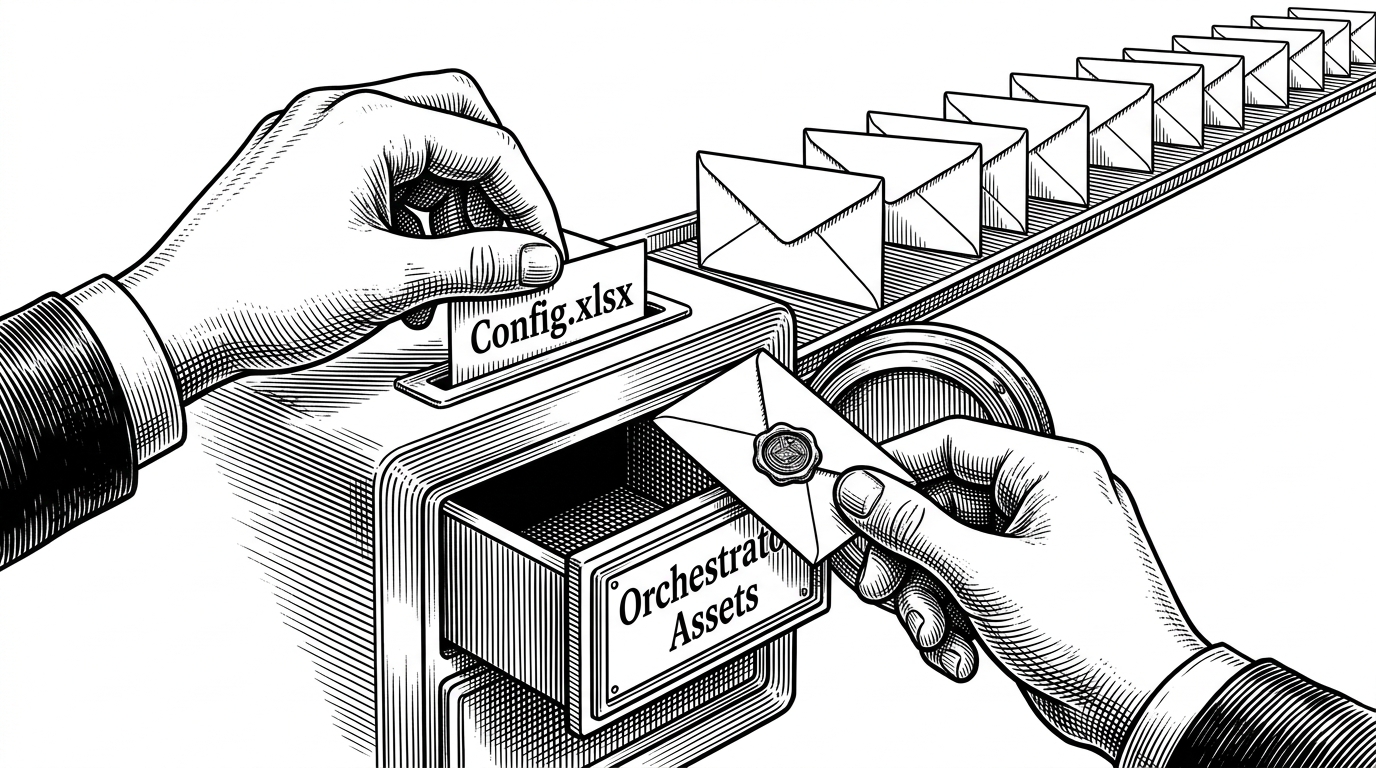
Transactions are abstracted so the template survives changing sources of work
`GetTransactionData.xaml` and `SetTransactionStatus.xaml` define the transaction contract. The default source is an Orchestrator queue, but the framework does not hard-code the whole project to one queue implementation. That makes the template portable across Excel, SQL, and other work sources when teams need it.
| Approach | What owns the workflow | What breaks first |
|---|---|---|
| Linear automation | The script | Recovery, reuse, and clean handoff |
| Custom ad hoc bot | The project team | Consistency across apps and deployments |
| ReFrameWork | The framework plus a process layer | Only the business logic changes when the job changes |
That abstraction is why the repo lasts. Teams can swap the source of work without rewriting exception handling, logging, or recovery logic. The framework is opinionated where it should be and flexible where it must be.
`Process.xaml` is the boundary that keeps business logic from poisoning the framework
`Process.xaml` is intentionally the place where project-specific work lives. The framework keeps the plumbing stable, while the business process changes underneath it. That separation is what allows the same template to survive invoice checks, onboarding flows, and other repetitive enterprise tasks.
It also protects maintainability. A developer can focus on the task itself without accidentally rewriting the control flow, retry logic, or status reporting. In larger teams, that separation is not a nice-to-have. It is what keeps the template from collapsing into bespoke one-off automation.
Why enterprise RPA needed a template like this
ReFrameWork has the fingerprints of a mature standard: documentation, tests, reusable framework folders, and a long-lived structure that teams can recognize immediately. The point is not that the template is clever. The point is that it reduces organizational entropy.
Mihai Dunareanu framed the repo’s purpose plainly in the UiPath forum: it is a template for handling configuration, retries, and logging for transactions that succeed or fail. That is the kind of boring infrastructure enterprises reward because it keeps their bots predictable.
The template versus the alternatives
| Model | Strength | Weakness | Best fit |
|---|---|---|---|
| Simple linear automation | Fast to build | Fragile under errors | Tiny, low-risk tasks |
| Custom internal framework | Tailored to one team | Hard to transfer and maintain | Organizations with very specific standards |
| ReFrameWork | Standardized recovery and configuration | Requires discipline and UiPath familiarity | Enterprise RPA with repeatable transaction work |
| Agentic process tools | Flexible decision-making | Less deterministic for queue-style work | Cases where judgment matters more than transaction throughput |
ReFrameWork does not win because it is the newest idea in automation. It wins because it optimizes for repeatability, recovery, and handoff. That is still the right trade-off for a lot of enterprise work.
What survives after the hype
The lasting lesson here is simple. ReFrameWork is not just an automation template. It is a compact operating doctrine for unreliable software environments. That is why the framework stuck around: it taught bots how to fail in a way that still lets the business move forward.