Sentiment-Analyzer: The Cleanest Part of This Repo Is Not the Model
A Streamlit sentiment app that shows how to turn notebook-era NLP into a shareable tool, with mirrored preprocessing, cached model loading, and a pragmatic workaround for large model files.
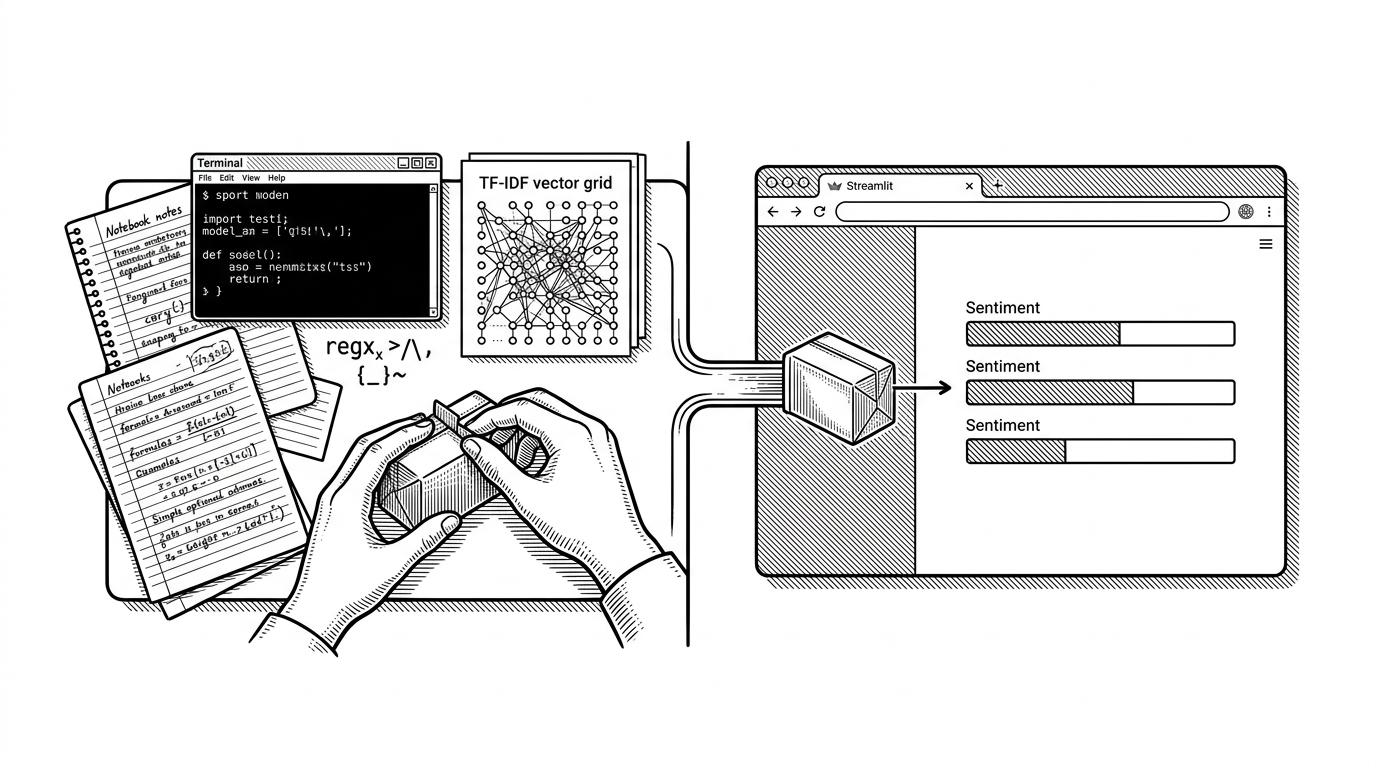
- This repo is strongest as a packaging lesson, because it turns a local sentiment model into a lightweight app without pretending to be enterprise-grade.
- Its most important engineering choice is feature parity, since the training script and Streamlit app mirror the same text preprocessing path.
- The `gdown` model fetch and cached loading make the app practical, which matters more here than chasing a fancier classifier.
- The project reads like a polished student prototype, and that is exactly why it works as an example for small ML deployments.
Why this tiny repo is more useful than it looks
Most sentiment demos stop at the notebook. This one keeps going. The interesting move is not that it predicts Positive, Negative, or Neutral, but that it ships those predictions through a small Streamlit app without stuffing a large model file into the repository.
That is a real trade-off, not a cosmetic one. The repo uses runtime model retrieval with `gdown`, then avoids repeated reloads with `@st.cache_resource`, which keeps the app fast enough to feel like a product instead of a demo.
The repo’s split-brain architecture: train here, serve there
The repository is cleanly split between `src/sentiment_analysis.py` and `app/app.py`. That is the right boundary for this kind of project. One side does the data work, cleaning text with regex, preprocessing with NLTK, and training or evaluating models. The other side does the serving work, loading the model, accepting user text, and presenting a result.
@st.cache_resource
def load_model():
    model_url = "https://drive.google.com/..."
    output = "model.pkl"
    gdown.download(model_url, output, quiet=False)
    with open(output, 'rb') as f:
        return pickle.load(f)

text = preprocess_text(user_input)
prediction = model.predict(vectorizer.transform([text]))
The model pipeline is classical, and that is the point
This repo does not try to win a benchmark arms race. It uses a very recognizable ML stack: regex cleanup, NLTK preprocessing, vectorization, then a small model sweep across Logistic Regression, Random Forest, SVM, and Naive Bayes. That is exactly why it is useful as a teaching artifact.
| Model | What it gives you | Why it fits this repo |
|---|---|---|
| Logistic Regression | Simple, fast baseline | Easy to explain and hard to overcomplicate |
| Random Forest | Nonlinear decision boundaries | A practical winner for small text features |
| SVM | Strong margin-based classifier | Common in classical NLP pipelines |
| Naive Bayes | Tiny and efficient | A good sanity check for bag-of-words data |
The point is not that one of these models is magical. The point is that the repo shows the usual path clearly, from noisy text to a vector space to a classifier that can be packaged and served.
How the app avoids the usual Streamlit demo traps
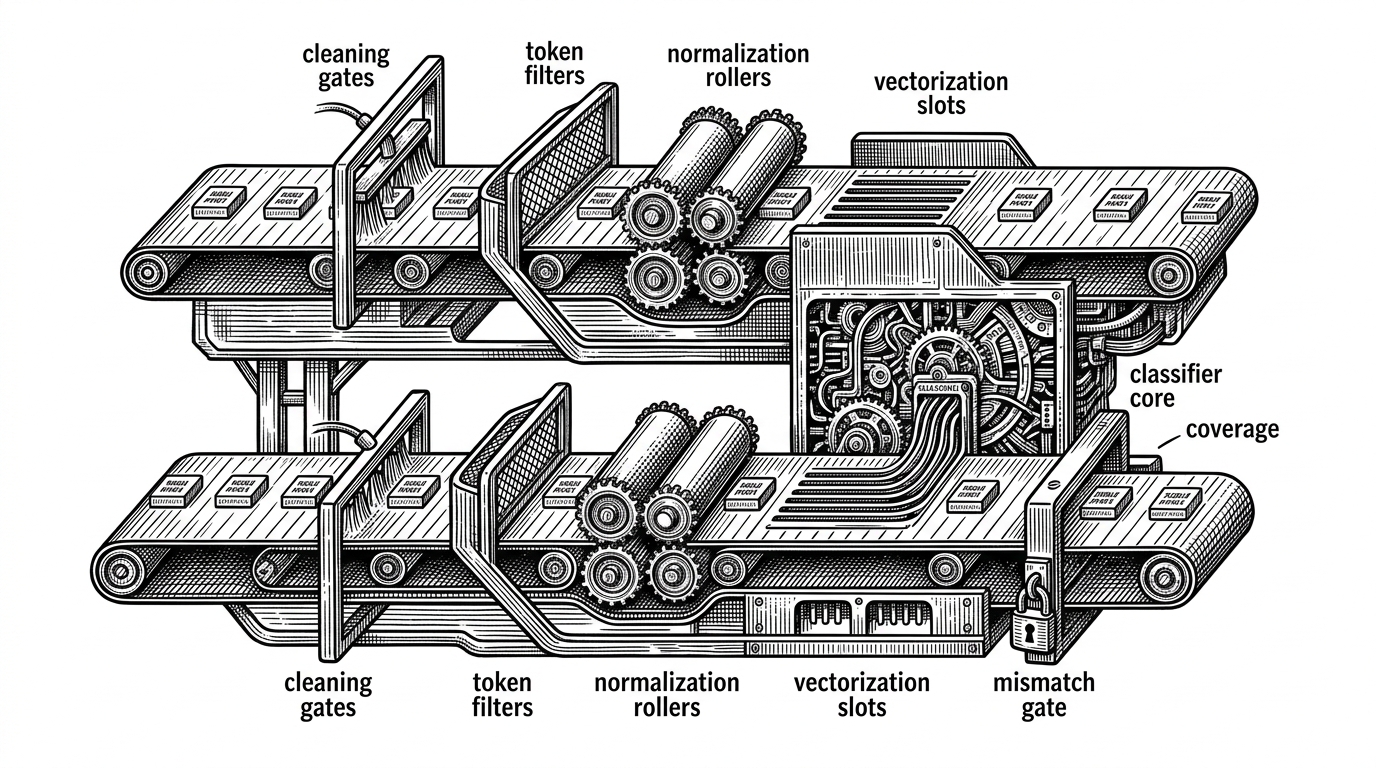
A lot of Streamlit ML apps fail in the same boring ways. They reload too often, they preprocess differently in training and inference, or they break when a dependency expects a local data path. This repo avoids those traps with boring discipline, which is a compliment.
The app caches the model load, keeps NLTK assets inside the project, and mirrors the same cleaning logic used during training. That matters because sentiment models are fragile when the live input looks different from the training input. If the text pipeline drifts, the model starts guessing in the dark.
Why this belongs in the good student project category
This is a functional prototype, and it is honest about that. The codebase looks like a converted notebook in places, which is normal for a learning project. But the structure is clear, the app works, and the implementation choices are coherent.
| Signal | What it suggests |
|---|---|
| Single-purpose repo structure | The author optimized for clarity, not abstraction |
| Classical ML models | The goal was learnability and interpretability |
| Runtime model fetch | The repo stays lightweight on GitHub |
| Future enhancement notes | The project has an obvious next step into FastAPI or transformers |
That combination is more valuable than a flashy demo with no architecture. It shows how to move from a notebook mindset to something a non-technical user can actually click.
Compared with similar Streamlit sentiment apps, what stands out?
This repo sits in a crowded niche. Plenty of GitHub projects do some version of text classification in Streamlit. The differentiator here is not novelty. It is clarity, restraint, and a thoughtful workaround for model delivery.
| Repo | Surface shape | Distinctive strength | Limit |
|---|---|---|---|
| Vaishnavish05/Sentiment-Analyzer | Streamlit text sentiment app | Lightweight deployment with mirrored preprocessing | Modest scope |
| SiddiquiZainab/Sentiment | Streamlit sentiment app | Straightforward educational layout | No standout delivery trick |
| GaganpreetKaurKalsi/SentimentAnalysis-Streamlit | Streamlit NLP demo | Broad beginner accessibility | Typical tutorial-style structure |
| tonykipkemboi/SentimentAnalysisApp | Review sentiment app | Real review-source framing | More about data source than pipeline discipline |
That is why this repo is worth covering. It is not trying to be the biggest idea in the room. It is trying to be the clearest bridge between classical NLP and a shareable web interface, and it succeeds at that.