Vinifera: The Watchtower That Scans GitHub Like a Security Team Would
A Ruby on Rails recon engine that tracks developer activity, catches stray public repos, and runs Gitleaks inside Docker to keep scans isolated, throttled, and production-safe.

- Vinifera treats public GitHub activity as a live security signal, so a developer can trigger scrutiny even when the repository was never in the monitored inventory.
- Its most distinctive idea is the stray path, which turns unknown public repos into first-class targets instead of blind spots.
- The project pairs durable GitHub recon with containerized secret scanning, so detection, throttling, and isolation are all part of the same system.
- Vinifera is less about inventing a new detector and more about making secret hunting continuous, behavior-aware, and safe to run at organizational scale.
The leak tools most teams imagine are too narrow
Most secret scanners assume the repo list is the truth. Vinifera does not. It watches organization members, follows their public GitHub activity, and treats unexpected pushes as events worth investigating, even when those repos were never in the original inventory.
That is the shift. The unit of concern is not just a repository. It is a person moving through public GitHub space. Vinifera turns that behavior into a perimeter.
Built for a real breach, not a toy problem
Vinifera comes out of a security posture that had to be practical, not academic. The repository’s own framing is a recon and monitoring tool for organizations that want to find internal data leaks on GitHub, and the surrounding Zomato context makes the motive easy to understand: public code exposure is not a hypothetical when the cost of failure is already known.
The hacker has been very cooperative with us. He/she wanted us to acknowledge security vulnerabilities in our system and work with the ethical hacker community to plug the gaps. His/her key request was that we run a healthy bug bounty program for security researchers
That origin matters because it explains the design bias. Vinifera is not trying to be clever for its own sake. It is trying to survive real operational conditions: noisy GitHub APIs, incomplete inventories, and the fact that people make mistakes outside your expected process.
The “stray” repository is the real invention
The best way to understand Vinifera is to compare two paths. A registered target is a repo the system already knows about. A stray target is anything public that a monitored user touches or creates outside that list. That sounds small, but it changes the security model completely.
That is why the project feels more like a watchtower than a scanner. It does not wait for a curated list to be perfect. It assumes the list is incomplete, and it designs around that failure mode.
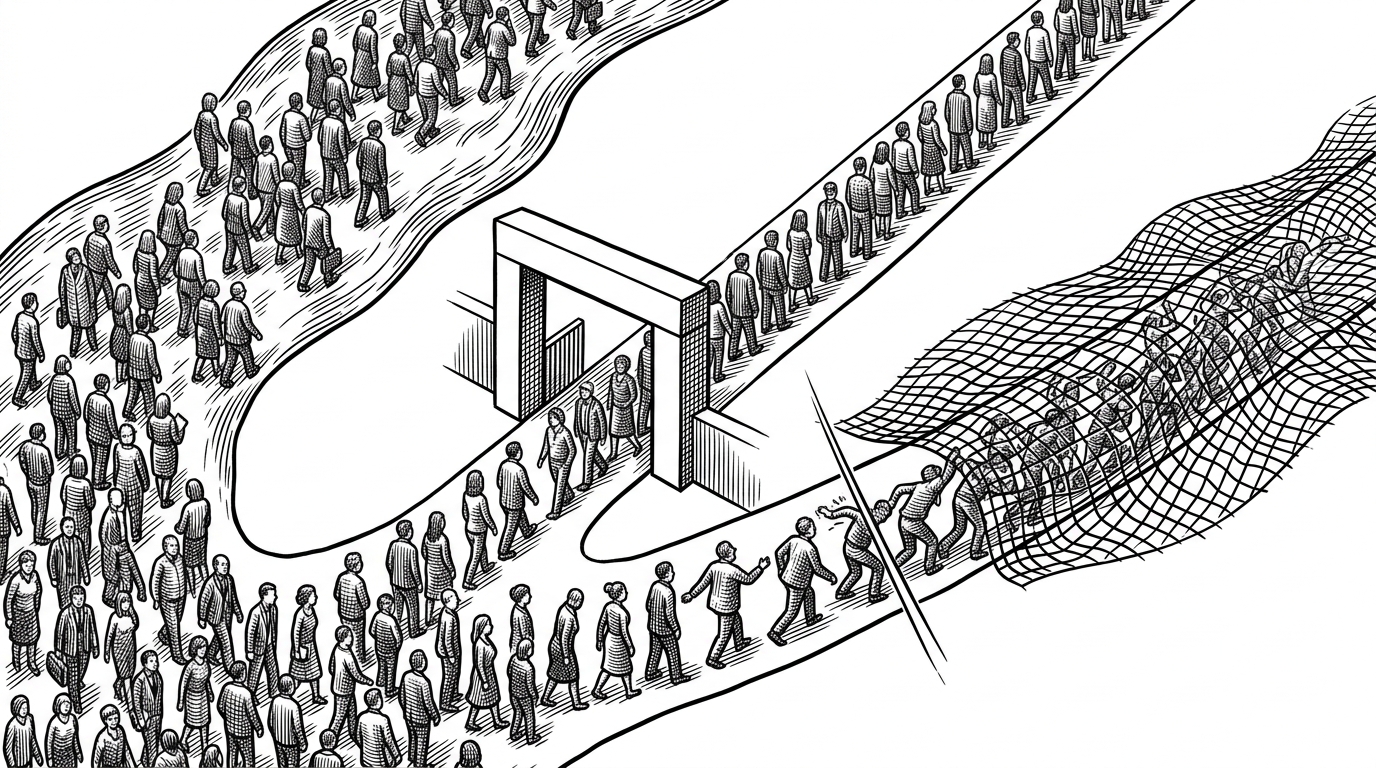
How Vinifera survives GitHub without getting rate-limited into silence
Under the hood, the Ruby on Rails app behaves more like a durable API consumer than a web product. The GitHub wrapper leans on Octokit, pagination helpers, and Faraday caching. Sidekiq and sidekiq-throttled keep jobs from hammering the API into refusal, and the retry logic treats GitHub failures as something to manage, not something to hope away.
class GithubClient
  def user_public_commits(user)
    iterate_pagination("/users/#{user}/events/public") do |event|
      next unless event['type'] == 'PushEvent'
      process_push_event(event)
    end
  rescue Octokit::TooManyRequests
    throttle_and_retry
  end
end
That combination matters because the tool is not checking one repo once. It is watching many users over time. A shallow script might work on a demo account. A production watcher needs caching, backoff, and a queue that can absorb bursts without collapsing.
Why the scanner runs inside Docker
Vinifera does not run secret detection as a loose binary on the host. It wraps Gitleaks in Docker and gives the scanner its own resource limits, its own lifecycle, and its own failure boundaries. That is a security decision as much as an engineering one.
MEMORY_LIMIT = '512m'
CPU_SHARE = '0.3'
IMAGE_VERSION = 'v7.2.0'

container = Docker::Container.create(
  'Image' => "zricethezav/gitleaks:#{IMAGE_VERSION}",
  'Memory' => MEMORY_LIMIT,
  'CpuShares' => (CPU_SHARE.to_f * 1024).to_i
)

monitor_container(container, ttl: 600)
The repo’s code scanner follows a reaper pattern. Containers that go stale, idle, or overstay their welcome get killed. That keeps a secret scan from becoming the thing that takes the whole system down. Security tooling should be boring in production, even when it is pointed at messy code.
Where Vinifera sits relative to Gitrob, TruffleHog, Gitleaks, and GitHub native scanning
| Tool | Primary focus | Continuous monitoring | Deployment model | Where it is strongest |
|---|---|---|---|---|
| Vinifera | Developer activity and stray public repos | Yes | Self-hosted Rails orchestration plus containerized scanning | Behavior-aware monitoring across an org |
| Gitrob | Known GitHub repositories | Mostly no | Standalone scanner | Simple reconnaissance against a defined repo set |
| TruffleHog | Secret hunting in git history | Can be integrated | Standalone Go tool | Deep history inspection and entropy-based detection |
| Gitleaks | Secret detection in repos and CI | Can be integrated | Fast standalone scanner | Practical regex and entropy scanning |
| GitHub native scanning | Platform-managed secrets | Yes for supported repos | GitHub service | Convenience and built-in workflow integration |
The useful distinction is not which tool has the most detectors. It is what each tool treats as the unit of work. Vinifera watches humans and their public behavior. The others mostly scan code surfaces that are already known.
The pattern, in one sentence
Vinifera’s lesson is that internal security tooling gets better when it becomes behavior-aware, API-resilient, and container-isolated all at once.