Point-M2AE: The 3D Masked Autoencoder That Thinks in Pyramids
A deep dive into how hierarchical masking, token merging, and custom CUDA kernels let a point-cloud model learn shape efficiently without flattening geometry into a plain transformer.
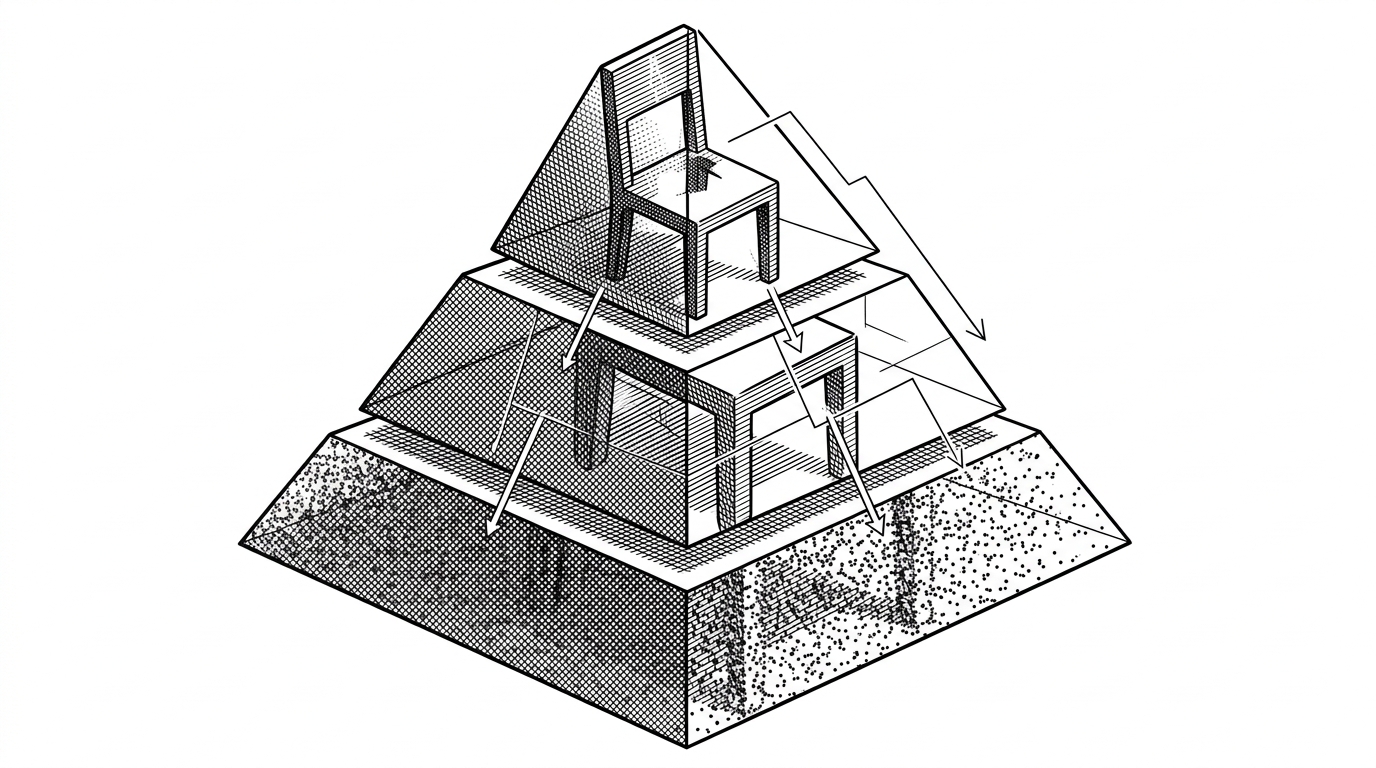

In this paper, we propose Point-M2AE, a strong Multi-scale MAE pre-training framework for hierarchical self-supervised learning of 3D point clouds. Unlike the standard transformer in MAE, we modify the encoder and decoder into pyramid architectures to progressively model spatial geometries and capture both fine-grained and high-level semantics of 3D shapes.
- Point-M2AE’s real move is structural: it turns masked autoencoding into a hierarchy problem instead of a flat token prediction problem.
- Its encoder and decoder behave like a geometry-aware U-Net, which is why coarse shape can guide fine reconstruction without wasting compute.
- The repo’s practical edge comes from the combination of pyramid masking, local token merging, and custom CUDA kernels for expensive point-cloud losses.
- Compared with flatter 3D MAE variants and contrastive baselines, Point-M2AE treats multi-scale geometry as the main inductive bias.
Why a 3D model needs a pyramid, not a flat sequence
Point clouds are messy in a way images are not. They are sparse, irregular, and full of structure at different scales. Point-M2AE starts from that fact and refuses the easy lie that 3D geometry can be treated like a plain token stream.
That is the repo’s core idea: mask and reconstruct through a hierarchy. Instead of flattening points into one sequence, it builds a pyramid that carries coarse shape and local detail together. The result is a model that learns like a person does, silhouette first, detail second.
The trick is masked once, then propagated
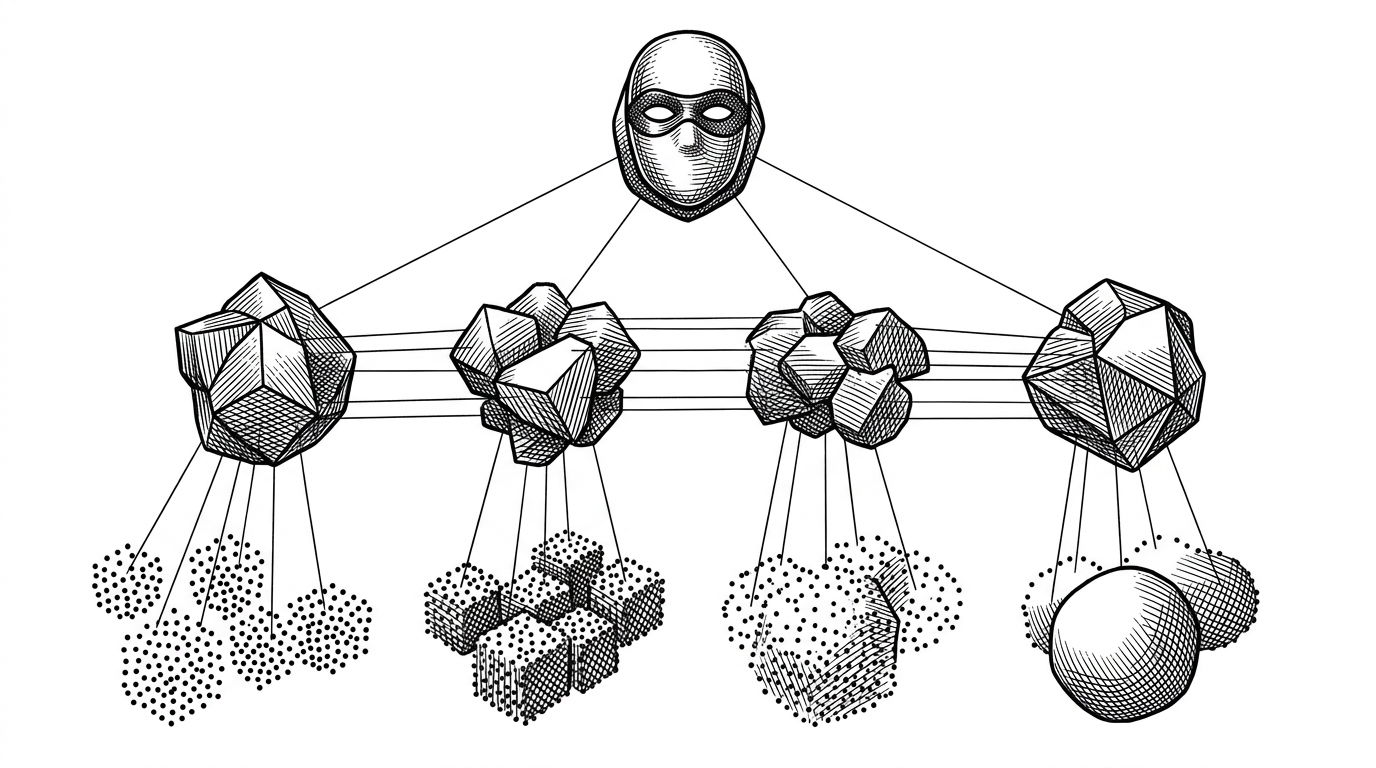
If you remember one mechanism, make it this one. Point-M2AE does not invent a new mask independently at every stage. It creates a coarse mask first, then propagates that decision down through the hierarchy so the fine levels inherit spatial consistency.
That matters because the decoder is not filling random holes. It is solving a geometry-aware puzzle where global structure constrains local completion. The model gets a cleaner learning signal, and the representation it learns is less fragile.
Inside the encoder: token merging with geometric discipline
The encoder, `H_Encoder`, is the part that makes the hierarchy real. It gathers local neighborhoods, merges tokens, and keeps the spatial indices intact so later stages know where every feature came from. This is not just attention. It is attention with geometry attached.
# Simplified idea from the hierarchical encoder
for i in range(num_stages):
    x_vis = gather_visible_tokens(x, idxs[i])
    x_vis_neighborhoods = gather_neighbors(x_vis, neighborhood_idx[i])
    x = transformer_block(x_vis_neighborhoods, local_att_mask[i])
    x = merge_tokens(x)

# The important part:
# the mask and neighborhood structure move together through the pyramid.
The repo also uses locality as a constraint, not a suggestion. Distance-based masks limit attention to nearby regions early on, which gives the network a useful bias for 3D data. The model still uses transformers, but it does not let them float free of shape.
The decoder reconstructs from global shape back to points
Point-M2AE’s decoder behaves more like a geometry-aware U-Net than a standard masked autoencoder head. It starts from compressed structure and expands back toward dense coordinates. That reverse path is why the architecture feels coherent rather than bolted together.
| Stage | Point-M2AE | A flat MAE |
|---|---|---|
| Representation | Pyramid of point tokens | Single token stream |
| Masking | Coarse mask propagated through scales | Mask often applied per token or patch |
| Decoder job | Refine global structure into local points | Predict missing tokens directly |
| Geometry bias | Built in through hierarchy and locality | Usually weaker and more uniform |
The comparison is not just aesthetic. Hierarchy gives the model a better tradeoff between compression and detail. It can move information around with fewer tokens at the top and richer spatial context at the bottom.
Why the repo still needs CUDA
3D learning gets expensive fast. Chamfer Distance and Earth Mover’s Distance are central losses here, and both become painful at scale. Point-M2AE keeps the research practical by compiling custom CUDA and C++ kernels for the pieces that would otherwise drag training into the mud.
// The repo ships custom extensions for point-cloud losses.
// In practice, these kernels keep Chamfer Distance and EMD usable
// during training and evaluation on large point sets.

#include <torch/extension.h>

PYBIND11_MODULE(TORCH_EXTENSION_NAME, m) {
    m.def("chamfer_distance_forward", &chamfer_distance_forward, "Chamfer forward");
    m.def("emd_forward", &emd_forward, "EMD forward");
}
That low-level work is part of the story. A model like this is not just an idea in a paper. It is a pipeline that has to survive real training loops, memory pressure, and benchmark-scale point clouds.
How Point-M2AE differs from Point-BERT, Point-MAE, and contrastive methods
Point-M2AE lives in the same family as other self-supervised 3D systems, but its bias is different. Point-BERT relies on a different discrete tokenization path. Point-MAE is closer to a plain masked autoencoder. CrossPoint takes a contrastive route. Point-M2AE is the one that treats hierarchy as the main event.
| Project | Pretext task | Architecture shape | Masking strategy | Reconstruction target | Why Point-M2AE is different |
|---|---|---|---|---|---|
| Point-BERT | Predict discrete point tokens | Flat transformer-style | Token masking after discretization | Token prediction | Uses a different tokenization philosophy |
| Point-MAE | Masked autoencoding for point clouds | Mostly single-scale | Token masking on point sets | Coordinate reconstruction | Less structurally hierarchical |
| CrossPoint | Contrastive alignment | Two-view representation learner | No masked reconstruction core | Embedding agreement | Learns by matching views, not rebuilding shape |
| Point-M2AE | Hierarchical masked autoencoding | Pyramid encoder and decoder | Coarse mask propagated through scales | Progressive 3D reconstruction | Treats geometry as multi-scale from the start |
With a frozen encoder after pre-training, Point-M2AE achieves 92.9% accuracy for linear SVM on ModelNet40, even surpassing some fully trained methods.
What this repo says about the next wave of 3D learning
The bigger lesson is not that 3D needs yet another transformer. It is that 3D needs more structure. Point-M2AE shows how a masked model can respect geometry, stay efficient, and still learn representations good enough to transfer across tasks.
That line of thinking continues in follow-up work like I2P-MAE, which leans on 2D priors to improve 3D pre-training. The direction is clear. The next strong 3D systems will probably be less flat, more hierarchical, and more willing to let geometry shape the model instead of the other way around.