Secure-Audio-Steganography: When the Secret Is in the Pauses
A Python steganography pipeline that asks you to speak the cover text, counts the silence, and hides encrypted bits where the waveform gives you room.
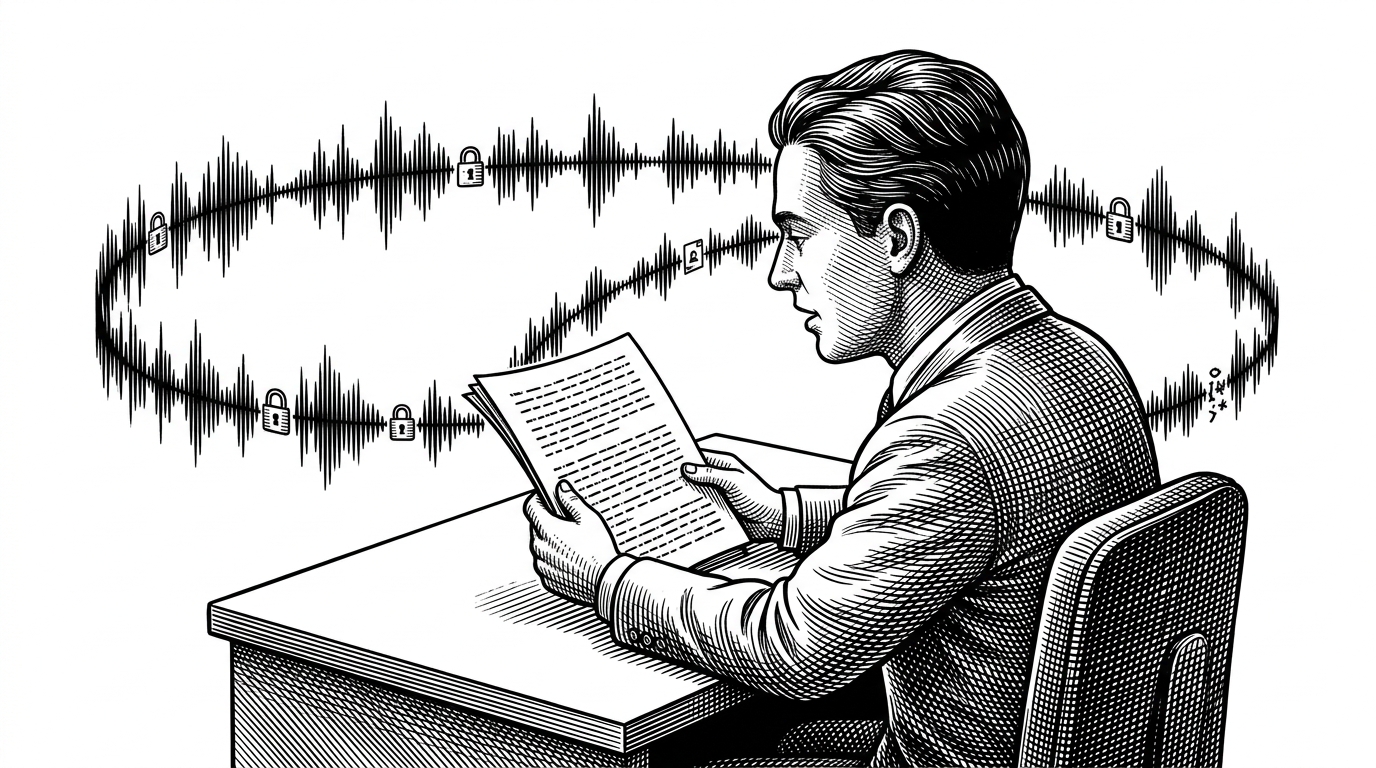

Secure Audio Steganography is an open-source project written in Python to hide secret messages in an audio file using LSB encoding.
- Secure-Audio-Steganography turns the human voice into part of the codec by budgeting message length into required pauses before recording starts.
- Its most distinctive move is not encryption or hiding bits, but manufacturing a usable cover signal by generating speech with enough silence to carry the payload.
- The pause detector combines zero crossing rate and energy so the embedder can aim for the middle of each pause instead of gambling on the edges.
- The repo reads like a teaching system that connects AI prompt generation, DSP, and steganography into one coherent pipeline.
The secret is not in the file. It is in the pauses.
Most audio steganography starts with a finished clip and asks where the bits can fit. This repo flips the order. It starts with the message, calculates how much pause budget it needs, then asks the user to read a generated script aloud so the recording itself becomes the container.
That is the neat trick. The hiding surface is not incidental silence in a random recording. It is designed silence, created by a human reading a cover text that was shaped for the payload.
A pipeline that makes the human part of the codec
The README keeps the pitch simple: this is an open-source Python project that hides secret messages in audio using LSB encoding. The codebase then expands that idea into a fuller pipeline with encryption, pause detection, and a web interface.
The architecture is split cleanly. One side handles encryption and embedding. The other mirrors it for extraction and decryption. Flask sits on top as the user-facing shell, while the DSP work lives in modules such as pause detection and QIM embedding.
# Core flow, simplified
plaintext -> AES-128 CTR -> bits
bits -> pause budget -> cover-text prompt
cover text -> recorded speech -> pause detection
pauses -> QIM embedding -> stego audio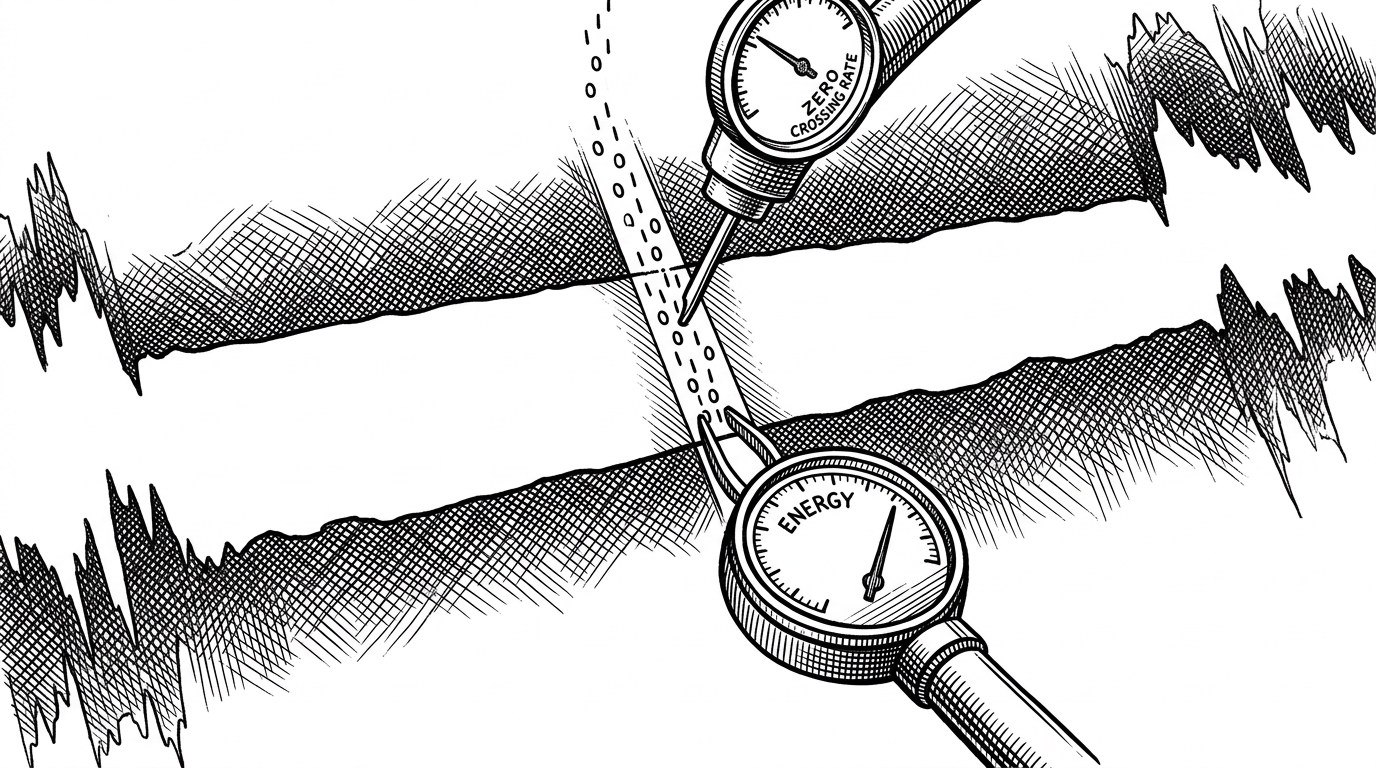
Why pause detection matters more than it sounds
The most interesting technical move in pause_detection.py is the pairing of zero crossing rate with short-term energy. ZCR helps distinguish silence from noisy or unvoiced speech, while energy catches low-amplitude gaps that would otherwise be missed.
That combination matters because the embedder wants stable windows, not merely low volume. By centering the payload inside each detected pause, the system leaves room for detection jitter and reduces the chance that the hidden bits get clipped at the edges.
| Signal cue | What it catches | Why it helps here |
|---|---|---|
| Zero crossing rate | Rapid sign changes in the waveform | Helps separate actual silence from fricatives and rough speech noise |
| Short-term energy | Low-amplitude regions | Finds quiet gaps that can hold bits |
| Centered pause window | The middle of the detected pause | Protects against edge clipping and alignment drift |
QIM is the upgrade from just hiding it in the bits
This repo does not rely on naïve LSB hiding alone. It uses Quantization Index Modulation, which makes the signal snap toward a quantized level based on the bit value. In practice, that is a sturdier place to hide data than simply flipping the last bit of a sample.
# QIM embedding idea
stego = delta * (2 * floor(signal / (2 * delta)) + bit)

# Fixed delta is a trade-off:
# smaller delta -> less audible, less robust
# larger delta  -> more robust, more audible
The choice of a fixed delta is a deliberate compromise. It gives the system a simple rule that is easy to explain and implement, even if it is not the most aggressive option for robustness.
The crypto layer protects the payload, not the channel
The project separates concealment from confidentiality. Steganography hides the existence of the message. AES-128 CTR protects the message content if the concealment fails. That distinction is the right one.
| Layer | Job | What it does not do |
|---|---|---|
| Steganography | Hide the presence of data | Does not make the payload unreadable on its own |
| AES-128 CTR | Encrypt the payload | Does not hide that a message exists |
| Pause-aware embedding | Choose a resilient place to store bits | Does not replace cryptographic security |
There is one reason to stay alert. The repository’s prototype nature shows through in places such as nonce handling and fallback behavior. That does not break the educational value, but it does mean the code should be read as a proof of concept, not a production-secure channel.
What this repo is better at than the usual tools
Compared with tools like Steghide, SilentEye, and AudioStego, this project is narrower but stranger in a useful way. It is less about broad format support or polished UI, and more about exposing the mechanics of capacity, timing, and embedding.
| Tool | Input assumptions | Encryption built in | Algorithmic style | UX style | Best use case |
|---|---|---|---|---|---|
| Secure-Audio-Steganography | User records spoken cover text | Yes, alongside steganography | Pause-aware pipeline with QIM | Flask-backed educational app | Learning how speech, silence, and embedding fit together |
| Steghide | Existing media files | Yes | Classical LSB-style stego | Command-line utility | General-purpose file hiding in supported formats |
| SilentEye | Existing audio or image files | Yes | Stego with GUI workflow | Desktop application | Non-technical users who want a graphical tool |
| AudioStego | WAV files | Varies by implementation | Python LSB steganography | Developer-oriented script | Simple experiments and reference implementations |
The distinction is conceptual. The usual tools start with a file. This repo starts with the payload, then manufactures a speaking script that creates enough room for it. That feedback loop is what makes it memorable.
The limits are part of the story
This is an experimental build, and it reads like one. That is not a flaw so much as a signal about audience and intent. The repo is strongest as a teaching artifact and a prototype of a clever pipeline.
- It is not a broad-format steganography suite.
- It is not a hardened secure messaging system.
- It is a compact example of how DSP, encryption, and prompt generation can cooperate.
That narrowness helps the article land. The interesting question is not whether this replaces established tools. It is whether the pipeline reveals a new way to think about capacity: not as a property of a file, but as something you can budget into a human performance.