loop-engineering-orange-book: The Loop Engineering Orange Book: Why AI Work Is Moving Beyond Prompts
A bilingual guide to building feedback loops for agents, and why verification, not prompting, is becoming the real architecture layer.

- Loop Engineering argues that the durable unit of AI work is not the prompt, but the feedback system that surrounds it.
- Verification is the book’s real hinge, because autonomy only works when something outside the model can judge the output.
- The four-layer stack of prompt, context, harness, and loop turns agent work into an engineering problem instead of a prompting trick.
- The hidden cost of autonomy is maintenance, since every extra loop can create verification debt, comprehension rot, and token blowout.
alchaincyf/loop-engineering-orange-book is a short repo with an oversized idea: the engineer’s job is moving away from writing better prompts and toward designing better loops. That sounds like a slogan until you see the structure underneath it. The book treats AI work as a system of inputs, checks, and retries, not a one-shot conversation with a model.
This repository contains the plain-language guide to Loop Engineering, provided in both Chinese and English.
The prompt is no longer the product
The book’s sharpest move is conceptual. It says prompt quality matters, but only as the first layer of a larger machine. Once a model is doing real work, the question changes from “What should I ask?” to “What environment will keep this work honest, repeatable, and recoverable?”
That is a stronger thesis than “AI agents are useful.” It reframes the field as a design problem about control surfaces, verification, and state. In other words, the interesting object is not the sentence you type. It is the system that decides what happens after the model replies.
What Loop Engineering actually means
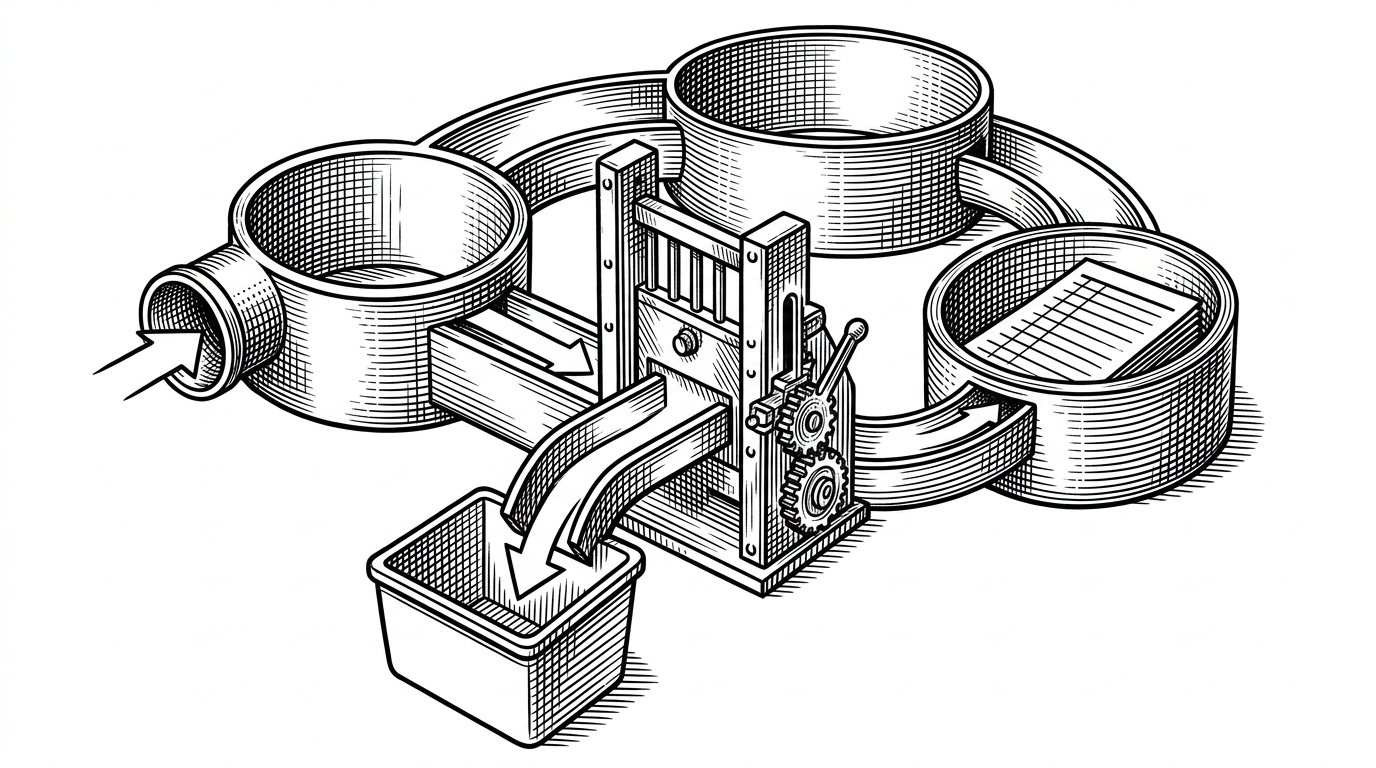
The four-layer stack is the cleanest way to understand the repo. A prompt tells the model what to do. Context supplies the relevant material. A harness gives the model tools and a controlled environment. The loop wraps the whole thing and decides when to repeat, verify, or stop.
That distinction matters because it moves the center of gravity. A prompt is a message. A harness is an environment. A loop is governance. Once you see that separation, “agent design” stops sounding mystical and starts looking like normal systems engineering.
Why verification is the real bottleneck
The most useful technical claim in the book is simple: an AI cannot reliably grade its own work. That means verification has to sit outside the model, or at least outside the same pass that produced the answer. Without that boundary, autonomy collapses into self-affirmation.
The repo’s five-move flow follows that logic: trigger the loop, spawn a sub-agent, verify the output, update state or memory, then decide what happens next. The interesting part is not the moving pieces. It is the fact that the system must be able to say no.
Trigger → Spawn sub-agent → Verify output → Update state/memory → Decide next action
                         ↘ failed? return to correction or retry
That is why the book feels more like engineering than prompting advice. Verification is not a polish step. It is the control plane. If the check is weak, the loop is just a fast way to accumulate errors.
The four costs of autonomy
The repo does not romanticize autonomous agents. It names the tradeoffs. Verification debt appears when the system can generate work faster than it can judge it. Comprehension rot shows up when humans lose sight of what the loop is changing. Token blowout is the obvious bill. The hidden one is maintenance.
| Cost | What it looks like | Why it matters |
|---|---|---|
| Verification debt | Outputs keep flowing, but tests and judges lag behind | The system becomes fast and unreliable at the same time |
| Comprehension rot | No one can fully explain the current state of the code or task | Teams lose the ability to intervene when the loop fails |
| Token blowout | Agents spin through long, inefficient cycles | Automation starts to eat the budget it was supposed to save |
| Maintenance burden | Every loop adds rules, retries, and edge cases | Autonomy becomes another system to operate, not a shortcut |
This is the part that keeps the thesis honest. A loop is not free just because it is automated. Every guardrail creates work. Every retry path adds complexity. Every extra judgment layer needs upkeep.
Who this book is for
| Reader type | What they get | What they probably do not need |
|---|---|---|
| AI-native builder | A practical mental model for agent systems | Basic prompting tips |
| Tool-first developer | A vocabulary for harnesses, checks, and loops | High-level AI hype |
| Team lead or founder | A way to think about cost, reliability, and autonomy | Another vague framework deck |
| Beginner prompt writer | A useful but advanced shift in perspective | A step-by-step prompt cookbook |
This is not beginner material, and it does not try to be. It is for people already using Claude Code, Cursor, Codex, or similar tools who have realized that the real challenge is not getting a good answer once. It is getting a good process every time.
How it relates to Lean Startup, Agile, and DevOps
| Model | Primary unit | Feedback mechanism | Main risk | What Loop Engineering adds |
|---|---|---|---|---|
| Prompting | The prompt | Ad hoc trial and error | Brittle one-off success | A system around the prompt |
| Lean Startup | The experiment | Build-measure-learn | Shallow product learning | A technical loop for agent work |
| Agile / Scrum | The sprint | Reviews and retrospectives | Process without execution control | A more explicit automation stack |
| DevOps / CI/CD | The pipeline | Tests and deployment gates | Tooling without agent autonomy | A loop that includes model behavior |
The comparison matters because it shows what is new here and what is not. Loop Engineering borrows the logic of old feedback systems, but it narrows the focus to AI work. It cares about the operating environment of the agent, the quality of verification, and the mechanics of repetition.
That makes it less like a management philosophy and more like a system design pattern. The book is not arguing that every team should become autonomous. It is arguing that if you want autonomy, you need an explicit loop, not a better vibe.
The practical takeaway
The best question the repo leaves you with is not “What prompt should I write?” It is “What loop will produce, verify, and recover from the work?” That shift is small in wording and large in practice.
The bilingual format reinforces the point. This is not a niche prompt cookbook for one tool or one language community. It is a compact attempt to name a new layer in AI engineering before everyone argues over what to call it.