NightShield: The SOS App Built Like a Reliability System
When panic, bad connectivity, and dead phones are all part of the threat model, NightShield’s answer is redundancy: guest access, live location sync, geospatial alerting, multi-device sockets, and cloud evidence capture.
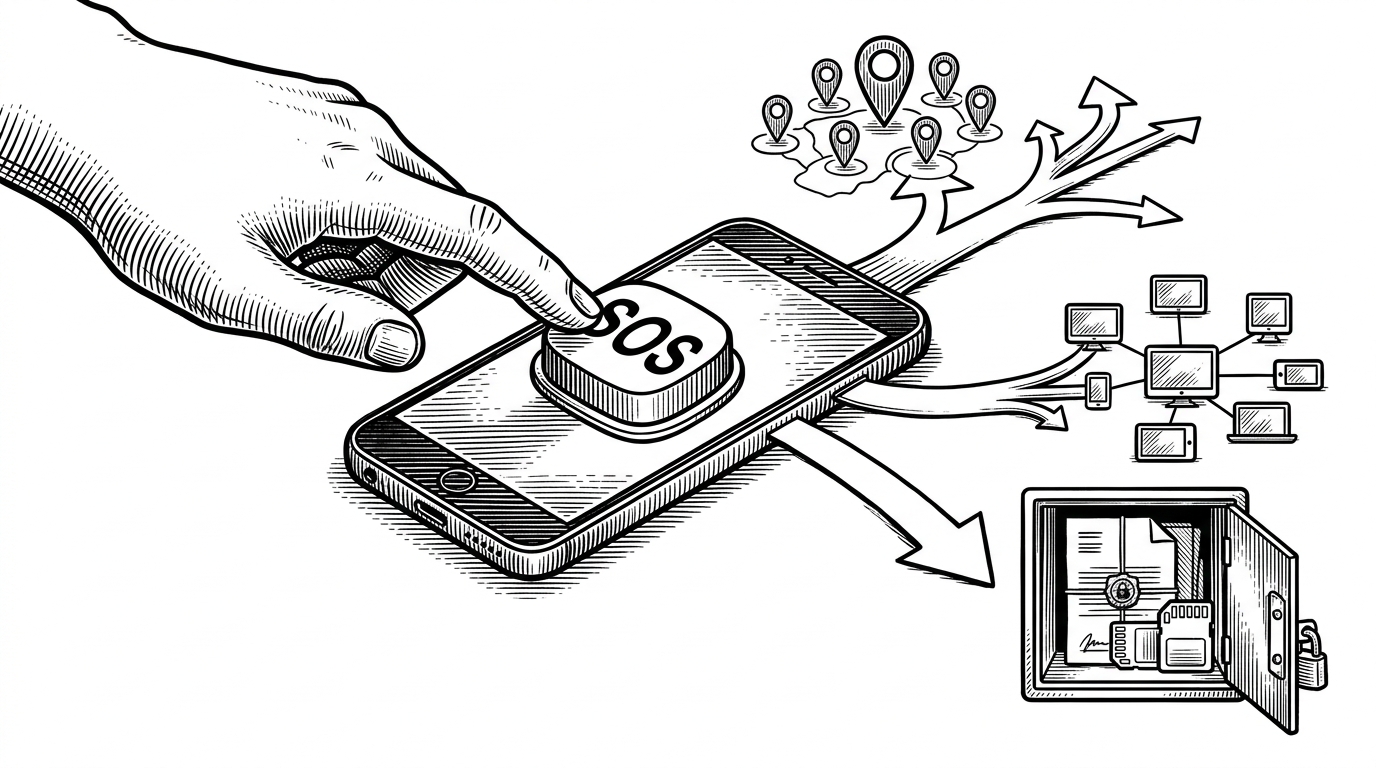
- NightShield treats emergency UX as a reliability problem, so the app keeps adding escape hatches before panic can break the flow.
- Its strongest idea is redundancy, because the alert can still move through nearby geospatial matching, multi-device sockets, and a broadcast fallback.
- Guest access is not a compromise here, it is the point, because safety workflows cannot depend on perfect authentication or calm behavior.
- The architecture is solid for a prototype, but the in-memory socket registry would need a shared store before it could scale across server instances.
Why emergency UX has to think like fault tolerance
NightShield is not trying to win on polish alone. It is trying to survive the moment when a user is stressed, offline-ish, half-locked out, or holding a phone with one shaking thumb.
That changes the design problem. Most apps assume the user can stop, read, and choose. NightShield assumes the opposite and builds a path that still works when the person can barely think straight.
The repository makes that intent visible in the stack: guest mode, live location sync, Socket.IO delivery, nearby matching, and evidence persistence all point toward the same goal. The alert should not die just because one step fails.

The panic path: press, hold, sync, send
The first clever move is the hold gesture. It reduces accidental triggers, but it also does something subtler: it turns the SOS action into an intentional, time-bound state instead of a single brittle tap.
That state machine matters. The flow moves from idle to holding to sending to sent, which is exactly the kind of discipline emergency UX usually skips. There is also a mobile browser audio unlock workaround, which sounds small until you remember that alarms are useless if the browser refuses to play them.

How NightShield makes an alert hard to miss
This is where the app stops looking like a consumer feature and starts looking like infrastructure. The backend verifies the socket handshake with Clerk, so even real-time delivery is authenticated before it enters the network.
From there, the system fans out. A custom socket store keeps one user tied to multiple socket IDs, which is how the same alert can hit more than one device at once. That matters in the real world, where the phone in your hand may not be the device someone else is watching.
The location logic is equally pragmatic. NightShield uses MongoDB’s $near query with a 2dsphere index and a 20 km radius to find nearby users first. If that returns empty, the system falls back to broadcasting to all connected sockets so the alert does not disappear into a dead zone.
The diagram below is the core of the product: one trigger, several gates, and a fallback path that refuses silence.
| Step | What NightShield does | Why it matters |
|---|---|---|
| Trigger | Press-and-hold SOS gesture | Reduces false alarms and makes intent explicit |
| Freshness | Periodic sync plus focus and visibility refresh | The backend gets recent coordinates before the alert starts |
| Identity | Guest prefix or Clerk user | The app stays usable without forcing account friction |
| Routing | Nearby match with geospatial lookup | Primary delivery goes to people physically close to the user |
| Fallback | Broadcast to all connected sockets | The alert still propagates if nearby matching returns nothing |
| Persistence | SOS record plus evidence objects | The incident survives the phone and becomes reviewable later |
Evidence survives the phone
NightShield does not treat an SOS as a transient notification. The SOS model stores more than a moment in time. It keeps evidence data and a target contact object, which makes the event behave more like a record than a ping.
That is the right instinct. In a crisis, the device can fail, but the event should already be out in the world. Cloudinary-backed media and MongoDB persistence turn the alert into something that can be inspected after the fact, not just felt in the moment.
This is also where the product’s shape becomes clear. NightShield is not only about getting help. It is about preserving proof.
Guest mode is not a downgrade. It is the product.
The hybrid auth strategy is one of the smartest parts of the codebase. The middleware accepts both guest-prefixed IDs and authenticated Clerk users, which means the system is willing to reduce friction when the situation demands it.
That is a useful product lesson. Safety-first software often fails when it asks users to complete identity setup before it will listen. NightShield moves the other way. It lets the emergency happen first and the account structure second.
| Dimension | Typical SOS app | NightShield |
|---|---|---|
| Access | Login first | Guest mode or authenticated user |
| Trigger | Tap once | Press and hold |
| Location | Often captured at send time | Refreshed continuously before the alert |
| Delivery | Single channel or single device | Multi-socket fanout plus nearby routing |
| Failure mode | Alert can stall quietly | Fallback broadcast keeps it alive |
| Aftermath | Simple notification | Persistent SOS record with evidence |
What this architecture gets right, and where it would break at scale
The architecture is tidy. Controller, service, route, model, and socket concerns are separated cleanly, and the security layer is not an afterthought. That makes the codebase feel like a real product, not a demo glued together for a screenshot.
The main scaling limit is obvious and honest. The socket store is in memory, which is fine for a single instance and fragile across multiple instances. If NightShield grows, that piece wants Redis or a similar shared pub-sub layer.
That trade-off does not weaken the idea. It clarifies it. NightShield already knows how to be reliable inside one process. The next step is making that reliability survive a distributed deployment.
| Area | Current implementation | Scale-ready direction |
|---|---|---|
| Socket presence | In-memory Map | Shared store such as Redis |
| Delivery topology | Single backend instance | Multi-instance pub-sub fanout |
| Operational scope | Prototype or demo | Production-grade distributed service |
| State durability | Process-bound | Externally coordinated |
NightShield versus the usual SOS app
Most SOS tools optimize for convenience. NightShield optimizes for survivability under stress. That is the real difference, and it shows up everywhere from the trigger to the fallback path.
| Question | Usual SOS app | NightShield |
|---|---|---|
| Can a panicked user trigger it cleanly? | Sometimes | Yes, with press-and-hold |
| Does it require a full account flow? | Often | No, guest mode works |
| Does it refresh location before crisis time? | Usually not | Yes, with background sync and focus refresh |
| Does it rely on one delivery path? | Often | No, it fans out to sockets and nearby users |
| Does it keep evidence after the device fails? | Not always | Yes, via persistent records and media storage |
| Does it fail silently if no one is nearby? | It can | Fallback broadcast is built in |
That makes NightShield feel less like a consumer alert button and more like a panic-tolerant delivery system for distress signals. The design does not pretend panic will make users precise. It assumes panic will make them human, then builds around that reality.