ChronoBook: The Matching Engine That Splits Speed From Proof
A C++17 limit order book that keeps the hot path lean, pushes I/O off the critical path, and uses replay plus a reference matcher to make correctness testable.
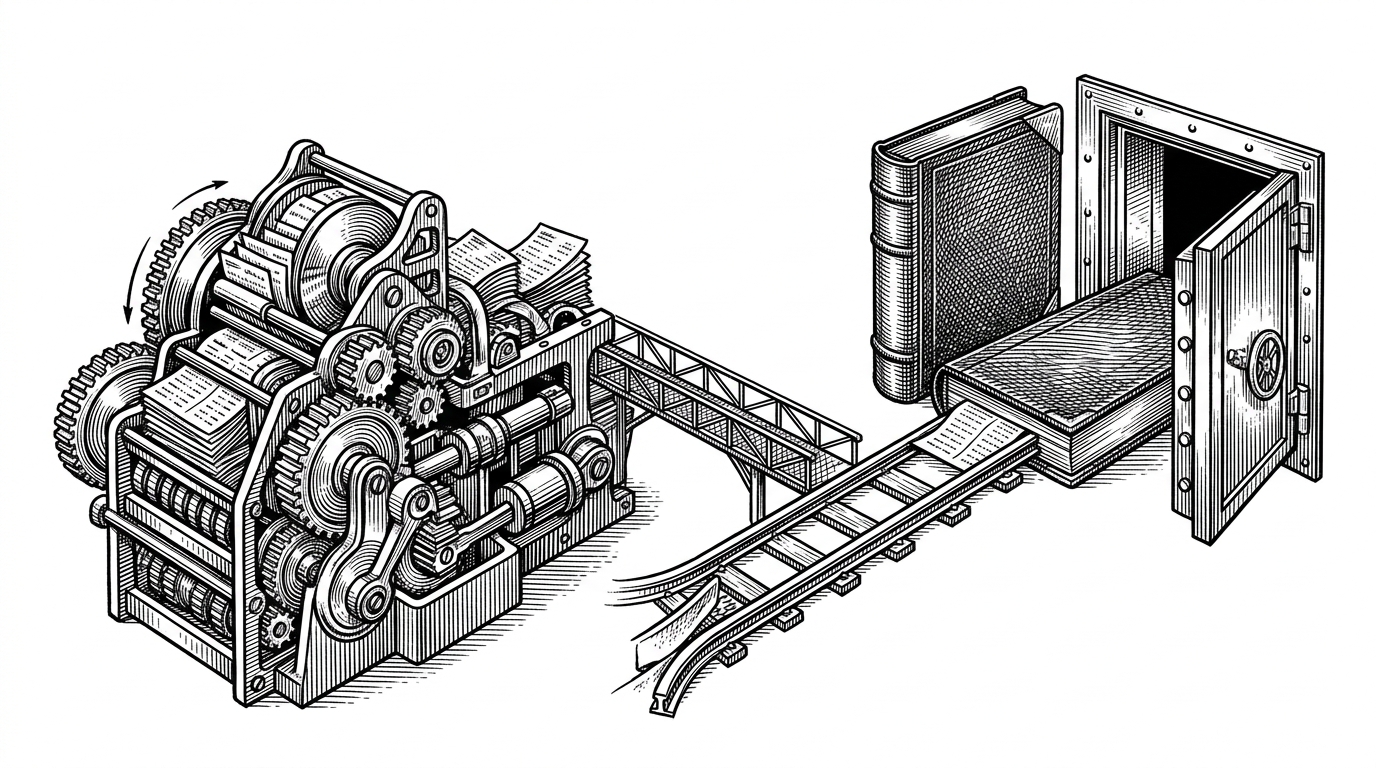
- ChronoBook’s real innovation is the split between a fast matching path and a separate durability path.
- The engine treats replay and a reference matcher as first-class correctness tools, not afterthoughts.
- Its C++17 implementation is shaped around avoiding allocations, contention, and false sharing.
- The design reads less like a hobbyist order book and more like a blueprint for auditable trading infrastructure.
ChronoBook is interesting because it refuses to make one loop do everything. Matching, persistence, and proof live in different lanes, which is exactly what you want when latency and correctness both matter. The architecture says something clear: don’t let disk, allocation, or verification contaminate the hot path.
The engine is really two systems
The first surprise in ChronoBook is that the matching engine is not treated as the whole product. The code splits the problem into a low-latency book update path and a separate durability pipeline. That matters because the worst thing a trading engine can do is let I/O sneak into the critical path.
That separation gives ChronoBook a clean mental model. The matching loop is responsible for state transitions. The durability layer is responsible for making those transitions durable. The replay and reference layers are responsible for proving the transitions were correct.
Why the hot path stays hot
ChronoBook’s performance story starts with memory. Orders are intrusive nodes, so the order itself carries the links instead of being wrapped in extra containers. That keeps pointer chasing predictable and avoids the overhead that comes with more abstract data structures.
// Intrusive order node style: the object carries its own linkage.
struct Order {
    Order* next;
    Order* prev;
    uint64_t id;
    uint64_t price;
    uint32_t qty;
};

// Allocated from a slab pool, not via malloc in the matching loop.
Order* o = slabPool.acquire();
The slab allocator is the other half of that discipline. Orders are preallocated, often in bulk, which turns creation and destruction into simple pointer operations. The repo also leans on cache-friendly details like reserved fill vectors and lock-free single-producer single-consumer buffering.
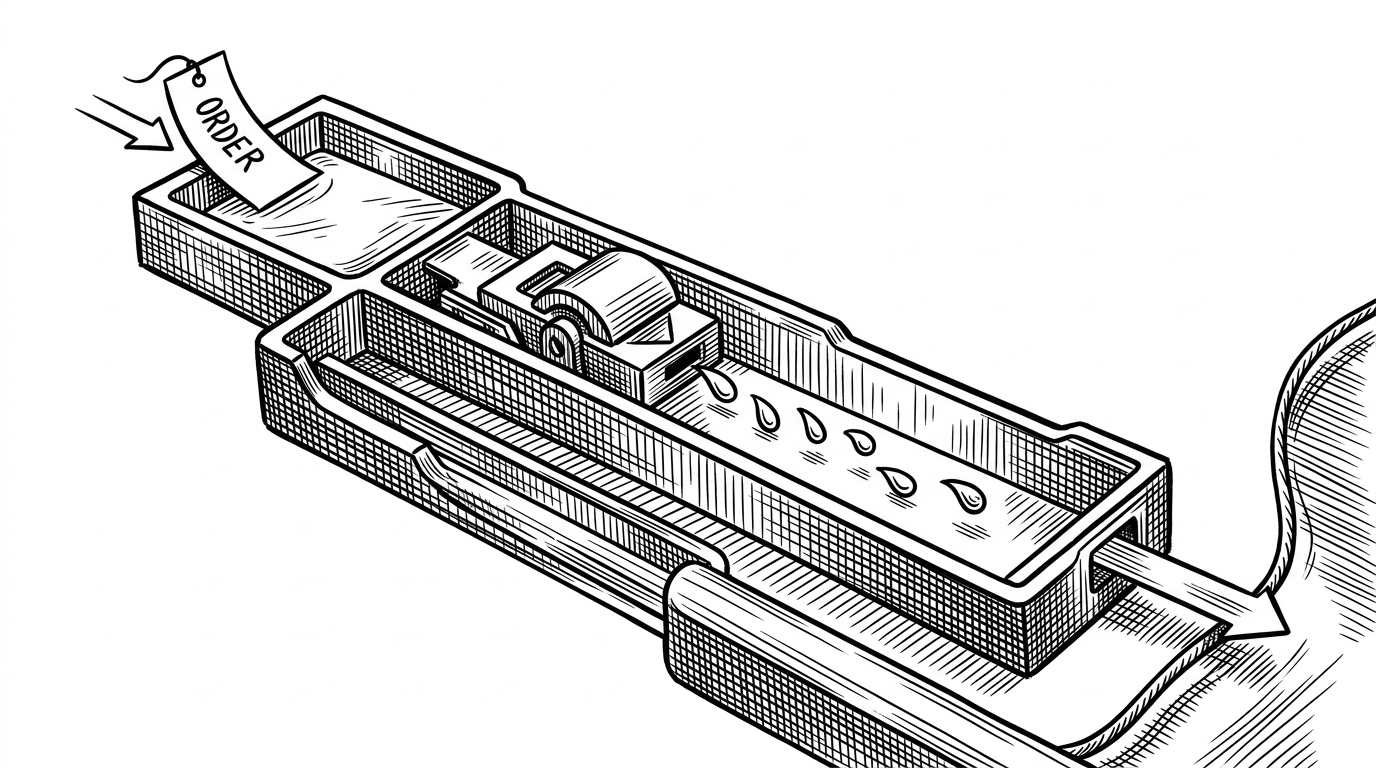
The point is not that ChronoBook uses clever C++ tricks. The point is that each trick reduces a specific source of latency variance. Fewer allocations. Less false sharing. Less blocking. Less reallocation in the loop that actually matters.
The matching book, not just the matching loop
ChronoBook uses a pragmatic hybrid: `std::map` for sorted price levels and `unordered_map` for order lookup by ID. That is a sensible compromise. One structure gives you sorted access to the book’s edges. The other gives you fast cancellation and lookup by identifier.
| Concern | ChronoBook approach | Why it matters |
|---|---|---|
| Price ordering | `std::map` for price levels | Keeps best bid and best offer easy to find. |
| Order lookup | `unordered_map` by order ID | Makes cancel and amend paths practical. |
| Purity | Hybrid structure instead of one container for everything | Optimizes the job, not the ideology. |
| Latency | Lookups are shaped around the critical path | Avoids turning the book into a generic data structure exercise. |
This is one of the places where the repo feels production-minded. It is not trying to be academically elegant. It is trying to be predictable under load.
How ChronoBook proves itself
The deepest idea in ChronoBook is not speed. It is proof. The system uses deterministic replay, logical sequence numbers, and a reference matcher so that correctness can be checked against a slower oracle. That shifts testing from a vague confidence exercise into something closer to differential verification.
This is what makes the design feel serious. A fast engine without a way to replay and compare behavior is hard to trust. ChronoBook bakes that trust mechanism into the architecture instead of bolting it on later.
The durability lane runs behind the book
Persistence is intentionally decoupled. Fills go into a bounded SPSC ring buffer, a background thread drains that buffer, and journaling happens through memory-mapped storage. That means the matching path does not stall waiting for disk, fsync behavior, or a slow downstream store.
The design is not pretending that durability is free. It is doing the opposite. It is saying persistence is important enough to deserve its own pipeline, and important enough to keep out of the way until the matching work is done.
Why this feels more production-ready than hobbyist-fast
ChronoBook signals maturity in the small things. Static assertions protect object layout. Sanitizers are part of the build story. Benchmarks focus on OS-level behavior like futexes versus condition variables. Compiler hints and alignment choices show that the code is written with the machine in mind.
| Signal | ChronoBook | Typical hobbyist engine |
|---|---|---|
| Memory discipline | Slab pools, intrusive nodes, cache-conscious layout | Frequent heap allocation and wrapper objects |
| Concurrency | SPSC buffering and aligned indices | Ad hoc threading or shared queues |
| Correctness | Replay plus reference matcher | Unit tests only |
| Build quality | Sanitizer-friendly, low dependency footprint | Works on the author’s machine |
| Persistence | Separate journal lane | Inline file writes in the hot loop |
That combination matters more than a star count or a benchmark chart. It tells you the project is organized around failure modes the way real infrastructure has to be.
What ChronoBook is really competing against
ChronoBook is not mainly competing against another open-source order book. It is competing against a common architecture: the single-threaded, allocation-heavy engine that does matching and persistence inline, then hopes the load stays forgiving.
| Architecture | Strength | Weakness |
|---|---|---|
| Monolithic matching plus persistence | Simple to understand at first glance | Couples latency to I/O and makes stalls contagious |
| ChronoBook split-path design | Keeps matching deterministic and hot | Requires more deliberate engineering discipline |
| Reference matcher and replay | Makes bugs reproducible | Adds test infrastructure upfront |
The better comparison is not old versus new. It is speed-only versus speed-plus-auditability. ChronoBook clearly chooses the second path.