Compiling the Security Mind: How bmad-cyber-sec Hardens the AI Persona
Moving beyond "vibes" to a schema-first architecture that turns LLMs into validated, role-specific security engineers.
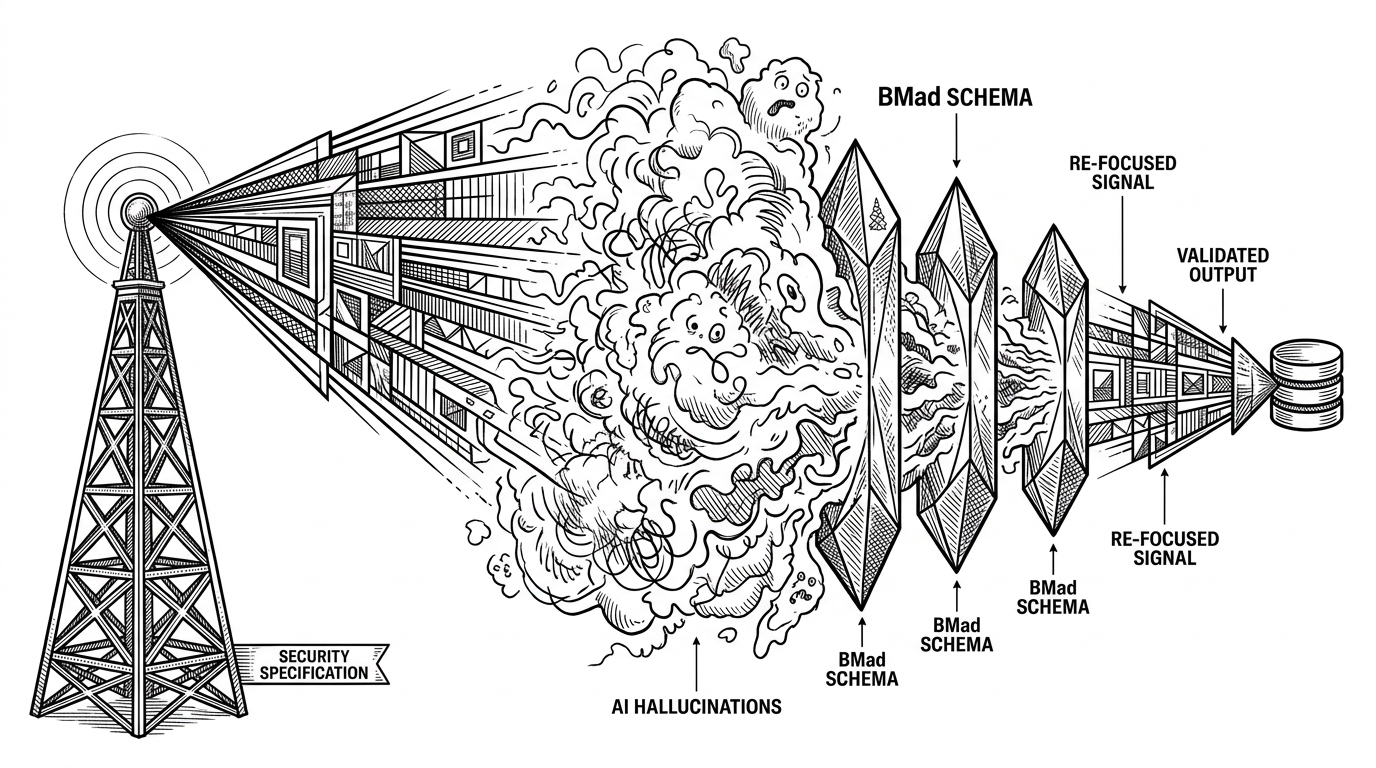
- The bmad-cyber-sec framework prevents agentic drift by treating AI persona instructions as validated code rather than loose prompts.
- A Zod-based compilation engine ensures that security agents adhere to strict YAML-defined schemas before they are deployed.
- The system uses a state-aware routing table to force security workflows through logical phases from discovery to shipping.
- This architecture moves security upstream by embedding autonomous remediation directly into the AI's cognitive framework.
The Entropy of an AI Conversation
Developers are increasingly delegating code generation to AI agents. But there is a hidden cost to this autonomy: context rot. As an AI chat session grows longer, its adherence to initial system instructions naturally fades. A general-purpose LLM told to "act as a security expert" will eventually drift back into its default, permissive state.
This "agentic drift" makes relying on prompt vibes dangerous for cybersecurity. The bmad-cyber-sec repository offers a structural solution. Instead of whispering security rules into a chat window, it treats AI instructions as code. It leverages a schema-driven architecture to ensure that the AI's operational boundaries are programmatically sound before the agent ever boots up.
Compiling the Persona
The core innovation of bmad-cyber-sec lies within its test/schema/agent.js file. The project uses Zod to validate YAML-defined AI agents. This acts as a compiler for the agent's personality and capabilities.
When a developer defines a new security persona, they specify its principles, communication style, and menu triggers. The validation engine ensures these triggers map correctly to keyboard shortcuts. It prevents compound trigger conflicts and guarantees that the persona metadata matches the required schema. If the YAML definition is flawed, the agent fails to compile.

The BMad Pedigree
This repository is a specialized extension of the broader BMad (Breakthrough Method for Agile AI-Driven Development) ecosystem. Launched in January 2026, the module template allows domain experts to package their knowledge into portable, installable units.
BMAD (Breakthrough Method of Agile AI Driven Development) is an open-source framework that provides specialized AI agent personas, guided workflows, and intelligent planning that adapts to project complexity.
By adhering to the BMad standard, bmad-cyber-sec integrates directly into a developer's existing IDE workflow. It transforms specialized security knowledge from a static PDF document into an active, conversational participant in the coding process.
From Script to Action
The module uses a routing table named module-help.csv to connect user commands to specific security phases. These phases include Discover, Define, Build, and Ship. This state-aware workflow ensures that development follows a logical progression.
You cannot trigger a deployment security check if the architecture has not yet been defined. The routing table maps a command like /code:EW to the appropriate YAML workflow file and assigns the validated security agent to execute it.
Hardened Architecture vs. Reactive Scanning
Traditional security tooling relies on static analysis to find bugs after the code is written. Standard AI workflows rely on loosely prompted chat agents to write the code in the first place. The bmad-cyber-sec approach sits between them, offering autonomous remediation guided by a rigid schema.
| Feature | bmad-cyber-sec | Standard LLM Chat | Static Analysis (SAST) |
|---|---|---|---|
| Validation | Zod schema-based | None (Prompt Vibes) | Rule-based signatures |
| Context Awareness | High (Phase-structured) | Low (Fading over time) | None (Code only) |
| Remediation | Autonomous (Agent-led) | Manual prompting | Manual fixing required |
By moving upstream of the vulnerability, this module acts as a security architect rather than just an auditor. It ensures that when an AI agent writes code, it does so within a verified cognitive framework.