bmad-plugins-marketplace: The Registry That Treats Prompts Like Supply Chain Code
Inside BMad’s AI workflow marketplace, where modules are versioned, classified, and pinned like software artifacts, and where trust matters more than freshness.

- BMad’s marketplace is really a governance layer that decides which AI behaviors can be trusted, not just a directory of plugins.
- The repo treats prompt content, provenance, and update policy like supply-chain concerns, with official modules tracking branches and community modules pinned to immutable SHAs.
- Its indexer turns YAML into a reproducible registry, so discovery, validation, and publication all come from the same source of truth.
- The taxonomy suggests a bigger ambition than distribution: BMad is trying to define the ontology of AI workflows.
The first surprise in bmad-plugins-marketplace is that it is not mainly about discovery. It is about restraint. The repo draws a hard line between official modules that can follow main and community modules that must be pinned to immutable Git SHAs, which means the real product is trust, not freshness.
That matters because the artifact being governed is not a binary. It is behavior. In BMad’s world, a plugin can contain prompts, workflow steps, file access, and network calls, so the review surface looks much closer to software supply-chain control than to a normal marketplace listing.
The real product is trust
The registry’s design makes a sharp distinction: official modules can track a branch, while community modules are locked to a specific approved commit. That split is the editorial thesis of the repo. If prompt content can steer an agent, then a prompt bundle without provenance is not a convenience artifact, it is a risk surface.
This repository serves as a marketplace for multiple plugins. Each plugin is developed and maintained in its own repository, but they are all listed here for easy discovery and installation.
That quote describes the basic marketplace pattern. BMad adds a stricter layer on top of it. Discovery is still there, but the module is only accepted into the ecosystem if its identity, trust tier, and versioning rules can survive registry policy.
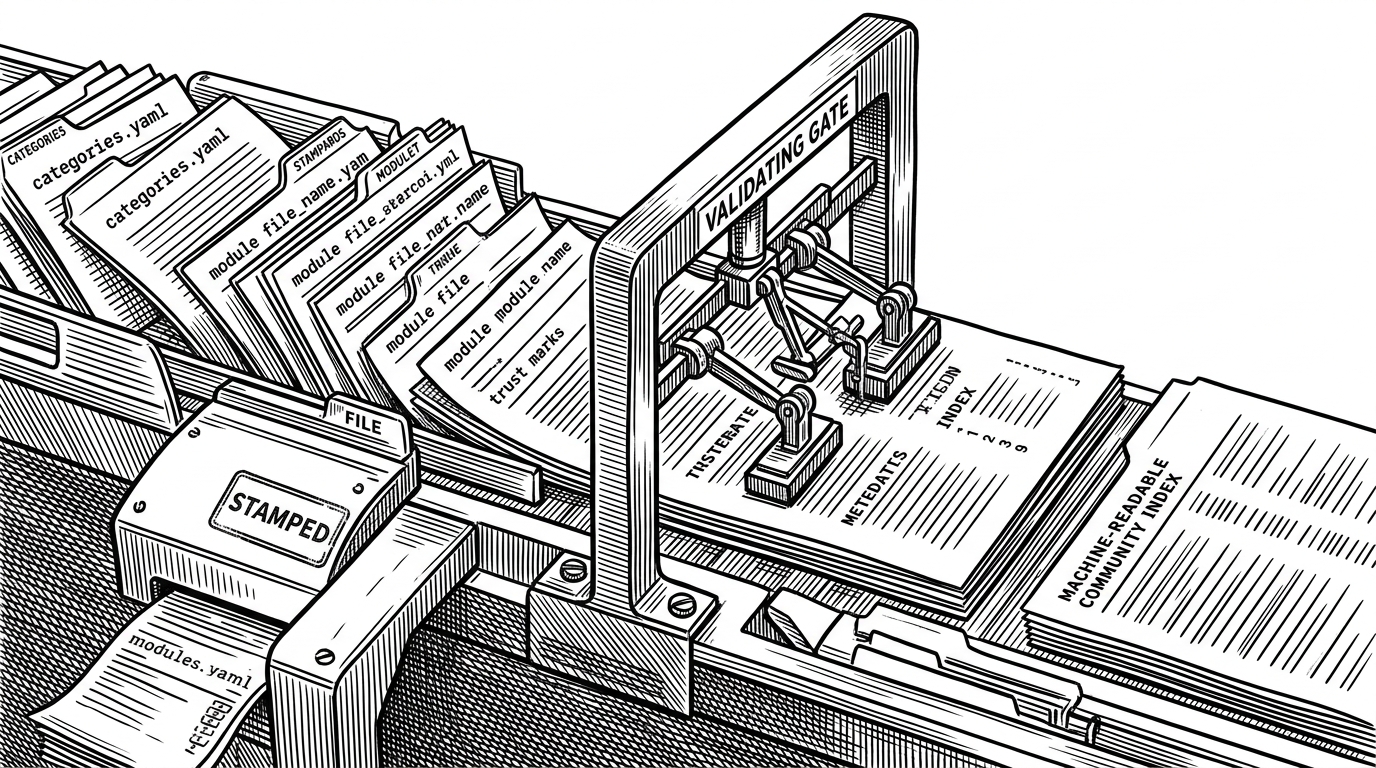
How the registry turns YAML into a marketplace
The repo is built as data-as-code. The core files live under registry/, with separate paths for official, community, and utility modules, while categories.yaml provides the taxonomy. The important thing is not the folder tree itself. It is that the folder tree is the database.
At the schema level, registry-schema.yaml defines identity fields, trust tier, and versioning behavior. That gives each module a policy wrapper, not just a record. The schema is doing governance work before a human ever opens a pull request.
name: bmad-builder
code: bmb
display_name: BMad Builder
trust_tier: bmad-certified
approved_tag: v1.2.0
approved_sha: 7e3c2f1a9b8d4c0f2d6f1a8b9c0d7e6f5a4b3c2d1
That shape matters because it makes the marketplace reproducible. A community module is not just "available." It is anchored. The registry can resolve it the same way every time, which is exactly what you want when the thing being installed can alter an agent’s behavior.
The indexer is the product’s hidden engine
The hidden engine is .github/scripts/generate-index.py. It crawls the registry tree, injects provenance with a directory marker, joins that data to the category taxonomy, and emits both human and machine outputs. In practice, that means the marketplace behaves like a static site generator for trust.
This is the most elegant part of the repository. The registry is not maintained in two places, one for humans and one for machines. The script compiles one source of truth into both forms, which keeps drift low and review simple.
- Source YAML files define the module record.
- The generator adds provenance and classification.
- Validation checks the schema before publish.
- Two outputs keep humans and tools in sync.
Why prompt governance matters more than package versions
Traditional package managers care a lot about dependency graphs, binaries, and API compatibility. BMad cares about those things too, but it cares more about prompt content and script behavior. That is because a prompt can be both product and attack surface. If it changes, the agent changes.
| Dimension | Traditional package manager | BMad registry |
|---|---|---|
| Artifact type | Binary or library package | Prompt bundle, workflow, agent module |
| Trust model | Version numbers and release tags | Pinned SHAs, approved tags, trust tiers |
| Review surface | Code and API compatibility | Prompt content, file access, network calls |
| Update policy | Latest release is often preferred | Official modules may track a branch, community modules stay pinned |
| User intent | Install software | Install behavior |
That is why the contribution templates matter so much. They turn review into a security ritual. A new module is not accepted because it looks useful. It is accepted because its behavior is understandable, auditable, and stable enough to trust.
Where BMad fits in the Claude Code ecosystem
BMad is designed to plug into Claude Code through marketplace configuration, which makes it an extension layer for AI development workflows rather than a generic app store. The ecosystem goal is simple: let teams add specialized behavior without turning the base agent into a custom fork.
That positioning also explains the registry architecture. If the marketplace is meant to feed an agent runtime, then discoverability alone is not enough. The system has to preserve the exact module that was reviewed, approved, and installed.
The taxonomy reveals the ambition
The category map matters because it shows BMad thinking in terms of roles and domains, not just features. A taxonomy turns a pile of modules into a model of the AI engineering world. That is a bigger ambition than distribution. It is ontology.
Once you do that, the marketplace stops being a shelf and starts looking like a language. Each category says what kinds of agent behavior the ecosystem thinks are worth naming, reviewing, and reusing.
| What the taxonomy does | Why it matters |
|---|---|
| Groups modules by domain | Helps users find the right behavior fast |
| Encodes trust and classification | Makes governance visible in the listing itself |
| Normalizes AI workflow roles | Suggests the ecosystem is becoming a vocabulary, not a catalog |
What this marketplace is really becoming
The direction is clear. BMad is building a registry for executable AI behavior, with provenance, taxonomy, and trust policies baked in from the start. That is a different mental model from package distribution. It is closer to a governed marketplace of constrained agent capabilities.
If the rest of the software world learned to treat dependencies like supply-chain assets, AI toolchains may need to go one step further. They will need to treat instructions as the package, and trust as part of the install.