chhayaproject4: How a Heartbeat Becomes a Feature Table, Then a Prediction
A compact ECG notebook that turns noisy physiological signals into interpretable inputs for XGBoost, showing why medical AI often works better as engineering than as end-to-end magic.
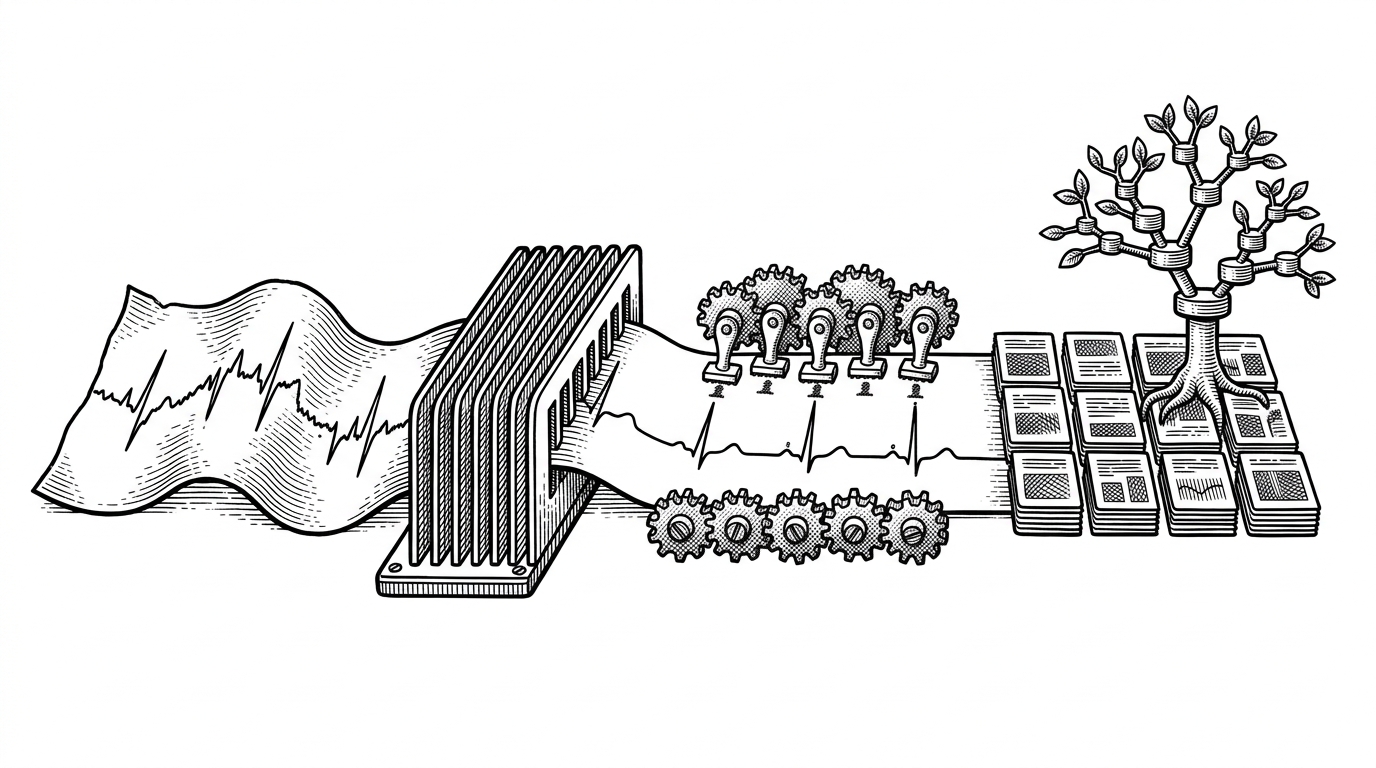
- This notebook treats ECG analysis as an interpretability problem first and a modeling problem second.
- Its most important design choice is to convert raw heart signals into a tabular feature set before training XGBoost.
- That feature-first pipeline is a better fit for noisy, small, and clinically sensitive datasets than a black-box end-to-end model.
- The repo is a strong proof of concept, but it is still notebook-shaped rather than production-shaped.
The interesting thing here is not that the repository can read an ECG. It is that it refuses to let the waveform stay a waveform. Instead, it turns a messy physiological signal into something smaller, cleaner, and easier to argue with.
Why this notebook chose features over raw signal learning
If you came in expecting a deep net, this repo takes a different path. It leans on wfdb for signal ingestion, neurokit2 for ECG-aware cleaning and peak detection, and xgboost for classification. That stack says a lot: this is a notebook built around usable structure, not brute-force representation learning.
| Approach | Input | Training complexity | Interpretability | Data hunger | Debuggability | Fit for small medical datasets |
|---|---|---|---|---|---|---|
| Raw-signal deep learning | Waveform samples | High | Lower | High | Harder | Sometimes strong, but expensive to tune |
| Feature-first boosting | Engineered ECG features | Moderate | High | Lower | Easier | A very practical default |
That does not make deep learning wrong. It makes it a different optimization target. In healthcare, the best model is often the one you can inspect when the result looks strange.
Inside the pipeline
The notebook’s flow is straightforward: mount Drive, load ECG records, clean the trace, detect peaks, derive features, and train the classifier. The structure matters because each stage reduces uncertainty before the next one starts making decisions.
from google.colab import drive
import wfdb
import neurokit2 as nk
from xgboost import XGBClassifier

# 1. Mount data
# 2. Load ECG records with wfdb
# 3. Clean signal and detect peaks with neurokit2
# 4. Build feature table
# 5. Fit XGBoost
The Colab-first setup is convenient, but it also tells you where the project lives: as an exploratory notebook, not a packaged library. That is fine for a proof of concept. It just means reproducibility depends on the notebook cells staying in sync with the data in Drive.
What neurokit2 adds that plain DSP does not
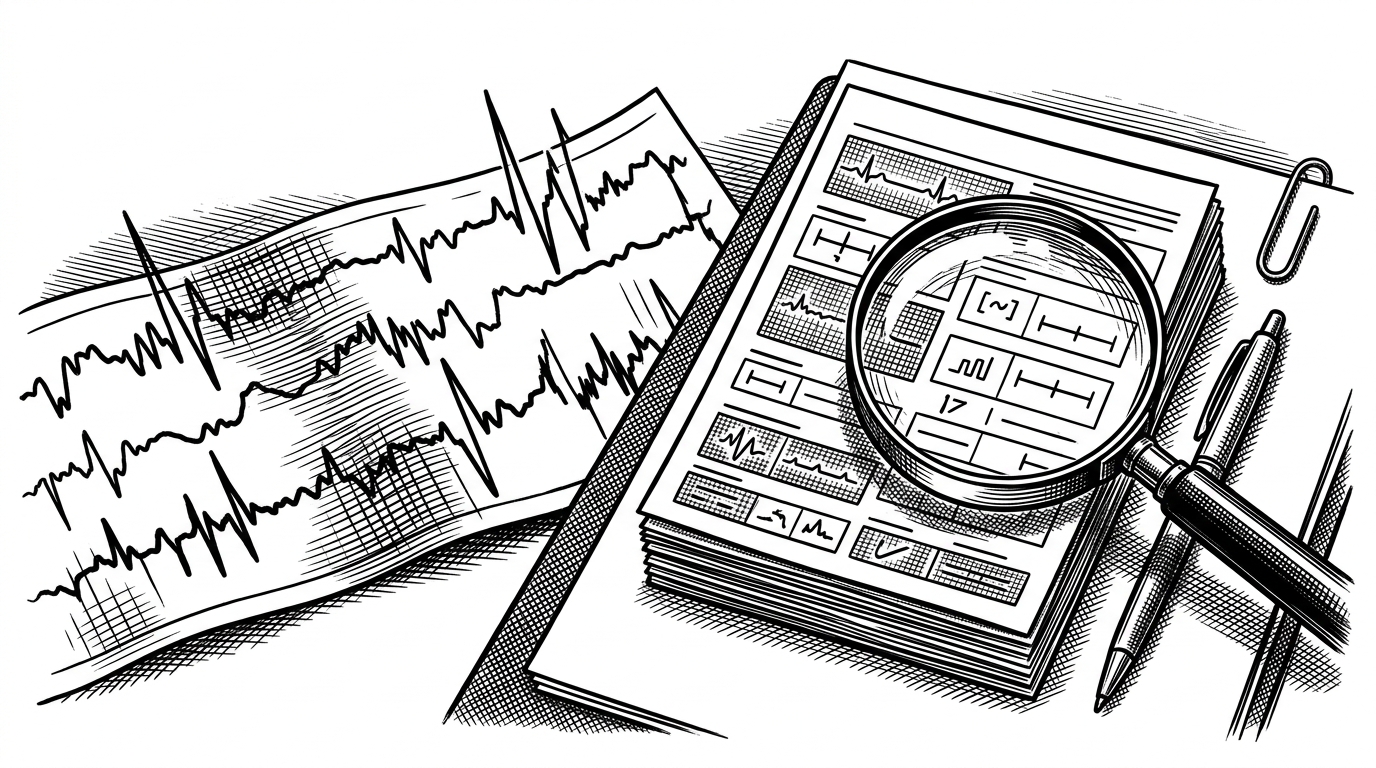
This is where neurokit2 matters. It is not just a filter library. It is a signal-processing layer that knows the vocabulary of ECG, so the notebook can move from voltage trace to clinically meaningful structure without reinventing the wheel.
That includes the kind of preprocessing medical data asks for all the time: noise reduction, peak detection, and feature extraction that compresses a long waveform into a compact representation. The result is easier to inspect and easier to compare across patients or records.
Why XGBoost fits this problem
| Model choice | Why it helps here | Tradeoff |
|---|---|---|
| XGBoost | Works naturally on tabular features and handles mixed signals well | Less expressive than a sequence model |
| 1D CNN / RNN | Can learn directly from raw waveforms | Needs more data, more tuning, and more care |
| Rule-based diagnosis | Very explainable | Often too rigid for real-world signal variation |
XGBoost is a sensible ending point because the notebook has already done the hard part: it has turned a difficult signal into structured inputs. At that point, gradient boosting is less a compromise than a fit. It gives you a model that is strong on tabular data and easier to reason about than a black-box temporal network.
That matters in a clinical setting. If a model flags a rhythm problem, the next question is usually not just whether it was right. It is why it made that call.
What the repo gets right, and what it leaves undone
- It makes a good domain choice by extracting ECG features before modeling.
- It uses specialized libraries instead of forcing generic tools to do medical work.
- It keeps the workflow simple enough to inspect inside a notebook.
- It stops short of packaging, documentation, and reproducible training scaffolding.
That last point is the right critique. The repository is not trying to be a polished platform. It reads more like a strong technical prototype, one that shows judgment in how it treats the data. For a medical AI task, that judgment is the story.