The Remote Brain for Coding Agents: Inside chroma-core/package-search
How a Python pipeline and a GitHub repository orchestrate a massive, continuously updated vector database of the world's open-source packages.
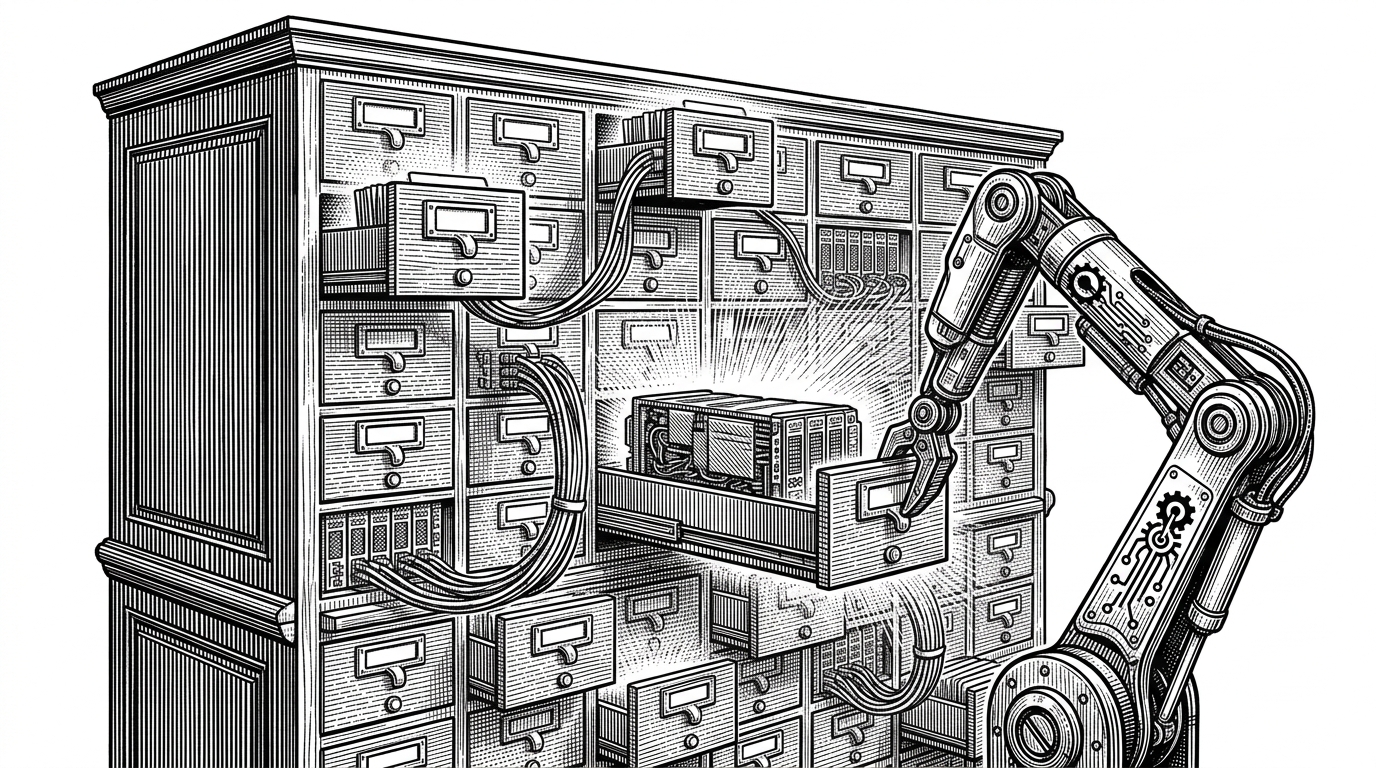
- Chroma solves the problem of hallucinated API calls by providing a centralized, remote Model Context Protocol (MCP) server that indexes thousands of open-source packages.
- The entire state of this massive vector database is managed declaratively via a public GitHub repository, utilizing a strict Data-as-Code architecture.
- A robust Python 3.13 pipeline with exponential backoff syncs the database five times a day, converting community pull requests into immediately available AI context.
The Context Window Bottleneck
Context windows are finite. While modern AI coding assistants excel at understanding the proprietary code sitting on your local machine, they consistently stumble when interacting with third-party libraries. If an AI agent has not been explicitly trained on the latest major release of a popular framework, it will confidently hallucinate deprecated API calls.
You cannot simply paste the entire AWS SDK or React documentation into your prompt every time you ask a question. The ecosystem needed a way to perform "RAG for dependencies"—a system that allows agents to quickly look up the exact syntax and documentation for external libraries on the fly.
The Rise of Remote MCP
The Model Context Protocol (MCP) emerged as the standard way to connect AI models to external data sources. Initially, the dominant pattern was "Local MCP," where developers run small servers on their own laptops to index their local files or query personal SQLite databases.
Chroma took a different approach. Instead of asking every developer to download, embed, and index the entire npm registry on their MacBook, they built a centralized, remote MCP server.
| Feature | Local MCP Servers | Chroma Remote MCP |
|---|---|---|
| Compute Cost | High (runs embeddings locally) | Zero (handled by Chroma Cloud) |
| Scope | Proprietary workspace files | Entire open-source ecosystem |
| Freshness | Real-time upon file save | Synced 5x daily via GitHub Actions |
| State Management | Ephemeral or local database | Declarative GitOps via versions.json |

Data-as-Code: The GitHub Control Plane
The most surprising aspect of Chroma's remote MCP architecture is how they manage the underlying data. The control plane for this massive cloud vector database is simply a public GitHub repository. chroma-core/package-search uses a strict Data-as-Code architecture. The repository is essentially a giant configuration manifest.
{
  "native_identifier": "react",
  "registry": "npm",
  "sentinel_timestamp": "2023-10-25T12:00:00Z"
}
Directories map to package registries like npm, PyPI, and crates.io. Inside these directories are thousands of `config.json` files that dictate the exact ingestion rules for each package. To update the database, you don't run an INSERT statement; you open a pull request.
The Industrial Sync Engine
To turn these text files into a live database, Chroma relies on a heavy-duty Python pipeline located in the .github/scripts/sync directory. This pipeline runs on Python 3.13 and uses uv for lightning-fast dependency resolution.
Syncing over 3,000 packages five times a day requires resilience. The engine utilizes a custom exponential backoff decorator to handle the inevitable flakiness of cloud APIs. Once a package is successfully ingested in the data plane, the script updates a colossal versions.json file, which serves as the definitive lockfile for the global vector database.
Safely Crowdsourcing a Global Index
Because the repository accepts community pull requests, it requires a rigorous validation layer. Scripts like validation_utils.py enforce strict schema constraints to prevent malicious or malformed configurations from breaking the global MCP server.
This repository contains a curated list of public code packages that Chroma keeps indexed into Chroma collections. The repository currently indexes **3K+** packages across various registries.
By offloading the compute and storage to a remote server, and democratizing the curation process through a familiar GitHub workflow, Chroma has built a critical piece of infrastructure for the next generation of AI coding agents.