Flash-MoE: The Apple Silicon Engine That Makes a 397B Model Behave Like It Has More Memory
A pure C and Metal inference stack for Apple Silicon that streams MoE experts from SSD, leans on macOS page cache instead of custom caching, and turns hardware constraints into the architecture.
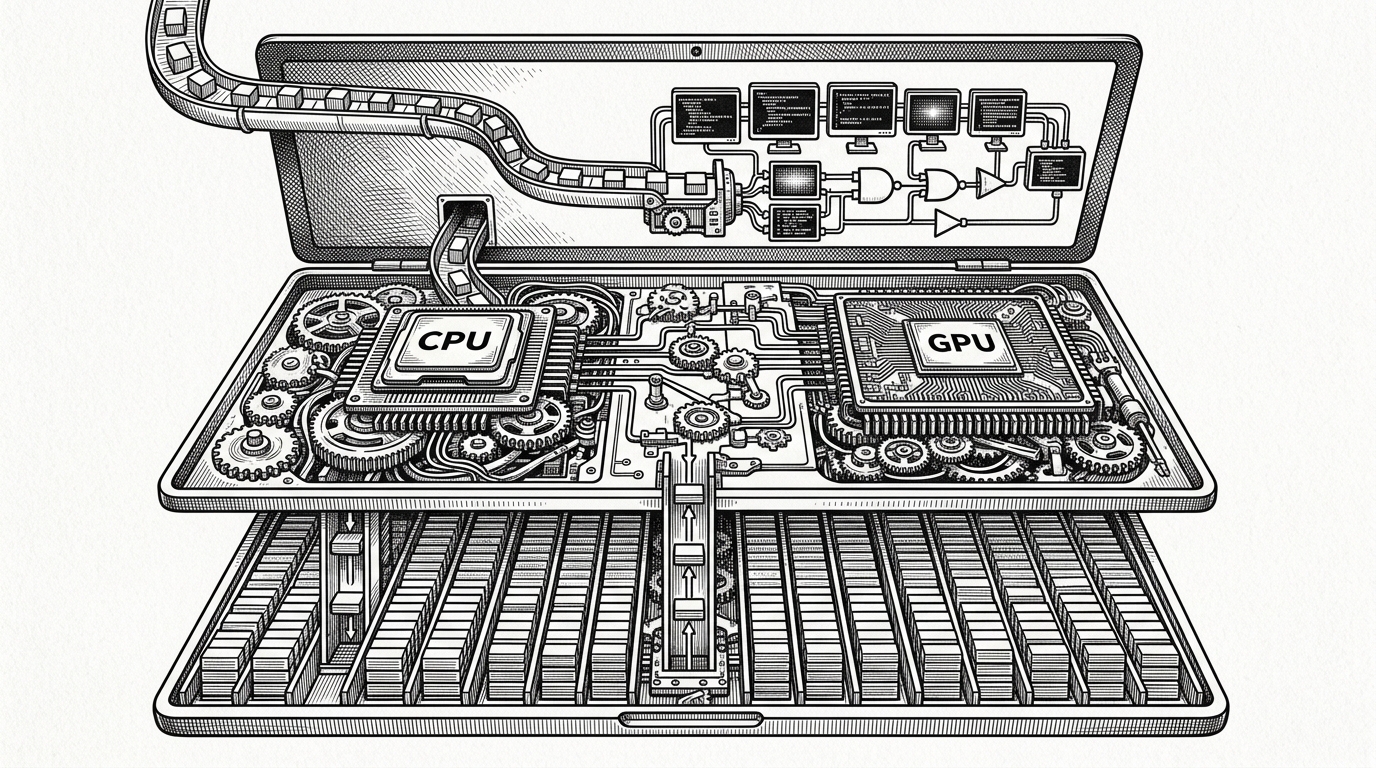
- Flash-MoE works because it treats the OS, SSD, CPU, and GPU as one coordinated memory system.
- Its biggest advantage comes from narrowing the problem to one model family and one hardware stack.
- The repo proves that latency hiding and expert streaming can matter more than brute-force residency in RAM.
- The project is a systems-engineering argument for local AI, not just a stunt about running a huge model on a laptop.
Flash-MoE is not trying to win the generic inference framework race. It is trying to make one absurdly large MoE model behave on one very specific machine, and that choice changes everything.
The MacBook Is Not the Bottleneck. Memory Is.
The headline feat is simple to state and hard to believe: a 397B parameter model can be used on consumer Apple Silicon by refusing to keep the whole thing resident in RAM. Flash-MoE loads only the active experts for each token, then lets the rest stay on SSD until they are needed.
That reframe matters. Once you stop treating the model as something that must fit in memory, the problem becomes a systems question about overlap, latency hiding, and where each part of the machine is best used.
Expert weights (209GB at 4-bit) are read from NVMe SSD on demand via parallel pread() with GCD dispatch groups. Only the K=4 active experts per layer are loaded (~6.75MB each). The OS page cache manages caching — no custom cache needed ("Trust the OS" principle).
Why Flash-MoE Bets on macOS Instead of Fighting It
Most systems would put a bespoke cache between the runtime and the disk. Flash-MoE does the opposite. It trusts macOS page cache, uses ordinary pread(), and lets Darwin handle memory pressure.
That is the contrarian move at the center of the project. The repo treats the operating system as an optimization layer, not an obstacle to route around.
int fd = open(model_path, O_RDONLY);
ssize_t n = pread(fd, expert_buf, expert_bytes, expert_offset);
if (n != expert_bytes) {
    perror("pread");
    return -1;
}

// The point is not custom caching.
// The point is to let the OS decide what stays hot.
The Pipeline: Projections, Routing, Experts
Inside infer.m, the model is organized around a triple-buffered command pipeline. One stage handles projections, another handles routing, and a third handles expert execution. The point is to keep those stages overlapped across layers instead of serializing them into a single wait loop.
That matters because Flash-MoE is not just moving data. It is scheduling data movement around compute so the GPU, CPU, and SSD each stay busy doing the work they are best at.
Inside the Hot Path: The Metal Kernel That Does the Heavy Lifting
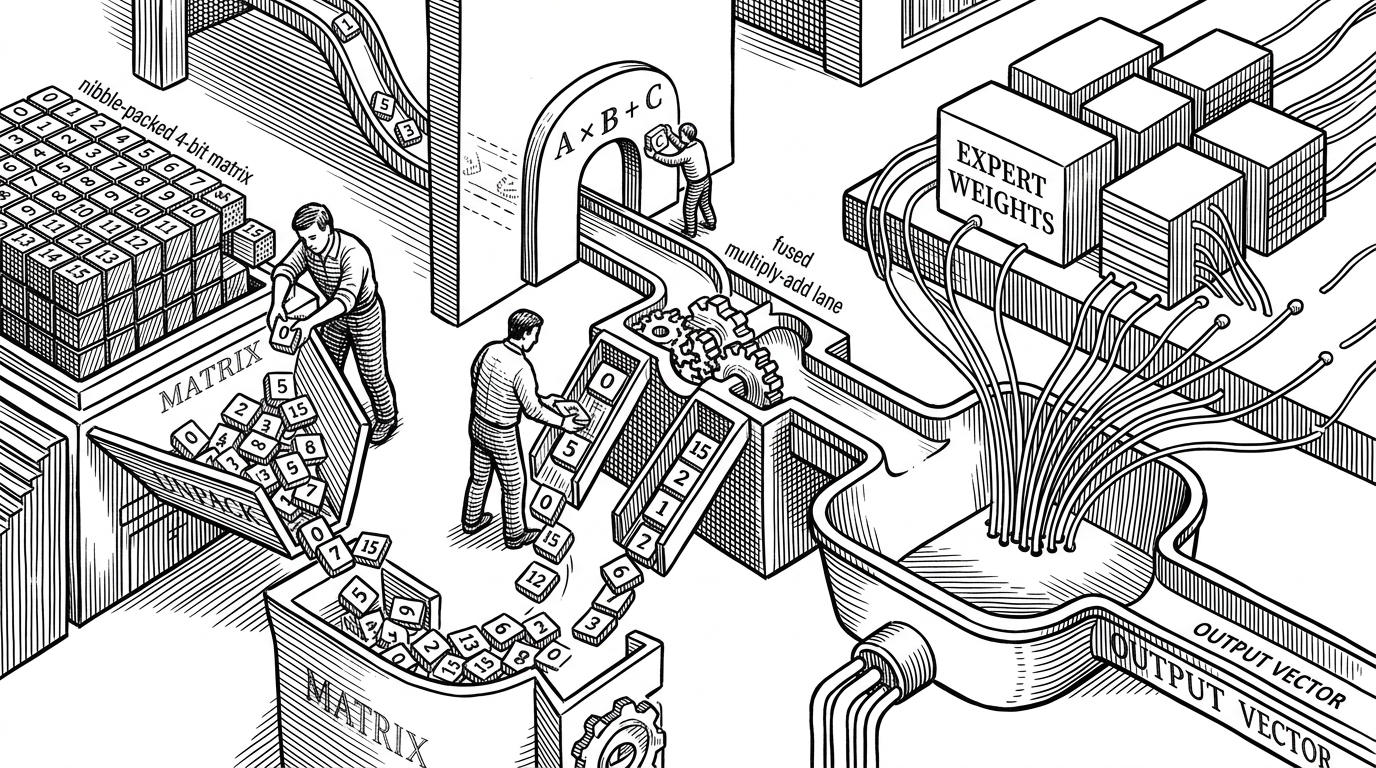
The sharpest code in the repo lives in shaders.metal, especially dequant_matvec_4bit_v3. Its job is straightforward to say and hard to do well: unpack 4-bit weights, apply scaling, and push the work through Metal without wasting bandwidth.
The trick is a rearranged fused multiply-add path. Instead of treating dequantization and multiply as separate steps, the kernel folds them together so the GPU does less bookkeeping and more useful arithmetic.
It also leans on SIMD-group reductions and threadgroup memory. That keeps intermediate values close to the compute units and reduces the cost of talking to global memory every time a partial sum appears.
Why This Is Not a General-Purpose Framework
Flash-MoE is deliberately narrow. It is built around one model family, one GPU backend, one storage strategy, and one hardware target. That is not a weakness. It is the reason the repo can be so aggressive.
| Project | Platform focus | Model scope | Storage strategy | Specialization |
|---|---|---|---|---|
| Flash-MoE | Apple Silicon | One giant MoE model family | SSD streaming with OS page cache | Very high |
| llama.cpp | Broad, cross-platform | Many model families | Mostly resident memory, with experiments around offload | High portability |
| ExLlamaV2 | NVIDIA GPUs | GPU-friendly LLMs | GPU-first loading and kernels | Performance tuned |
Specialization buys simplicity in the runtime and speed in the hot path. The tradeoff is obvious: this is not the engine you pick if your first priority is portability.
How It Stacks Up Against llama.cpp and ExLlamaV2
The comparison is not about who is better in the abstract. It is about what each project is optimized to prove. llama.cpp proves breadth. ExLlamaV2 proves GPU performance on NVIDIA hardware. Flash-MoE proves that a very large MoE model can be made usable on Apple Silicon if the runtime is willing to live inside the machine's memory hierarchy.
That is a different kind of claim. It is narrower, but it is also more radical.
The Origin Story: A Human, an AI, and a 24-Hour Build
The repo's backstory fits the project's tone: fast, technical, and a little absurd in the best way. Dan Woods describes Flash-MoE as a pure C and Metal inference engine that runs Qwen3.5-397B-A17B on a MacBook Pro with 48GB of RAM at more than 4 tokens per second.
The broader lesson is not that a laptop is secretly a supercomputer. It is that a focused runtime, built around a specific model and a specific memory strategy, can punch far above what the raw specs suggest.
Pure C/Metal inference engine that runs Qwen3.5-397B-A17B (a 397 billion parameter Mixture-of-Experts model) on a MacBook Pro with 48GB RAM at 4.4+ tokens/second with production-quality output including tool calling.
What Flash-MoE Suggests About the Next Generation of Local AI
Flash-MoE is a clue about where local AI may be headed. The winning stack may not be a giant general-purpose framework with every backend under the sun. It may be a set of highly opinionated runtimes that understand a specific model, a specific chip, and a specific storage path.
In that world, the operating system is not just there to support the model. It is part of the model runtime.