RubikCubeSolver: The Smallest Useful Bridge Between a Cube and a Solver
A clean Python wrapper turns cube state into Kociemba’s two-phase logic, showing how much value lives in representation, not reinvention.
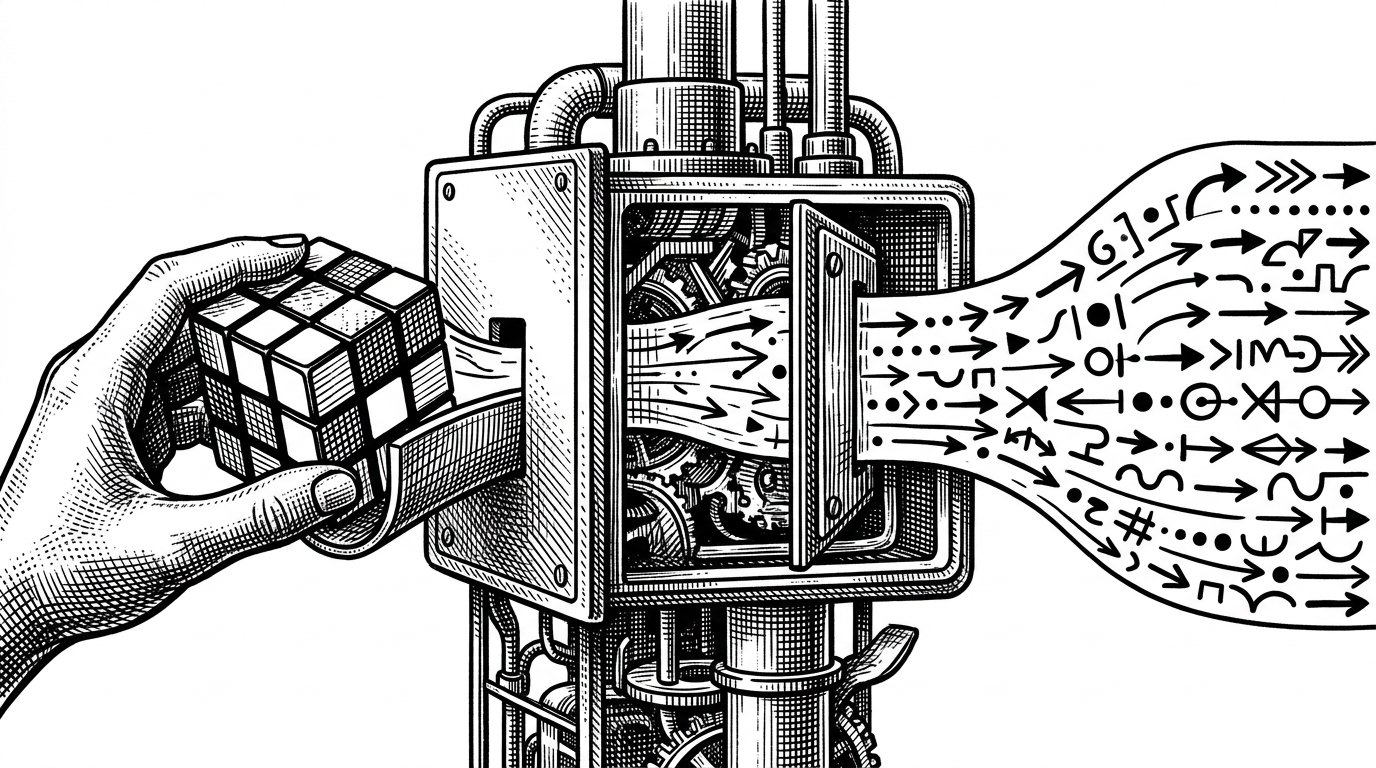

This repository contains a simple Rubik's Cube solver implemented in Python. The solver uses the Kociemba algorithm to find an efficient solution for a given Rubik's Cube configuration.
- RubikCubeSolver is best understood as an interface project that makes a powerful solver easy to reach from Python.
- Its main value is not algorithmic novelty but clean representation, validation, and handoff.
- The repo sits between a raw library and a heavier all-in-one solver, which makes it useful as a learning scaffold.
- The lesson is broader than cubes: good software often lives in the seam between a hard problem and the person using it.
The real trick is not solving the cube. It is packaging the problem correctly.
A Rubik’s Cube solver sounds like a search problem. In this repo, it is really a boundary problem. The code’s job is to take a cube state, express it in the form a solver expects, and hand the result back in a shape a human can use.
That sounds modest. It is also the whole point. When an algorithm is already world-class, the product value shifts to the seam around it: input model, validation, and output handling.
What this repository actually does
The repository is a lightweight Python project built around one core move: it delegates the hard part to kociemba.solve(). That means the interesting logic is not in inventing a new search strategy. It is in making a cube state usable by an existing solver.
import kociemba

solution = kociemba.solve(cube_state)
print(solution)
That makes the repo easy to read, easy to reuse, and easy to explain. It also makes the scope clear. This is a wrapper, not a research implementation.
Why representation is the whole game
A cube solver can only be as good as its input model. If the state is malformed, incomplete, or ambiguous, the solver does not get smarter. It just gets confused faster.
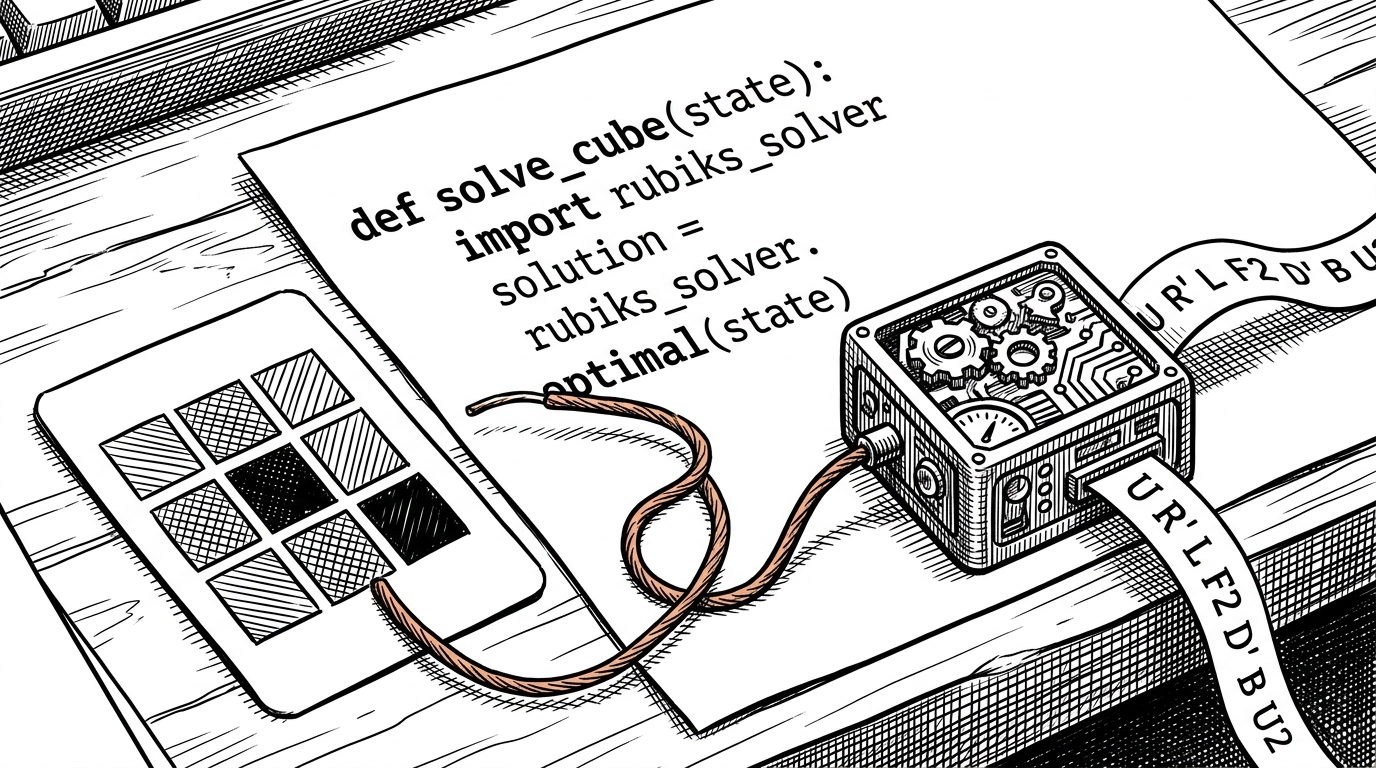
The handoff to Kociemba
This is where the project’s shape becomes obvious. A user gives the repo a cube configuration. The code normalizes that state, sends it into the Kociemba library, and receives a move sequence back. The solver is the engine. The wrapper is the transmission.
That distinction matters because it changes what this repo is for. You do not come here to study cube theory. You come here to see how a usable interface can stand in front of a strong algorithm and make it feel accessible.
| Layer | What it does | Best for | What it is not |
|---|---|---|---|
| RubikCubeSolver | Wraps cube state and delegates solving to Kociemba | Learning, prototyping, quick experiments | A new solving algorithm |
| kociemba | Implements the two-phase solver itself | Fast, near-optimal solving | A full application wrapper |
| rubiks-cube-NxNxN-solver | Supports broader cube sizes and a fuller CLI | Serious end-to-end use | A minimal teaching example |
Why this project is educational, not competitive
The competition here is not really between solvers. It is between levels of abstraction. The core Kociemba library is the engine. Heavier solver suites add breadth and operational completeness. This repo sits in the middle as a clean teaching layer.
That middle position is why it is worth looking at. It shows how much software value can come from reducing friction around a hard tool. The code does less, but the user does more with it.
- If you want the algorithm, use the library directly.
- If you want a broader solver package, use a fuller project.
- If you want to understand the seam between state and solution, this repo is the useful one.
What you can learn from a thin wrapper
Thin wrappers are easy to dismiss until you need one. They clarify inputs, constrain outputs, and make a hard dependency feel tractable. In that sense, RubikCubeSolver is not a trivial project. It is a compact lesson in interface design.
The broader takeaway is simple. Not every strong repo needs to invent the underlying method. Sometimes the best contribution is a cleaner path to a method that already works.