finalyearproject: PredictIQ: The MLOps Repo That Treats Customer Prediction Like a Production System
From raw retail transactions to segmentation, explainability, drift detection, and live prediction streams, this project builds the whole loop, not just the model.
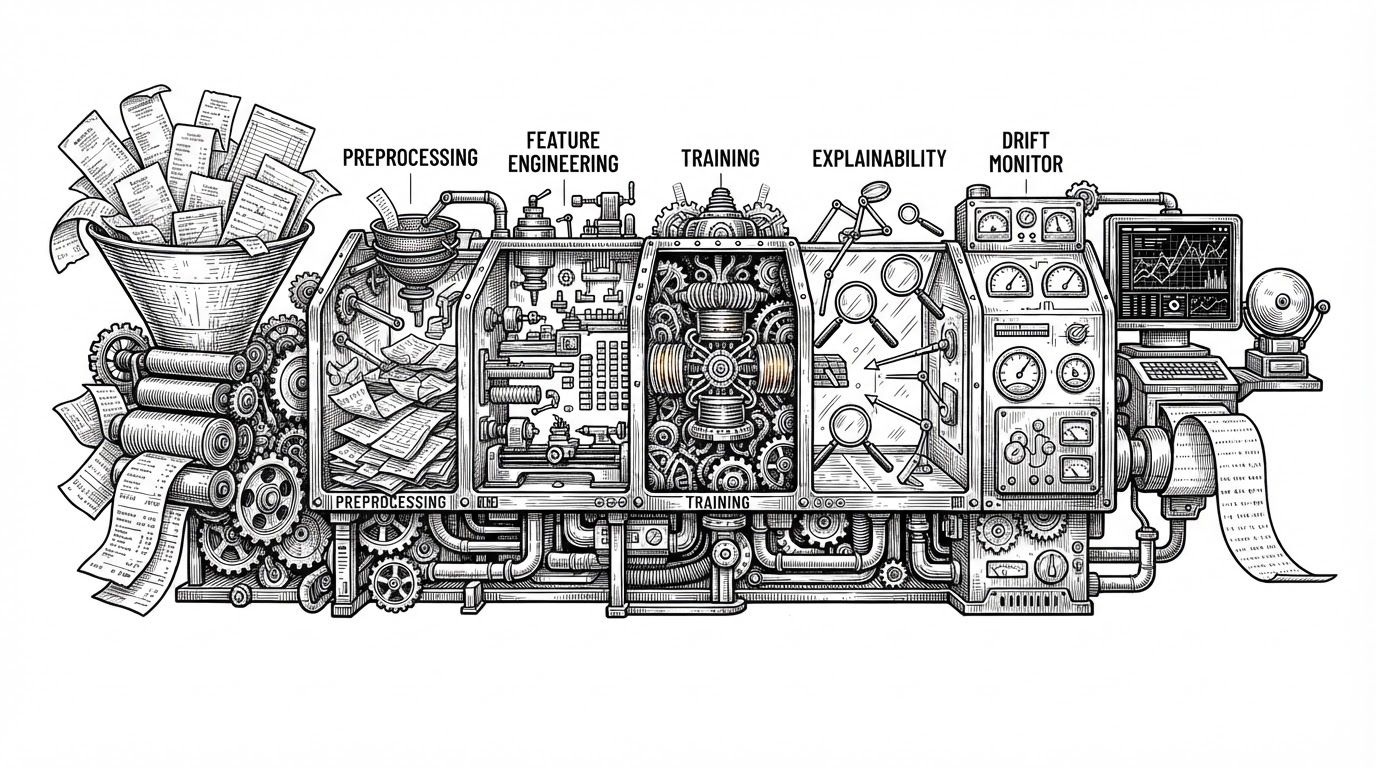
- PredictIQ matters because it closes the loop from retail data to prediction, monitoring, and retraining readiness instead of stopping at model output.
- Its strongest move is not a single algorithm but the feature layer, where RFM, return behavior, monthly frequency, and outlier handling turn raw transactions into usable signal.
- The repo treats explainability and drift detection as core system features, which is what makes it feel production-minded rather than notebook-derived.
- Compared with a typical dashboard project, PredictIQ is built like a living service that can explain itself and notice when its own assumptions are failing.
A customer model that behaves like a product
PredictIQ is not trying to be a prettier segmentation notebook. It is organized like a customer intelligence system that can ingest data, shape features, train models, serve predictions, and watch for drift after deployment.
That matters because most ML demos stop at the moment the model is saved. This repo keeps going. It treats prediction as a business process, not a one-time experiment.
The result is a rare kind of student project: a full loop with enough discipline to resemble a real internal tool. That is the hook.
Why this repo feels more mature than a typical final-year project
The repo’s folder structure signals intent. Backend, frontend, pipeline, monitoring, data, and models are split into separate concerns, which is exactly what you want when a project claims to do more than offline training.
The stack is also unusually complete. FastAPI, WebSockets, Redis, PostgreSQL, Docker Compose, Grafana, and test files all show up together, which tells you this was built as a service, not a notebook export.
That is the big difference. A lot of projects can predict. Far fewer can survive deployment, observability, and repeated use.
The feature engineering is the real intelligence layer
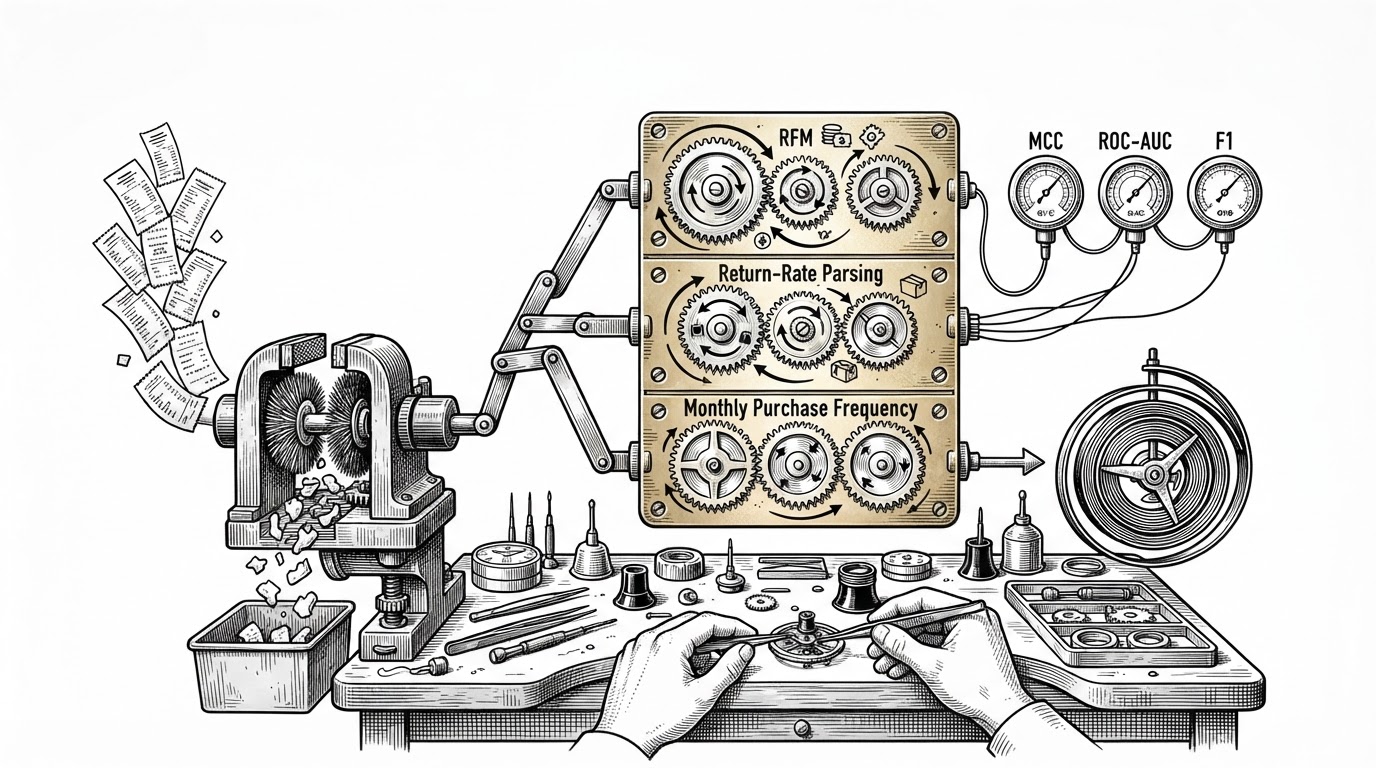
This is where the repo stops looking generic. It goes beyond standard RFM scoring and builds a richer behavioral feature space, including return-rate parsing and monthly purchase frequency, alongside outlier handling with IQR.
That feature layer is the hidden thesis of the project. If the inputs are sloppy, the model becomes a costume. If the inputs are behavioral, the model can start to mean something.
The README and pipeline notes suggest a 9-dimensional feature set, which is enough structure to support segmentation and supervised prediction without collapsing into a toy example.
How it chooses models instead of just training them
| Step | PredictIQ approach | Typical notebook project |
|---|---|---|
| Segmentation | Compares K-Means, DBSCAN, and hierarchical clustering | Runs one clustering method and calls it a day |
| Evaluation | Uses silhouette and elbow analysis to compare behavior | Shows a cluster plot without much justification |
| Classification | Trains multiple models, including a stacking ensemble | Fits a single classifier and reports accuracy |
| Imbalance handling | Uses SMOTE and favors MCC and ROC-AUC | Ignores class imbalance or optimizes for raw accuracy |
| Decision-making | Selects models with downstream use in mind | Stops at the best-looking validation number |
The model strategy is more disciplined than the average project. Instead of treating one algorithm as destiny, PredictIQ compares clustering methods and then trains multiple classifiers for the supervised side.
The important part is the metric choice. Accuracy is a weak hero in imbalanced retail problems. By emphasizing MCC and ROC-AUC, the repo shows it understands that a model can look good and still be useless.
SMOTE and stacking round out that story. The project is not chasing novelty. It is trying to make weak signals reliable enough to act on.
The surprising part: prediction is live, stateful, and explainable
PredictIQ is not just exposing an API. It behaves more like a prediction server, with WebSocket streaming for live outputs and SHAP support for per-customer explanation.
That combination matters. A dashboard that says a customer is likely to churn is useful. A system that can also explain which features pushed that decision is much closer to something a business user can work with.
The backend choice reinforces the point. FastAPI plus WebSockets gives the project a live feel, while SHAP keeps the model from becoming a black box with a nice UI.
The strongest enterprise systems do not just answer queries. They answer queries and tell you how much trust to place in the answer. That is the bar this repo is aiming for.
Why drift detection is the most important enterprise feature here
PSI is the quiet centerpiece of the project. It compares the distribution of live production data with the training baseline, which is how a system catches model rot before users do.
That is a much bigger deal than it sounds. A model that works on Monday and drifts by Friday is not a deployed product. It is an expired assumption.
By wiring drift detection into the workflow, PredictIQ shifts from prediction to stewardship. That is the difference between a demo and an operating system for decisions.
What PredictIQ does better than the usual notebook-to-dashboard path
| Capability | PredictIQ | Common notebook project |
|---|---|---|
| Ingestion | Structured pipeline from raw retail data | Manual file loading in a notebook |
| Feature engineering | Behavioral features and outlier handling | Basic columns with light cleanup |
| Serving | FastAPI and WebSocket prediction flow | Static notebook output or batch CSV |
| Explainability | SHAP-based individual prediction context | No explanation beyond a score |
| Monitoring | PSI drift detection and alerts | No post-deployment visibility |
| Retraining readiness | Explicit loop back into the system | Model saved once and forgotten |
PredictIQ is valuable because it closes the loop. The repo does not just produce a model artifact. It builds the machinery around the artifact so the model can be used, inspected, and eventually replaced without starting over.
That is the quiet standard this project meets. It is not flashy because it has more algorithms. It is compelling because it behaves like software that expects to keep running.