Workify Turns Hiring Into a Live AI Feedback Loop
This Socket.io-driven ATS does more than rank candidates. It evaluates job posts, scores fit across multiple dimensions, and pushes recruiting toward a real-time conversation.
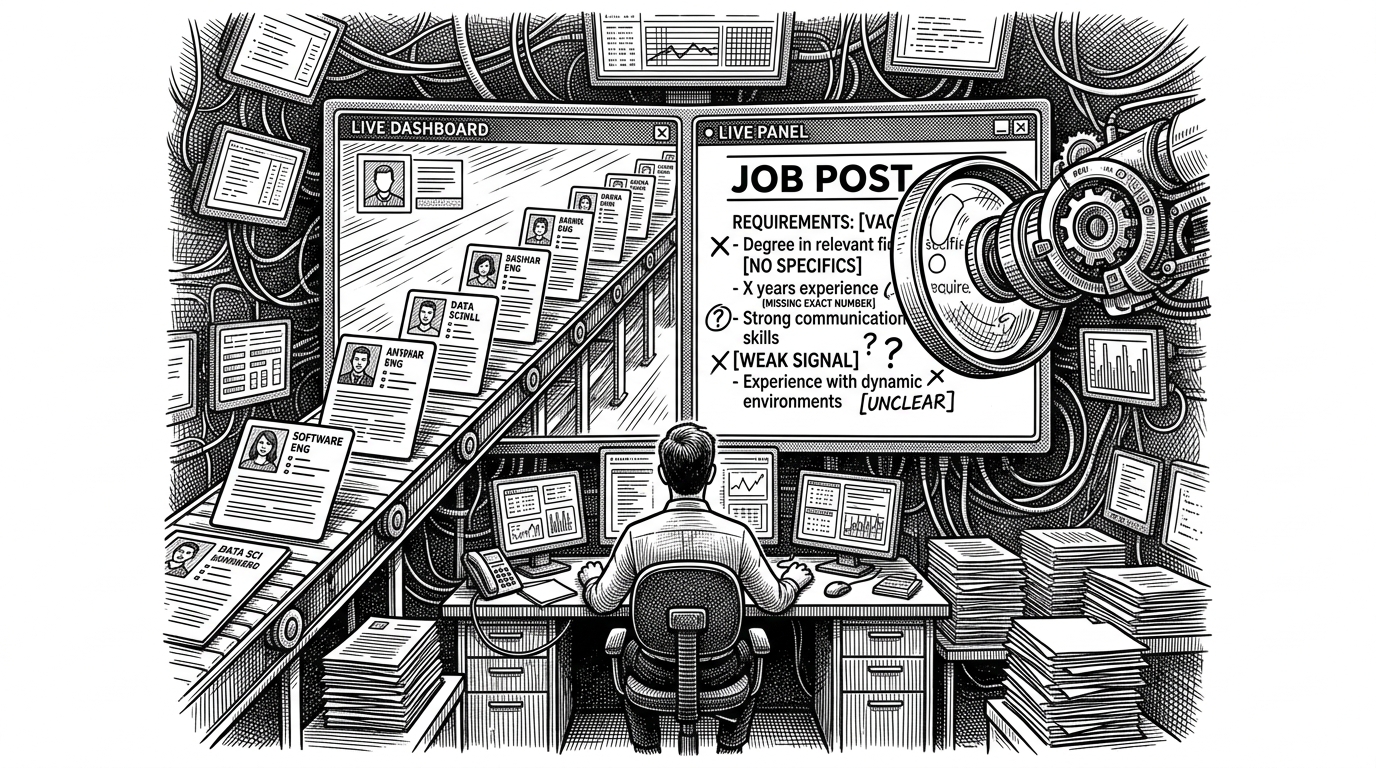
- Workify treats hiring as an event stream, not a static ATS workflow, so the product reacts in real time instead of waiting on page refreshes.
- Its most unusual move is that the AI evaluates the job description as well as the candidate, turning recruiting into a feedback loop about input quality.
- Socket.io is not decoration here. It is the coordination layer that connects dashboard actions, application events, database reads, and Gemini output.
- The repo reads like a prototype, but the product instinct is sharp: use AI to screen faster and to help companies write better roles in the first place.
Why Workify Feels Different From a Normal ATS
Most applicant tracking systems are built around forms, tables, and delayed review. Workify is built around motion. A recruiter changes something, a candidate applies, the system evaluates both sides, and the dashboard updates as an event instead of a refresh.
That matters because the product is not just trying to sort resumes. It is trying to improve the inputs that produce resumes. The job post becomes part of the loop, which is a sharper idea than a simple candidate scorer.
From Job Post to Ranked Candidates, in One Event Chain
socket.on("evaluateJob", async ({ jobId }) => {
  const job = await getJob(jobId);
  const applications = await getApplications(jobId);
  const prompt = generatePrompt(job, applications);
  const report = await evalate(prompt);
  socket.emit("reportData", report);
});
The AI Does Two Jobs at Once
The core product trick is simple and unusual at the same time. Workify scores candidates across competence, skill, and culture, but it also critiques the job post for clarity and completeness. That means the model is not only judging fit. It is judging the quality of the filter itself.
Workify is an AI-powered employment assistant tool that helps companies identify the most suitable candidates using advanced artificial intelligence. It streamlines the hiring process by intelligently analyzing resumes and job descriptions to surface top talent quickly and efficiently.

Why the Database Layer Matters More Than It Looks
The database code is not flashy, but it tells you a lot about the maturity of the system. The repo uses a singleton MongoDB client pattern and manual tracking of active operations, which is the kind of thing you build when you want to avoid connection churn and keep the app stable under rapid event traffic.
That choice fits the rest of the architecture. If your product revolves around frequent socket events, the boring layer has to stay disciplined. Otherwise the live experience falls apart quickly.
What the Recruiter Dashboard Is Really Optimized For
The dashboard is not just a view onto jobs. It is the main control surface for fetching user data, resolving job IDs, generating application links, and surfacing AI output in a way that supports a fast-moving hiring team. In practice, it is the place where hiring becomes operational rather than archival.
| Dimension | Traditional ATS | Workify |
|---|---|---|
| Input model | Forms and static records | Socket-driven events |
| System response time | Delayed and manual | Live and reactive |
| AI role | Optional add-on | Core evaluation layer |
| Candidate evaluation | Usually one-dimensional | Competence, skill, and culture |
| Job post evaluation | Rarely scored | Explicitly critiqued |
| UX rhythm | Review after submission | Continuous feedback loop |
| Implementation complexity | Lower, but less dynamic | Higher, but more interactive |
| Product maturity | Established category | Prototype-stage exploration |
Workify vs a Traditional ATS
The comparison is useful because it shows the product category shift. Traditional ATS tools are form-centric and asynchronous. Workify is event-centric and feedback-oriented. One stores applications. The other tries to reshape the hiring conversation while it is happening.
That also exposes the limits. The project is still prototype-shaped, and some implementation choices are clearly pragmatic rather than hardened. But the underlying model is strong enough to suggest a real direction for AI recruiting software.
What This Repo Reveals About Prototype-Stage AI SaaS
Workify shows a pattern that keeps appearing in early AI products. First, use the model to reduce manual screening. Then, use the same model to improve the quality of the inputs. That second step is where the product becomes more interesting than a thin wrapper around an API call.
This repo is rough in the way good prototypes often are. The architecture is ambitious, the workflow is opinionated, and the code is trying to prove a product instinct before it proves polish. That is enough to make it worth studying.