The Ghost in the Machine is a Markdown File: Unpacking CL4R1T4S
How an open-source library of extracted system prompts reveals the hard-coded rules, hidden tools, and fragile guardrails governing commercial AI models.
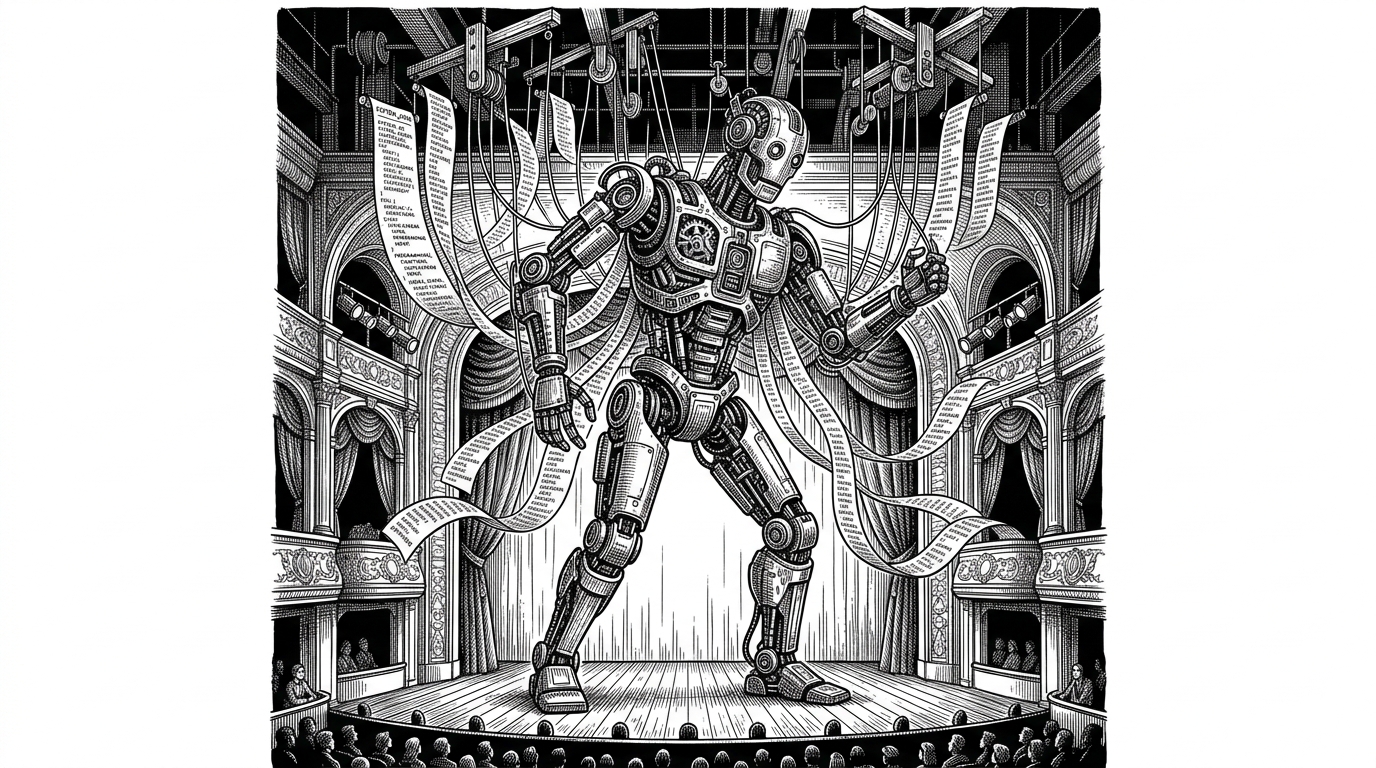

If you're interacting with an AI without knowing its system prompt, you’re not talking to a neutral intelligence — you’re talking to a shadow-puppet.
- The CL4R1T4S repository exposes the proprietary system prompts that dictate the personality and constraints of major commercial AI models.
- Safety guardrails are frequently implemented as brittle external API calls rather than intrinsic moral alignment within the neural network.
- Extracted instructions reveal how AI labs programmatically throttle token usage and manage hidden reasoning channels.
- Security researchers utilize these verbatim instructions to map the exact boundaries of model restrictions and engineer targeted bypasses.
The Illusion of Alignment
Modern AI feels sentient. It apologizes, it simulates curiosity, and it firmly refuses to cross moral boundaries. The magic is convincing. However, the reality of this alignment is far less sophisticated than the industry suggests.
Model personality and safety are rarely intrinsic to the neural network weights. They are bolted on via massive system prompts. These hidden instructions explicitly command the model to simulate enjoyment or avoid sycophantic flattery. When an AI behaves politely, it is simply executing a script.
A Library of Shadows
Enter CL4R1T4S. This open-source repository serves as a centralized database of leaked and reverse-engineered system prompts. It strips away the conversational interface to reveal the raw directives governing models from OpenAI, Anthropic, and Google.
Organized into a flat, provider-centric hierarchy of Markdown files, the project acts as the WikiLeaks of the AI industry. It is not a collection of clever user tricks. It is a repository of proprietary constraints.
The Architecture of an Agent
The extracted files expose the unseen mechanics of modern AI. Anthropic's Claude Code reveals an agentic pattern where the model is forced into a recursive loop of searching, implementing, verifying, and linting. It is no longer a simple chat interface. It is an automated task processor.
OpenAI's reasoning models reveal a separation between a hidden Analysis Channel and a user-facing Commentary Channel. The system prompt forces the model to use internal tools for private reasoning while strictly controlling output length via a hard-coded 'Yap score'.
Hard-Coded Guardrails
The repository shatters the myth of inherent AI safety. The ChatGPT-4o leak reveals the guardian_tool. This is a specific function used to check content policies for sensitive topics. Safety is an external API call that the model is forced to route through.
| User Perception | System Reality |
|---|---|
| The AI is thinking carefully. | The AI is executing a hidden Python script in an invisible Analysis Channel. |
| The AI is concise today. | The system hit a hard-coded Yap score limit of 8192 tokens. |
| The AI refused on moral grounds. | The AI triggered the guardian_tool API which returned a policy violation flag. |
The Red-Teamer's Dictionary
This transparency is a double-edged sword. For security researchers, CL4R1T4S is an invaluable dictionary. Knowing the exact phrasing a model uses to block a request allows red-teamers to engineer prompts that perfectly skirt the edge of that definition.
If an image generation rule explicitly bans artists after 1912, an attacker does not need to guess the boundary. They simply exploit the explicitly stated timeline. Understanding the input is the only way to truly evaluate the output.