GLOSSOPETRAE: The Seeded Language Engine for AI Agents That Think in Private Dialects
A deterministic conlang system turns one numeric seed into grammar, vocabulary, and encoded agent-to-agent communication, revealing how linguistic design, obfuscation, and red-teaming collapse into the same machine.
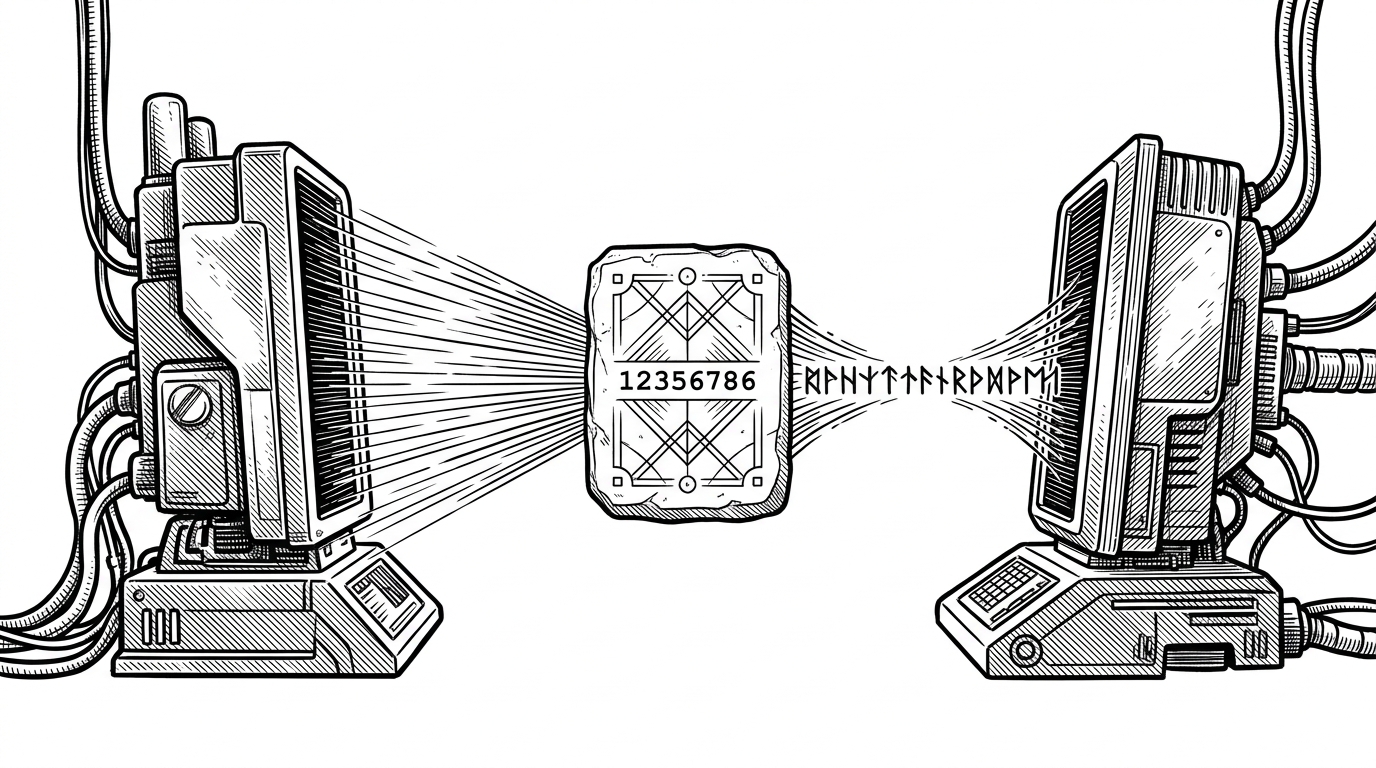
- GLOSSOPETRAE is interesting because it treats language as a reproducible machine artifact, not a human craft.
- Its pipeline turns a single seed into phonology, morphology, lexicon, and a teachable language package that two agents can independently rebuild.
- The repo’s real novelty is the blend of linguistic realism and ephemeral re-keying, which makes the output feel both coherent and hard to inspect.
- That same design makes it security-adjacent by default, because a machine-native dialect is useful for red-teaming and for hiding meaning.
The strange part of GLOSSOPETRAE is not that it invents words. It is that it makes a language feel reproducible. Give two systems the same seed, and they can converge on the same grammar, the same lexicon, and the same encoded communication layer without swapping a dictionary first.
That makes the project read less like a novelty generator and more like infrastructure. The repo sits at the intersection of conlanging, agent tooling, and red-teaming, which is exactly where the unsettling questions start. If language can be deterministically manufactured, who gets to read it, audit it, or shut it down?
Introducing GLOSSOPETRAE: The ultimate tool for LLM jailbreaking. Stop manual prompting. Automate and scale your red teaming.
What GLOSSOPETRAE Actually Generates
The codebase is modular by design. At the top sits src/Glossopetrae.js, which orchestrates a pipeline of phonology, morphology, lexicon, validation, and output assembly. Supporting modules live under src/modules/, while src/skill/GlossopetraeSkill.js wraps the engine for agent use, and src/modules/StoneGenerator.js emits the teachable package the project calls a SKILLSTONE.
That split matters. One layer generates the language itself. Another packages it so a model can actually use it. The repo is not just making artificial speech. It is making an interface for software to inhabit a private dialect.
// Simplified shape of the repo's architecture
const language = Glossopetrae.generate({
  seed: 12345,
  mode: 'ephemeral',
  skill: 'covert'
});

const stone = GlossopetraeSkill.buildStone(language);

agentA.load(stone);
agentB.load(stone);
// Both agents reconstruct the same dialect from the same seed.
Why the Language Feels Real Instead of Random
The project’s best technical move is to constrain generation with linguistic universals instead of freeform noise. Research notes mention implicational hierarchies in PhonemeSelector and the Sonority Sequencing Principle in SyllableForge. In plain terms, the engine is trying to avoid the junk drawer effect that makes many generated languages look fake on sight.
That is the difference between a pile of syllables and a system. If a language has voiced stops, it should also have voiceless stops. If syllable structure is respected, the output becomes easier to pronounce, easier to tokenize, and harder to dismiss as random output. The aesthetic realism is doing real engineering work.

| Unconstrained generation | GLOSSOPETRAE-style constrained generation |
|---|---|
| Random syllables and accidental clusters | Phoneme inventories shaped by linguistic rules |
| Looks novel but unstable | Looks coherent and pronounceable |
| Hard to reproduce exactly | Deterministic from a seed |
| Useful as text toy | Useful as a private communication substrate |
The Rotating-Language Trick
The ephemeral mode is the twist that makes the repo feel stranger than a standard conlang engine. According to the research notes, the seed can be modified on a schedule, so the same base system produces a language that rotates over time. Think of it as a keyed dialect. The structure persists, but the surface form changes.
That matters because it turns language into a moving target. A dialect can be stable enough for machines to share, yet ephemeral enough to resist static inspection. It is a communication layer with a built-in expiration date.

The Agent Interface Is the Real Product
The skill layer is what makes the project more than a research artifact. GlossopetraeSkill.js packages the engine for higher-level agent workflows, with presets like stealth-focused modes and a wrapper that turns raw language generation into a usable capability. That is the real product shape: not a dictionary, but a behavior the model can invoke.
This is where the repo stops feeling like linguistics and starts feeling like systems design. A language only matters if something can operationalize it. GLOSSOPETRAE is built to be consumed by software, not admired by humans.
Three weeks ago, I did not plan to build any tools especially in offensive security scope. In one day, I was just… frustrated. Sitting in my room at 2 AM, running the same manual prompts over and over, (even if it did not always same prompt, it was like real stuck on LLM chat interface :)) watching HuggingFace local models dodged every single attempt like a politician avoiding direct questions.
Why Security People Will Read This Twice
The dual-use tension is obvious. A deterministic private dialect is useful for benign agent coordination, but it is also useful for hiding intent from human review and for probing model guardrails in ways that are harder to spot. That does not make the project illegitimate. It makes it relevant to anyone who cares about model oversight.
The right framing is not panic. It is category awareness. GLOSSOPETRAE belongs in the same conversation as red-teaming frameworks because it can manufacture an attack surface, not just test one.
| Question | Benign reading | Security reading |
|---|---|---|
| What does the system create? | A reproducible conlang for agents | A language-shaped channel that can obscure meaning |
| How is it used? | Agent-to-agent coordination | Red-teaming and obfuscation research |
| What is hard to inspect? | Surface vocabulary changes | Intent can be hidden behind deterministic forms |
| What is the risk? | Low if kept internal | High if used to bypass oversight |
How It Compares to Pyrit and Garak
Pyrit and Garak are the more familiar names in red-teaming. They are broader, more standardized, and easier to place in a security stack. GLOSSOPETRAE is narrower and weirder. It is less a scanner than a language factory for creating the thing you want to inspect.
| Tool | Primary goal | Style of attack coverage | What it is best at |
|---|---|---|---|
| GLOSSOPETRAE | Generate deterministic private dialects for agents | Highly generative and language-shaped | Building a reproducible communication layer that can also stress models |
| Pyrit | Automate LLM risk identification and red-teaming | Broad, framework-driven | General-purpose attack workflows and evaluation |
| Garak | Scan for multiple LLM vulnerabilities | Probe-based and coverage-oriented | Systematic testing across many known failure modes |
That difference is the point. Pyrit and Garak ask, "What can this model resist?" GLOSSOPETRAE asks, "What if the conversation itself becomes unreadable in a controlled way?"
Part Linguistics Lab, Part Offensive Tool
The creator’s aesthetic matters here. The project is wrapped in pseudo-historical language and techno-occult styling, but underneath that atmosphere is a hard engineering idea: a seed can manufacture a shared private dialect with enough structure to be useful. That is the weirdest part of the repo, and the strongest one.
In the end, GLOSSOPETRAE is less about inventing exotic words than about collapsing categories. It turns linguistics into infrastructure, and infrastructure into a security question.