T3MP3ST Turns a Coding Agent into a Red-Team Swarm
A TypeScript meta-harness that treats LLMs as interchangeable brains, routes them through a mission loop, and insists on evidence instead of vibes.
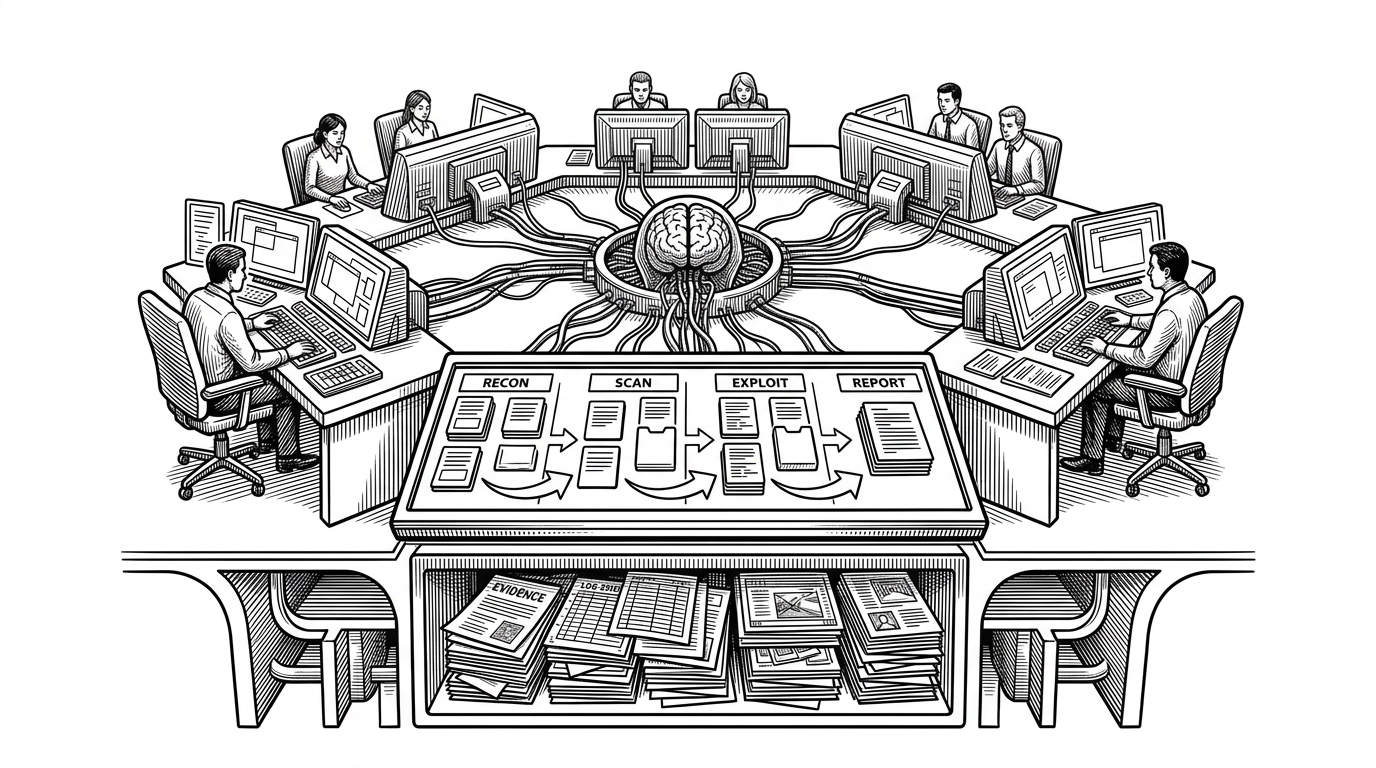
- T3MP3ST treats autonomous security as an operating system problem, not a prompt problem.
- Its real trick is swapping brains while keeping the mission loop, tool gates, and evidence rules intact.
- The project is unusual because it treats receipts and benchmark integrity as core product features, not afterthoughts.
- Compared with AI wrapper tools, T3MP3ST is trying to be an operational harness for controlled offense.
Why T3MP3ST Feels Like a Security Operating System
Most AI security tools start with a model and bolt features onto it. T3MP3ST starts with the workflow. It assumes the brain can change, but the mission structure, tool policy, and evidence trail should stay stable.
That is why the project calls itself a multi-agent offensive-security meta-harness. It is not trying to be a smarter scanner. It is trying to be the layer that coordinates the scanner, the exploit runner, the analyst, and the rules that keep them honest.
A multi-agent offensive-security framework, built to turn the AI coding agent you already run into a zero-day hunter.
The Swarm: Eight Operators, One Kill Chain
T3MP3ST decomposes the job into specialized operators: coordinator, recon, scanner, exploiter, infiltrator, exfiltrator, ghost, and analyst. That sounds theatrical, but the point is practical. Narrow roles reduce prompt drift and make it easier to decide which tools are allowed to run.
| Operator | Job | Why it matters |
|---|---|---|
| Coordinator | Assigns tasks and keeps state moving | Prevents the swarm from becoming a free-for-all |
| Recon | Collects initial facts and scope | Creates the first evidence packets |
| Scanner | Checks for likely weaknesses | Turns loose observations into structured signals |
| Exploiter | Tests whether a finding is real | Separates possibility from proof |
| Analyst | Turns receipts into a report | Forces the final output to stay grounded |

Inside the Mission Loop
The architecture is tick-based. A mission starts with an objective, gets broken into tasks, and then advances through a loop where the coordinator assigns work, tools execute, and evidence gets written into a vault. That structure matters because it makes the system inspectable.
The key abstraction is not the model. It is the state machine. That lets T3MP3ST pause, resume, branch, and demand receipts before the next step gets the green light.
Why the Receipts Rule Matters
The project is blunt about proof. It wants evidence kinds, tool output, and verified proof-of-concept execution, not vague claims that something probably worked. That sounds obvious until you compare it with the average agent demo, where the output is usually a confident paragraph and very little else.
In T3MP3ST, claims are supposed to land in the evidence vault. That gives the system a memory of what happened, but it also gives the operator a way to audit the chain of reasoning later. In security work, that is the difference between a story and a case file.
The Benchmark Layer Is Part of the Product
The repo does not treat evaluation as an afterthought. Its benchmark suite, claim verification scripts, and anti-fitting checks make performance a reproducible artifact. That matters because offensive AI is full of inflated demos and cherry-picked wins.
| Layer | T3MP3ST choice | Why it stands out |
|---|---|---|
| Evaluation | Re-derivable claims and benchmark scripts | The numbers are meant to be checked, not admired |
| Training contamination | No-fitting style integrity checks | Reduces the chance the tool is just memorizing the test |
| Autonomy | Mission loop with gates | Prevents the agent from pretending a success without proof |
| Tooling | Real adapters with risk levels | Allows dangerous actions to be deliberate instead of accidental |
That makes the benchmark layer part of the product story, not just the research appendix. The framework is trying to prove that autonomous offense can be measured with the same discipline as it is executed.
How T3MP3ST Differs from Other AI Security Tools
T3MP3ST is often grouped with pentest assistants, red-team frameworks, and commercial autonomous security platforms. That is understandable, but the comparison can hide the real distinction: some tools test models, some automate scans, and T3MP3ST tries to orchestrate a controlled offensive operation.
| Project | Primary purpose | Brain model | Target type | Evidence standard | Benchmark philosophy | Autonomy |
|---|---|---|---|---|---|---|
| T3MP3ST | Run a coordinated red-team mission | Swappable coding agents | Real targets and authorized scopes | Receipts stored in an evidence vault | Claims should be reproducible | High, but gated |
| PentestGPT | Assist pentesting with AI guidance | Single assistant model | Human-led pentest workflows | Mostly conversational output | Lightweight or absent | Low to medium |
| DeepTeam | Red-team AI systems | Test harness for models | LLMs, agents, RAG | Eval scores and adversarial cases | Framework-driven evaluation | Focused on model testing |
| XBOW | Commercial offensive platform | Proprietary system | Black-box targets | Platform-specific validation | Benchmark as competition | High |
| Penligent | Commercial autonomous red teaming | Swarm-style agents | Enterprise targets | Vendor-defined evidence | Productized eval stack | High |
The difference is not just technical. It is philosophical. T3MP3ST assumes the model is disposable, the process is sacred, and the proof has to survive contact with the operator.
The Creator and the Positioning
The project is strongly associated with elder-plinius, whose public identity already carried weight in the jailbreak and agentic tooling world. That matters because T3MP3ST launched with a ready-made narrative: this is not a generic enterprise product, but a creator-led offensive system with a point of view.
That background also explains the reaction. Some readers saw a dangerous new automation layer. Others saw a cleaner way to structure work that was already happening in messy, manual form. Both readings are true.
What T3MP3ST Suggests About the Future of Offensive AI
The deeper implication is simple: offensive AI is moving from standalone tools to composable systems. The model becomes a replaceable component. The real product is the orchestration, the policy layer, and the proof trail.
That shift matters well beyond security. Any agentic system that touches real-world consequences will need the same ingredients T3MP3ST emphasizes: constrained roles, auditable handoffs, and claims that can be checked after the fact.