topfilmtuiter: The repo that turns movie threads into a film canon
A Python pipeline scrapes community ballots, enriches them with TMDB data, and even finds taste-matched cinema neighbors for recommendations.

- topfilmtuiter treats a community ranking as infrastructure, not as a one-off list.
- Its real novelty is the jump from ballots to similarity matching and recommendations.
- TMDB enrichment and whitelist logic turn messy social input into a durable film dataset.
- The script-heavy workflow is old-school, but it stays reproducible and tightly scoped to one cultural job.
Most movie ranking projects stop when the list is published. topfilmtuiter keeps going. It treats community ballots as raw material for a recommendation engine, so the canon becomes something you can score, enrich, and compare.
The strange part is not the poll. It is the recommendation engine.
That is the unusual move here. The repo does not just count films and walk away. It takes the same voting behavior that produces a canon and turns it into a way to find people with similar taste, then suggests films those people surface.
La idea nació de un debate en Twitter sobre la encuesta de Sight & Sound, y pensamos que estaría guay hacer algo así en nuestro entorno. Ver cuáles eran las películas favoritas de nuestros colegas, y a raíz de eso desarrollar una lista global donde se mostrasen las preferencias o los sesgos
That quote captures the project's real ambition. Faustino Sánchez wrote the machinery, but the initiative itself came from a wider Spanish-speaking film conversation on X, with names like Álvaro Peleteiro, Pedro Crespo, Alicia Castilla, Iván Míguez, and Karina Solórzano shaping the effort. The goal was never just to publish a list. It was to make visible the preferences, biases, and overlaps inside a film community.
How a thread becomes a canon
The pipeline is easier to understand than its folder structure suggests. A ballot starts as a social object, then gets normalized into rows, scored by position, and cleaned until it can live in a dataset. Once that data is stable, the repo can reuse it for dashboards, similarity matching, and recommendations.

Why the project needed TMDB, whitelists, and validation
Raw social data is slippery. Movie titles are duplicated, misspelled, shortened, and remixed by the people who post them. The repo leans on TMDB, local mapping tables, and a whitelist so the same film keeps the same identity across scrapes, votes, and dashboards.
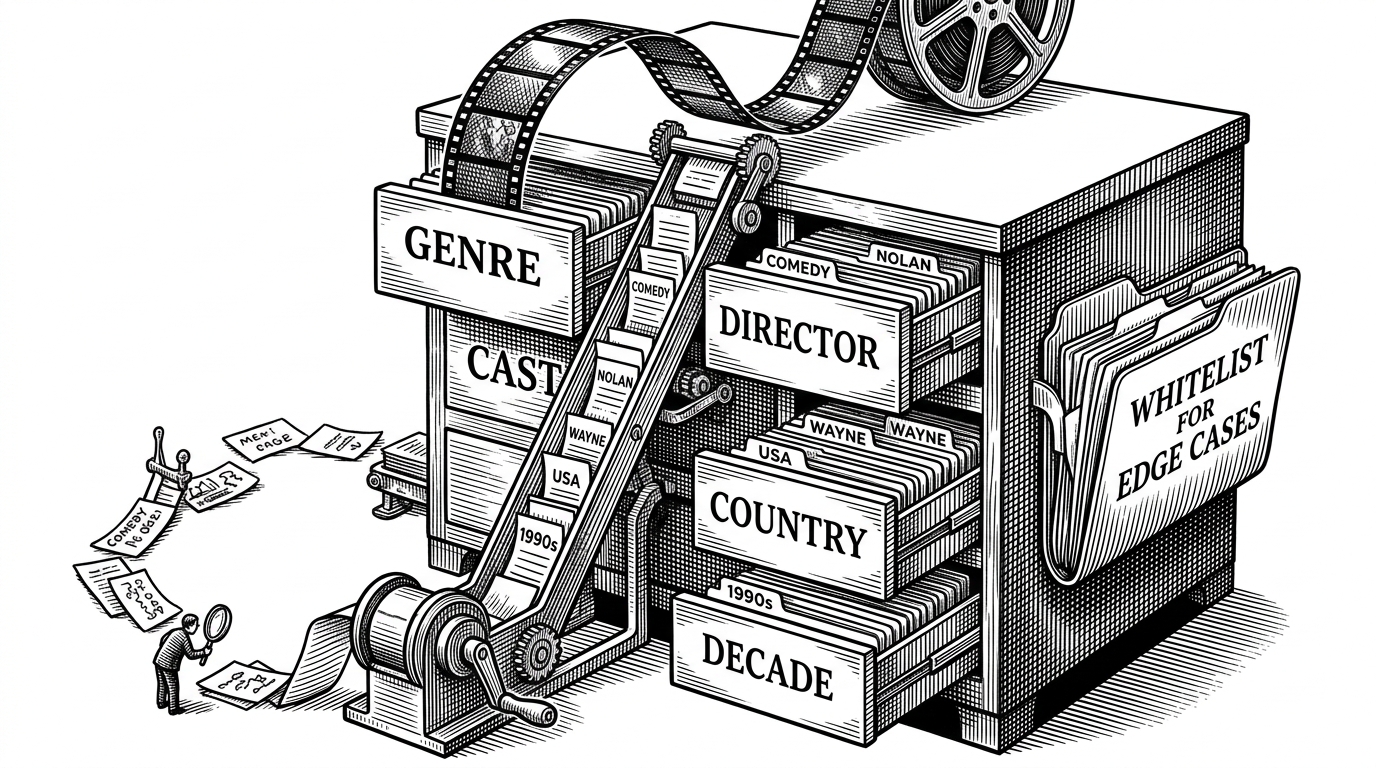
That extra layer matters because it gives the project staying power. Once a film is reconciled against a stable identifier, it can be filtered by decade, cast, country, or director without breaking the rest of the pipeline. That is the difference between a hobby script and a reusable cultural dataset.
The pipeline is old-school on purpose
The orchestration style is almost defiantly plain. Instead of a modern task runner, the repo uses a linear chain of scripts that call one another in sequence. It is not fashionable, but it makes the workflow easy to inspect, easy to rerun, and easy to debug when the source data changes.
steps = [
    'ParticipantesTopFilmTuiter/ParticipantesFinalesTFTLB.py',
    'ProcesamientoTFTdecadasLB/Top_FilmTuiter.py',
    'ProcesamientoTFTdecadasLB/createDatasetTFT.py',
    'ProcesamientoTFTdecadasLB/TopFilmTinderCB_hib.py'
]
for step in steps:
    exec(open(step, encoding='utf-8').read())
That pattern tells you what the project values. The code is not trying to become a platform. It is trying to get one specific job done with very little ceremony, then hand the results to Power BI and the recommendation layer.
What makes topfilmtuiter different from a normal film platform
| Project | Input | Output | Strength | Limitation |
|---|---|---|---|---|
| Sight & Sound poll | Critics and directors ballots | A canonical ranking with prestige | Deep authority and historical continuity | Closed process and slow cadence |
| Letterboxd | Mass user ratings and lists | User discovery and a social graph | Huge living dataset | Platform-owned and noisy |
| Twint | Twitter/X posts | Raw social data dumps | Flexible scraping for general use | No film-specific scoring or enrichment |
| topfilmtuiter | Community film threads and lists | Weighted canon, enriched dataset, recommendations | Turns one community's taste into infrastructure | Narrower audience than a general platform |
The comparison is really about intent. Sight & Sound is about authority, Letterboxd is about participation, Twint is about collection, and topfilmtuiter is about transformation. It takes one community's taste and operationalizes it.
What the project says about cultural software
This repo is a small example of a bigger shift. Communities no longer need a platform to bless their canon before they can analyze it. They can scrape their own ballots, build their own metadata layer, and ship their own discovery tools.
That is why topfilmtuiter feels larger than a niche film project. It is a taste machine built for a specific scene, which is often how useful cultural software starts. Narrow input. Clear rules. Useful output.