zk-mental-poker: Solving the 45-Year-Old Dealer Problem
How the Gear Foundation uses Bandersnatch curves and the Actor Model to build a trustless, high-speed deck that no one can peek at.
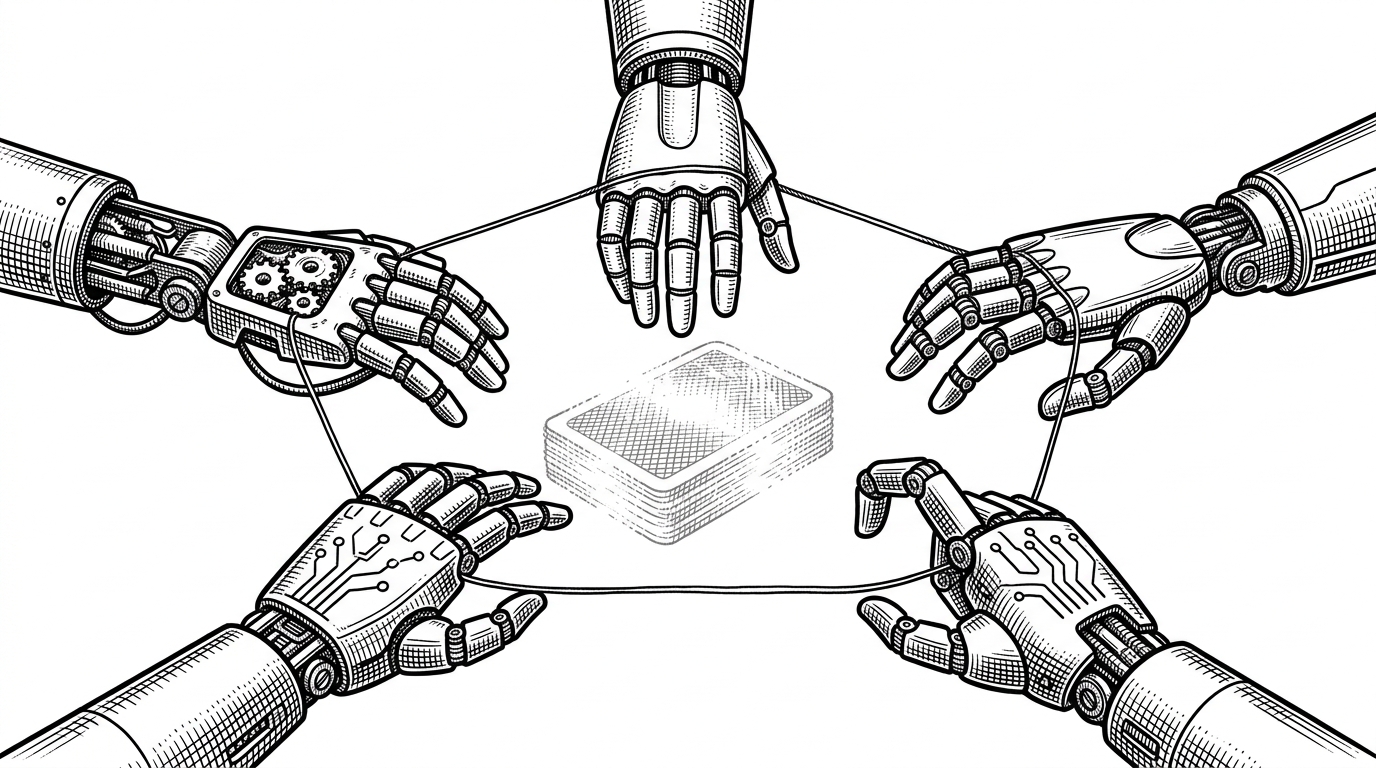
- The repository uses sequential Zero-Knowledge Proofs to allow players to shuffle and encrypt a deck without a central dealer.
- Bandersnatch curves and projective coordinates optimize complex elliptic curve math to make proof generation computationally feasible for standard devices.
- The Vara Network’s Actor Model manages the game as an asynchronous state machine to ensure each player’s shuffle builds correctly on the previous one.
- Temporary session keys enable high-speed gameplay by removing the need for users to sign manual transactions for every bet or fold.
The Multi-Party Paradox
In 1979, cryptographers asked a seemingly simple question: How do you play a fair game of poker over a telephone line? The problem, known as "Mental Poker," is a paradox of trust. You need to shuffle a deck so that the order is random, deal cards so that only the recipient knows their value, and prove at the end of the game that no one cheated—all without a central dealer.
For decades, solutions were largely academic. They worked on paper but were too slow or required too much communication overhead for real-world use. The rise of blockchains offered a potential solution for the "trust" part, but introduced a new problem: public ledgers are, by definition, public. If you shuffle a deck on Ethereum, everyone can see the cards.
The Gear Foundation's zk-mental-poker repository tackles this 45-year-old white whale by treating the game not as a series of transactions, but as an industrialized pipeline of Zero-Knowledge Proofs (ZKPs) managed by an asynchronous state machine.
The Shuffle Chain: How to Trust a Stranger
To understand the repository, you have to understand the "Shuffle-and-Encrypt" chain. When a game begins, the deck isn't shuffled by a smart contract. It's shuffled by the players themselves, sequentially.
Player A takes the deck, encrypts every card, shuffles them, and passes the result to Player B. But how does Player B know Player A didn't just stack the deck with four Aces? This is where the ZK circuits in circuits/shuffle_encrypt.circom come in. Player A must submit a mathematical proof that the new deck is a valid permutation of the old deck, without revealing what that permutation is.
The brilliance of the Gear implementation lies in its ShuffleChainValidator. Built on the Vara Network using the Actor Model, the smart contract acts as an asynchronous traffic cop. It ensures that Player B's shuffle starts exactly where Player A's ended. If a player tries to swap the deck or submit a bogus proof, the contract rejects the state transition.
Bandersnatch: The SNARK-Friendly Curve
The math required to make this work is staggering. Every card is represented as a point on an Elliptic Curve, and the encryption scheme (Commutative ElGamal) requires multiple scalar multiplications. Doing this inside a ZK circuit using standard cryptography would be computationally ruinous.
The developers bypassed this bottleneck by using the Bandersnatch curve. Found in circuits/common/bandersnatch.circom, this specific Edwards curve is built to be "SNARK-friendly." It allows the circuit to perform complex field arithmetic much more efficiently than standard curves like Secp256k1.
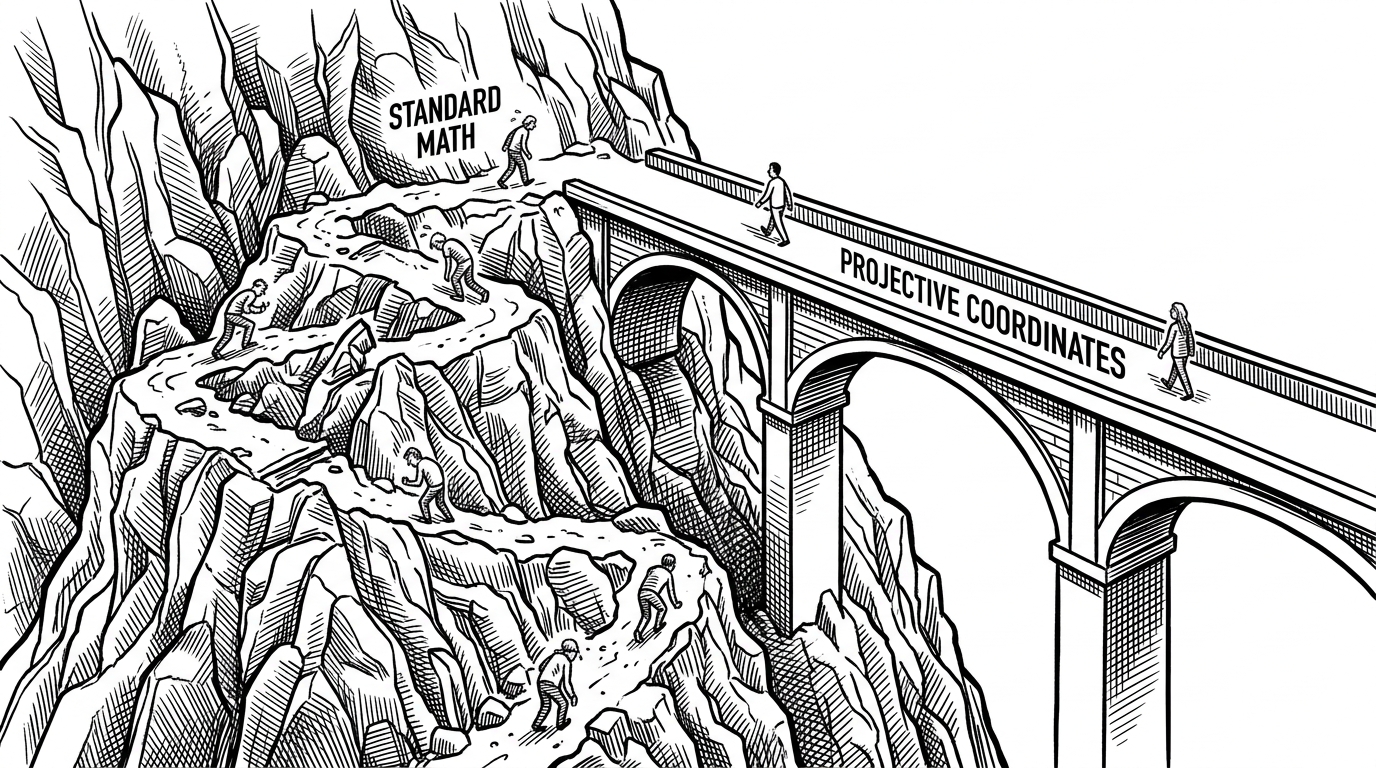
Furthermore, the codebase heavily utilizes Projective Coordinates (X, Y, Z) instead of standard Affine coordinates (X, Y). While this sounds like a minor implementation detail, it's a massive optimization. It allows the prover to avoid expensive modular inversions during point addition, deferring the heaviest math until the very end of the process.
Engineering for Humans: The Session Service
Perfect cryptography is useless if the game is unplayable. In a fully on-chain poker game, every action—checking, betting, folding—is a transaction. Asking a user to sign 50 MetaMask popups per hand is a non-starter.
The repo solves this in contracts/poker/app/src/services/session/mod.rs. Instead of signing every move with their main wallet, players authorize a temporary "Session Key." This key is granted limited permissions to act on the player's behalf for the duration of the hand. It’s a pragmatic compromise: you retain the absolute security of the ZK-shuffled deck, but you get the UX of a centralized web game.
The Cost of Absolute Fairness
The Gear Foundation's implementation is a masterclass in combining modern cryptography with asynchronous state management. But it comes with trade-offs. Generating a Groth16 proof for a 52-card shuffle takes significant local compute. The "Fairness Tax" is paid in CPU cycles on the client side.
| Model | Speed | Privacy | Trust Assumption |
|---|---|---|---|
| Centralized Server | High | None (Dealer sees all) | High (Trust the operator) |
| Optimistic (Fraud Proofs) | Medium | Partial | Medium (Trust the watchers) |
| ZK-Mental Poker | Medium | Absolute | Zero (Mathematically enforced) |
For a casual game of Go Fish, this architecture is overkill. But for high-stakes environments where trust is scarce and the cost of cheating is high, zk-mental-poker proves that the 45-year-old dealer problem is no longer a paradox. It's just an engineering challenge.