SkillSwap: How a LocalStorage Prototype Became a Real-Time Skill Barter Engine
A MERN refactor that keeps the original UI intact while adding persistent state, denormalized documents, JWT sessions, Socket.io signaling, and peer-to-peer video calls.

- SkillSwap’s main trick is architectural continuity: it rebuilds a prototype around persistent state without forcing the interface to relearn itself.
- The backend copies display-friendly fields into documents so the app can render quickly without joins or extra lookups.
- A swap is modeled as a lifecycle, not a chat thread, which makes the product feel like negotiated exchange instead of generic marketplace messaging.
- Socket.io is used as signaling glue for WebRTC, so the server coordinates the call without carrying the video stream.
SkillSwap is interesting because it refuses the usual refactor script. The app moves from local-only storage to a MERN backend, but it keeps the flat, display-first shape of the original UI. That choice shows up in the data model, the authentication flow, and even the realtime call setup.
The prototype that refused to die
The cleanest way to understand this repo is as a migration story. A frontend-first barter app was lifted into a full stack system, but the product still behaves like the old version: profiles stay simple, listings stay readable, and the mental model stays flat. The backend exists to make that simplicity durable.
That is a stronger design constraint than it sounds. Instead of redesigning the app around normalized database purity, the code preserves the shape the UI already wants. The result is a system that feels lightweight from the front, even though it now has persistence, auth, and realtime coordination behind it.
Why the backend copies the frontend
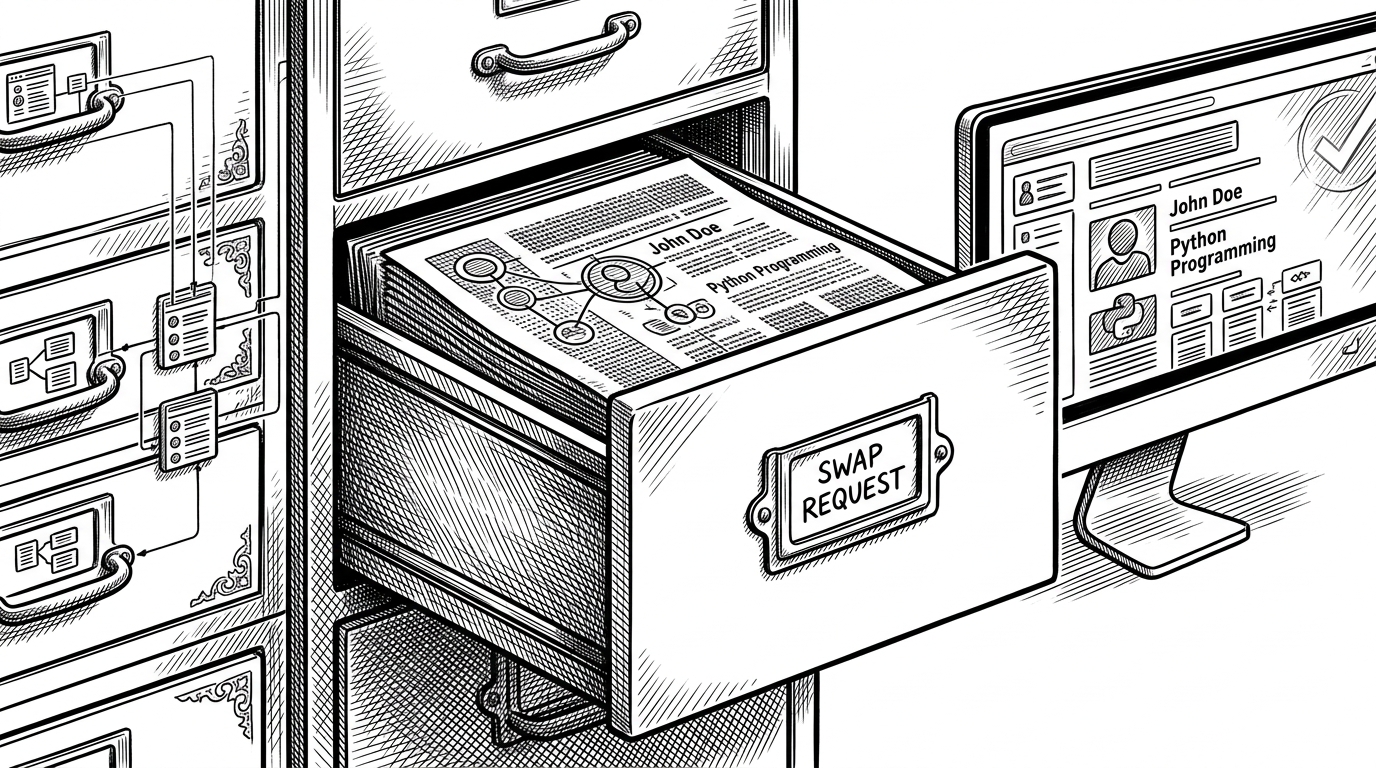
The most revealing part of the data layer is its deliberate denormalization. In models like Skill and SwapRequest, the repository stores both references and display fields such as names and usernames. That means the API can return enough information for the page to render immediately, without stitching together multiple collections at read time.
// Skill and swap documents keep display fields close to the data the UI needs
const skill = {
  title: 'Web Development',
  offeredBy: user.fullName,
  username: user.username,
  category: 'Technology'
};

const swapRequest = {
  skill: skill._id,
  requester: user._id,
  owner: skill.owner,
  skillName: skill.title,
  requestedByName: user.fullName,
  status: 'pending'
};The tradeoff is obvious: denormalized data can drift if profile fields change. But the payoff is equally obvious in a small product like this. The frontend stays fast, the queries stay simple, and the UI does not need a join-heavy rendering path to keep the experience coherent.
A swap is a state machine, not a message
SkillSwap treats barter as an evolving process. A request is not just sent and answered. It moves through states like pending, accepted, and active, which gives the system a clear way to represent negotiation and commitment.
That matters because exchange is the product here, not browsing. The app has to know whether a request is waiting, approved, or already in motion. Once you see that, the backend stops looking like a generic marketplace API and starts looking like a small workflow engine.
| Stage | What the system knows | Why it matters |
|---|---|---|
| Pending | A request exists but no one has committed yet | Keeps negotiation explicit |
| Accepted | Both sides agree to proceed | Creates a clear handoff point |
| Active | The exchange is underway | Supports the next realtime step |
| Completed or rejected | The outcome is recorded | Preserves the exchange history |
This is a better model than a loose inbox of messages. It keeps the product honest about the social contract it is trying to support: reciprocal exchange, not casual chat.
Realtime, but only where it matters
The realtime layer is narrow on purpose. Socket.io is used as signaling for WebRTC, not as a media transport. The server helps two browsers find each other, exchange offer and answer data, and pass ICE candidates, but the video itself moves peer to peer.
io.on('connection', (socket) => {
  socket.on('join-room', (roomId) => socket.join(roomId));
  socket.on('offer', (payload) => socket.to(payload.roomId).emit('offer', payload));
  socket.on('answer', (payload) => socket.to(payload.roomId).emit('answer', payload));
  socket.on('ice-candidate', (payload) => socket.to(payload.roomId).emit('ice-candidate', payload));
});
That separation is the right move for a project of this shape. The server coordinates the handshake, but it does not become a video relay bottleneck. It keeps the architecture small while still giving the product a meaningful realtime step after acceptance.
The app is opinionated about discovery
Discovery lives in a single skill query path that combines search, category filtering, and sort order. That keeps the UI simple and gives the product one obvious entry point for list views, without scattering the logic across multiple endpoints.
| Approach | Strength | Cost |
|---|---|---|
| Single query path | Easy for the frontend to consume | Can grow complex inside one controller |
| Separate endpoints | More explicit responsibilities | More client orchestration |
| Client-side filtering only | Cheap to prototype | Breaks down as data grows |
For a small marketplace, that is a good compromise. The app is still easy to reason about, but it has enough structure to handle search without turning every page into a bespoke data-fetching puzzle.
What SkillSwap is really competing with
SkillSwap is not trying to outcatalog Skillshare or outcredential Coursera. It sits in a different category entirely. The point is mutual exchange, not content consumption.
| Platform | Primary model | SkillSwap's difference |
|---|---|---|
| Skillshare | Paid content library | SkillSwap replaces one-way learning with reciprocal exchange |
| LinkedIn Learning | Professional course delivery | SkillSwap makes both users teachers and learners |
| Coursera | Structured education and certificates | SkillSwap is not credential-first |
| P2PU | Peer learning community | SkillSwap adds a direct barter workflow |
| Moodle or Open edX | Course management | SkillSwap is lighter and more exchange-driven |
That positioning matters. The product’s value is not scale, catalog depth, or certification. It is that it models a relationship people already understand, then gives that relationship software state, persistence, and a realtime endpoint.
The tradeoffs that shape the product
The codebase is thoughtful, but it is also clearly optimized for momentum. Hardcoded allowed origins reduce portability. Denormalized user data trades integrity for speed. And the architecture reads like a single-contributor project that values clarity over enterprise ceremony.
That is not a flaw in the context of this repo. It is the point. SkillSwap shows how far a focused refactor can go when the priority is to preserve product behavior, keep the UI familiar, and add just enough backend machinery to make the idea real.