deepagents: The Agent Harness That Treats Autonomy Like an Operating System
LangChain’s opinionated stack for planning, files, shell access, sub-agents, and human approval. It is less a chatbot framework than a controlled workspace for long-running work.
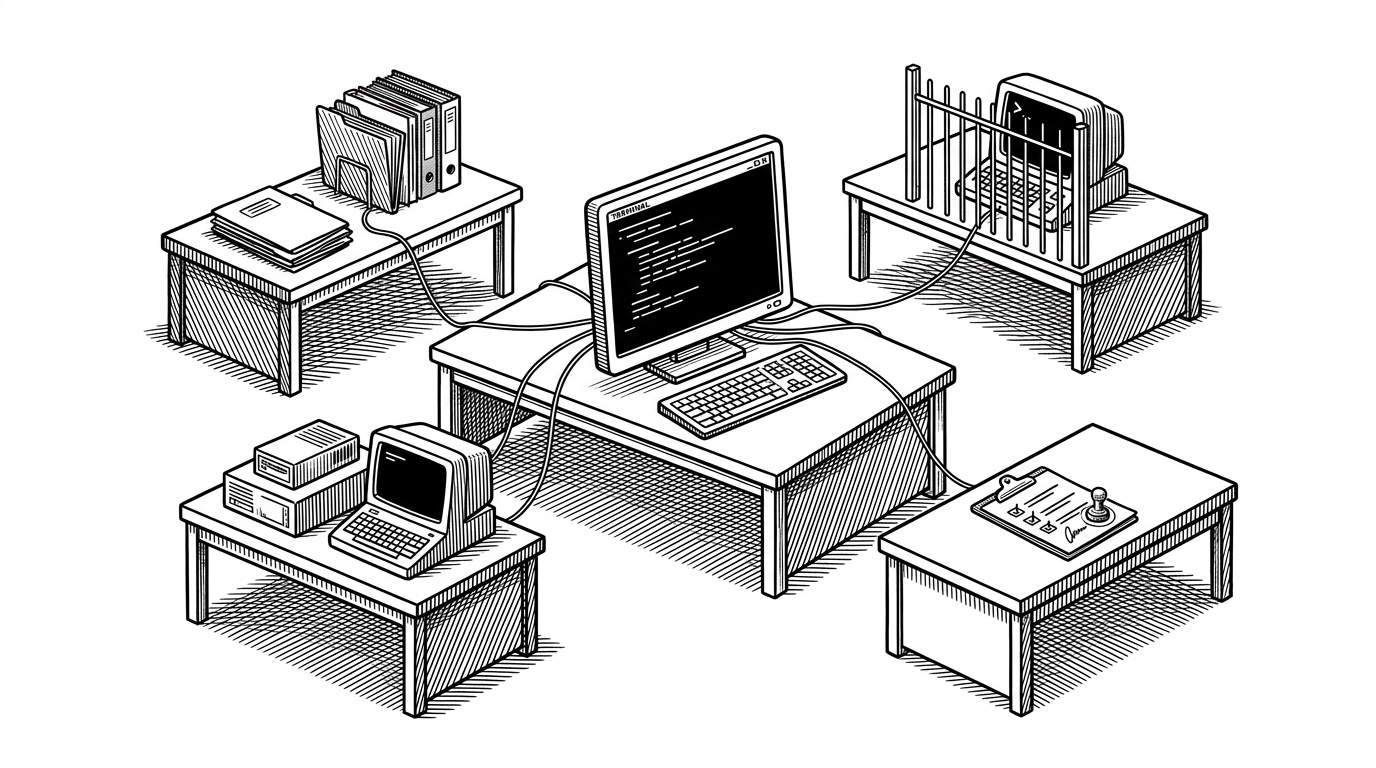
- deepagents is interesting because it treats autonomy as an operating environment, not a prompt trick.
- Its biggest move is delegation: the main agent can hand off work to sub-agents without dragging every detail into one bloated context.
- Security is built into the harness, especially around shell access, so power is checked before execution instead of trusted by default.
- The terminal-first design matters because files, commands, approvals, and state all live in the same working surface.
The clearest way to understand deepagents is to stop thinking about it as an agent demo. It is a harness for long-running work: one that expects messy tasks, broken context, risky commands, and the need to delegate before everything turns to soup.
The trick: delegate hard work before the context gets messy
That is the core move. The main agent does not try to hold the whole job in its head. It plans, splits the work, and sends slices of the task to sub-agents with fresh context, which keeps the center line clean while the work fans out.
Deep Agents is great for building more autonomous, long running agents where you want to take advantage of built in things like planning tools, filesystem, etc.
That is why the project feels closer to a controlled workspace than a clever prompt. It gives the model places to put things, and places to stop. In practice, that means planning, files, state, and delegation are first-class parts of the design, not add-ons tacked onto a chat loop.
What LangChain is really shipping here
LangChain describes deepagents as an agent harness, which is a useful label because it sits between a framework and a runtime. The repository builds on LangChain and LangGraph, then adds opinionated defaults for long-horizon work: a planning step, file-backed state, sub-agents, shell access, and human approval hooks.
The point is not that deepagents invents a new agent theory. It packages the boring parts that make agents survive contact with reality. The repo is trying to standardize the orchestration layer while keeping the underlying storage, execution, and integrations pluggable.
Why the shell is dangerous, and how deepagents fences it in
Shell access is where many agent systems become brittle or reckless. deepagents does not assume the model will behave. It puts command execution behind a whitelist middleware, so proposed commands are checked before they run.

That matters because the real threat is not just a bad answer. It is a bad answer that becomes a command, then a file change, then a system-level mess. With allowlists, interrupts, and approval points, deepagents treats execution as something that must be earned.
The terminal is not nostalgia here. It is the product
The CLI is not a side feature. It is the control surface. The project’s Textual-based terminal experience keeps the agent near the code, the files, and the commands, which is where this class of work actually happens.
That framing is revealing. A browser tab is good for conversations. A terminal is good for work. deepagents leans into streaming, status, approvals, and repo-local state because those are the affordances that make a long-running agent legible.
How the harness stays flexible without becoming mush
The repo is opinionated about workflow, but not about every implementation detail. Its backend model stays modular: virtual filesystem, persistent store, local shell backend, composite routing, and MCP connections. That lets the harness standardize behavior without forcing every deployment into the same storage shape.
This is the practical trade-off the project gets right. A harness only becomes useful if it can move between environments without losing its basic behavior. deepagents tries to be strict about orchestration and loose about infrastructure.
What this replaces, and what it does not
Here is the comparison that matters. deepagents is closest to Claude Code in spirit, but it is open and provider-agnostic. It is stricter and more structured than Auto-GPT or BabyAGI, and more opinionated than plain LangChain or LangGraph usage.
| Project | Primary goal | Context handling | Shell access | Sub-agents | Human-in-the-loop | Best fit |
|---|---|---|---|---|---|---|
| deepagents | Controlled long-running agent work | Isolated sub-agents plus file-backed state | Allowed through middleware and approval | Built in | Built in | Repo work, research, delegated execution |
| Claude Code | Terminal-native coding assistant | Managed inside the product | Integrated | Implicit | Supported | Coding sessions inside the CLI |
| Auto-GPT / BabyAGI | Early autonomous task loops | More fragile, more chat-like | Varies by setup | Limited or external | Usually light | Experiments and prototypes |
| Plain LangChain / LangGraph | Build your own agent system | Whatever you implement | Whatever you implement | Whatever you implement | Whatever you implement | Teams that want full control |
The lesson is not that deepagents is maximal. It is that it is better default architecture for a narrow but important class of problems: tasks that need delegation, state, and guardrails more than they need raw improvisation.
The bigger takeaway
The next useful agents may not be the freest ones. They may be the ones with the cleanest boundaries. deepagents is interesting because it asks a better question than “How autonomous can this get?” It asks, “How much work can this carry without losing control?”