Dify-Sandbox: How a Go Jail Lets LLMs Run Code Without Owning the Server
LangGenius’s sandbox trades per-task container startup for a tightly staged lock sequence: seccomp, chroot, privilege dropping, UID tricks, and a strict bootstrap order for Python and Node.js.
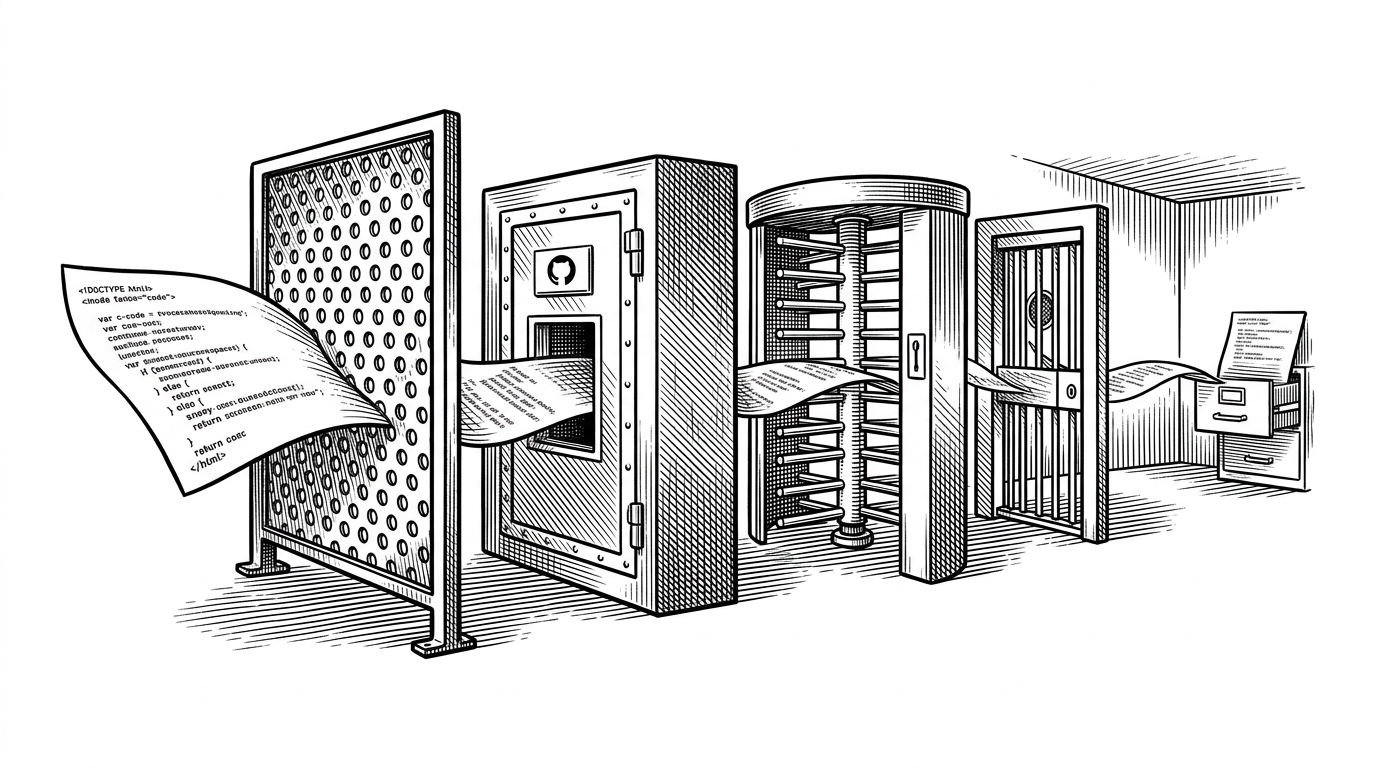
- Dify-Sandbox wins on workflow speed by keeping execution inside a shared container, then compensating with a layered sequence of Linux controls.
- Its most unusual engineering is compatibility work, because Python and Node still need believable identities, files, and startup conditions inside the jail.
- The sandbox’s real contract is sequencing, with identity, filesystem, privilege, and seccomp all landing before user code ever runs.
- It fits integrated Dify deployments well, but it does not erase the difference between shared-kernel isolation and a microVM boundary.
The bargain: one container, many locks
Dify-Sandbox does not begin by promising perfect isolation. It begins by promising that untrusted code will run fast enough to disappear into a workflow, then it stacks protections until that promise is safe enough to ship. That is the real design choice here: not a single hard wall, but a choreography of old Unix constraints.
That matters because Dify treats code execution as part of the product surface. A code node, a template transform, an LLM node, or a code interpreter tool can all hand user-written Python or Node.js to the sandbox. In that setting, latency is not a luxury. It is what makes the feature feel native instead of bolted on.
Why Dify needed its own sandbox
The project exists because the obvious alternatives each solved only part of the problem. Docker-per-task gives cleaner separation, but startup cost makes it feel heavy for interactive workflows. WebAssembly is attractive as a sandbox, but it is awkward when the runtime needs real dependencies and ordinary package behavior. Language-specific sandboxes are too narrow for a platform that wants Python and JavaScript in the same product.
Deeply integrated with Workflow, DifySandbox serves as the user-written code execution environment for code nodes, template transform nodes, LLM nodes, and the code Interpreter in tool nodes.
That quote is the clue to the architecture. Dify-Sandbox is not a generic security appliance. It is a runtime utility for a workflow engine, which means the team had to care about trust and throughput at the same time. The result is a Go service that behaves less like a fortress and more like a carefully managed border checkpoint.
The boot path from HTTP request to jailed process
The order is the whole story. A request arrives, the sandbox stages code and runtime files, and a prescript applies the boundary before user code ever gets a chance to touch the host. The point is not that any one primitive is magical. The point is that the process reaches the script only after the host has already taken away most of its leverage.
First the filesystem is narrowed, then privileges are dropped, then syscall behavior is constrained. That sequence matters because reversing it would leave gaps wide enough for the runtime to escape through. In other words, the sandbox is less a single wall than a timed lock sequence.
This is where seccomp earns its keep. It is not acting alone, and that is the point. The filter is strongest when the process is already inside a chroot, already running without extra privilege, and already denied the easy routes back to the host.
The strangest trick: making Python believe the user exists

This is the part that turns the project from a security story into an operating-systems story. Python expects things like `getpwuid()` to return a believable account record. If the sandbox gives it a synthetic UID with no matching passwd entry, ordinary library calls can fail in ways that look unrelated to security.
Dify-Sandbox answers with a UID pool and passwd entry management, so the runtime sees a normal-looking user even while the host is keeping the process on a short leash. That compatibility layer is the hidden cost of making untrusted code feel native. You are not just blocking escape paths. You are preserving the assumptions good software quietly depends on.
The runner also XORs the staged script with a random key and unwraps it in the prescript. That is not a grand secrecy story. It is a staging discipline story, where the bytes that reach execution are exactly the bytes the server intended, and not whatever happened to sit on disk.
What this design buys, and what it does not
The upside is straightforward. One sandbox can serve workflow traffic with low startup overhead, which keeps the product responsive and the deployment simple. For self-hosted Dify installations, that is a strong fit because the sandbox lives inside the same operational shape as the rest of the stack.
| Model | Boundary | Startup cost | Best fit | Main weakness |
|---|---|---|---|---|
| Dify-Sandbox | Shared container plus seccomp, chroot, and UID isolation | Low | Workflow platforms that need low latency | Weaker than hardware-backed isolation for multi-tenant risk |
| Docker per task | Fresh container per execution | Higher | Cleaner default isolation when latency is acceptable | Slower startup and more operational overhead |
| QEMU microVM | Hardware-backed VM boundary | Higher than a shared container | Regulated or high-trust multi-tenant environments | More complex to provision and operate |
The downside is just as clear. A shared container with seccomp and chroot is still not the same thing as a hardware boundary. That is why the multi-tenant critique matters, and why the proposal for a pluggable QEMU backend is not a theoretical detour. It is a sign that the project knows exactly where its current boundary ends.
Read the design honestly and it becomes more interesting, not less. Dify-Sandbox is not pretending to be the strongest possible jail. It is the fastest jail that still makes sense inside a workflow product, which is a very different and very practical claim.