BaoLianDeng: The macOS Proxy App That Hides a Rust Core Behind SwiftUI
A look at how BaoLianDeng intercepts flows at the socket layer, rewrites config before startup, and makes a Go-based proxy engine feel native on macOS.

- BaoLianDeng treats macOS proxying as flow interception and routing, which makes the app feel like a system service rather than a wrapper around a tunnel.
- Its unusual SwiftUI, Rust, and Go stack separates the UI, the safety layer, and the routing core in a way that fits a sensitive network extension.
- The app's real edge is control plane work, especially config rewriting and per-app routing, not feature sprawl.
- It competes by being native and disciplined, which matters more here than raw breadth.
It does not tunnel traffic. It intercepts flows.
That distinction is the whole story. BaoLianDeng uses NETransparentProxyProvider, so the system hands it flows, not raw packets. The app can then decide whether traffic should be routed, bypassed, or handled through a local proxy engine.
This is why the project feels more like a native macOS control surface than a generic VPN shell. It is not trying to fake a network stack in user space. It is leaning on Apple’s network extension model and using it as the enforcement point.
SwiftUI is the shell. Rust is the shock absorber. Go is the routing brain.
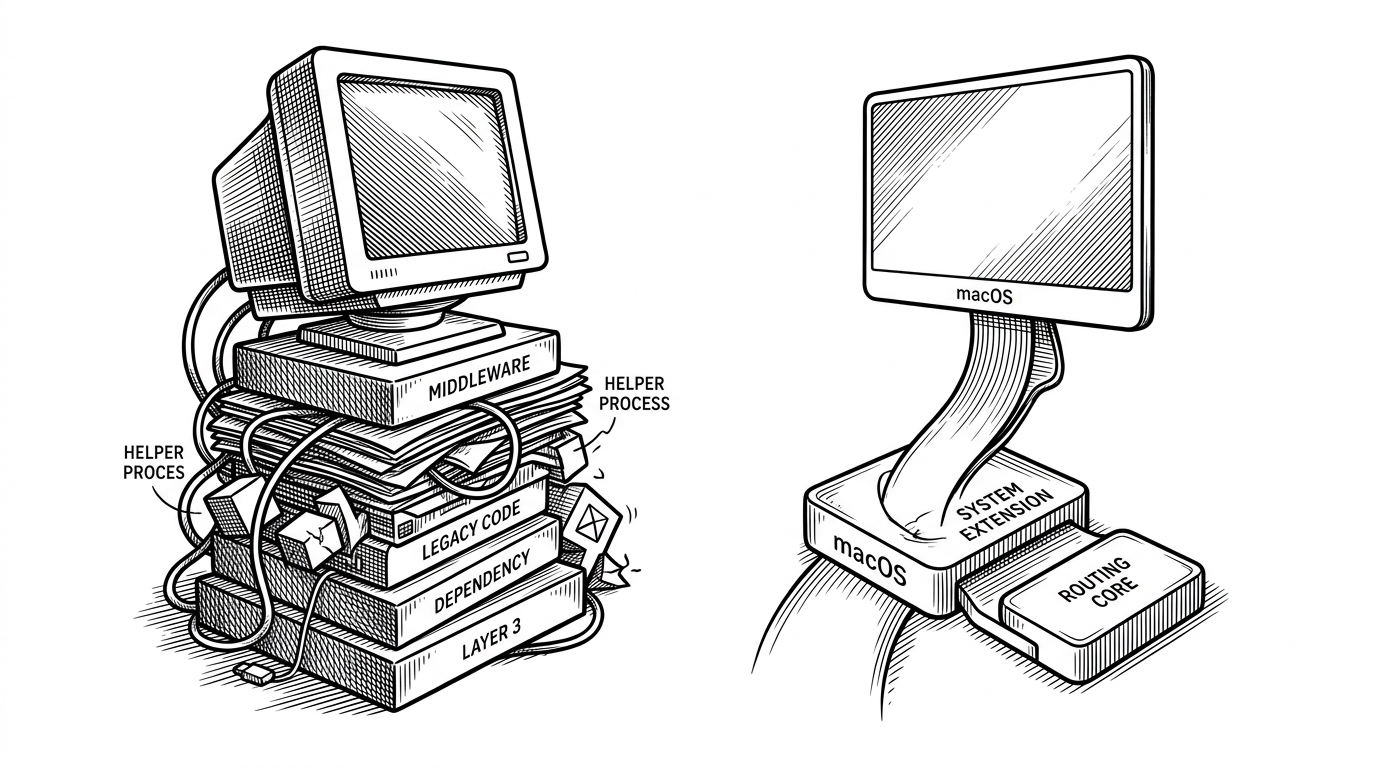
The codebase is split with intent. SwiftUI owns the app surface, shared state, and user actions. The network extension handles interception. Between them sits a Rust bridge that wraps the Go-based Mihomo core and gives the macOS targets a safer, more controlled interface.
That middle layer is the interesting move. Many projects would call into Go more directly or bury the logic inside a helper tool. BaoLianDeng instead uses Rust as an adapter, which is a strong signal that stability inside a system extension is being treated as a first-class product requirement.
macOS VPN proxy app powered by Mihomo (Clash Meta) core.
The config file is not static. It gets rewritten for the runtime.
BaoLianDeng does not simply load a YAML file and hope for the best. The config manager sanitizes user input, adjusts proxy selection, and patches the file before the engine starts. That means the runtime gets a configuration that already reflects the current app state.
This matters because proxy apps are full of state that users do not want to manage manually. The active node, subscription refreshes, routing rules, and local runtime constraints all collide at startup. BaoLianDeng handles that collision up front.

Per-app routing is the feature that turns it into a desktop tool
Per-app routing is where the macOS story becomes practical. The app can treat browsers, terminals, and background services differently, which is exactly what serious proxy users want on a desktop machine.
- A browser can be proxied while a terminal stays direct.
- A work app can follow one policy while a personal app follows another.
- The rule set stays visible and editable instead of disappearing into a black box.
That control is more valuable than a long feature checklist. It makes the proxy engine feel like part of the operating system workflow, not a separate utility you launch and forget.
Why this stack beats heavier macOS proxy clients
BaoLianDeng is not trying to win by being the biggest or the flashiest client. It wins by being native where it counts, which is the right tradeoff for a niche tool that lives close to the network stack.
| Project | UI stack | Core | Network handling | Open source | What it optimizes for |
|---|---|---|---|---|---|
| BaoLianDeng | SwiftUI | Mihomo | System Extension | Yes | Native macOS control and a disciplined runtime |
| Clash for Windows style clients | Electron | Clash or Clash Meta | Helper tools or mixed approaches | Usually no | Cross-platform reach and feature breadth |
| ClashX / ClashX Pro | Native macOS | Clash | Native macOS integration | Mixed | A familiar macOS Clash experience |
| Surge for Mac | Native macOS | Proprietary | Native macOS integration | No | An advanced power-user network suite |
This is what a maintained niche tool looks like
The repository does not look thrown together. It has end-to-end tests, stress scripts, mock servers, structured logging, and a build flow that spans Makefile orchestration, Rust, and Xcode. That is a lot of ceremony for a proxy client, which is exactly why it feels trustworthy.
The maturity signal is not just code volume. It is the separation of concerns, the use of modern macOS APIs, and the willingness to treat network stability as something that can be tested instead of merely hoped for. In a category full of rough edges, that is the differentiator that matters.