marblexyz/datadog-agent: The Smallest Possible Sidecar That Makes Railway Observable
A three-file template that turns the official Datadog Agent into a deployable observability layer, and shows why one networking flag matters more than a lot of code.
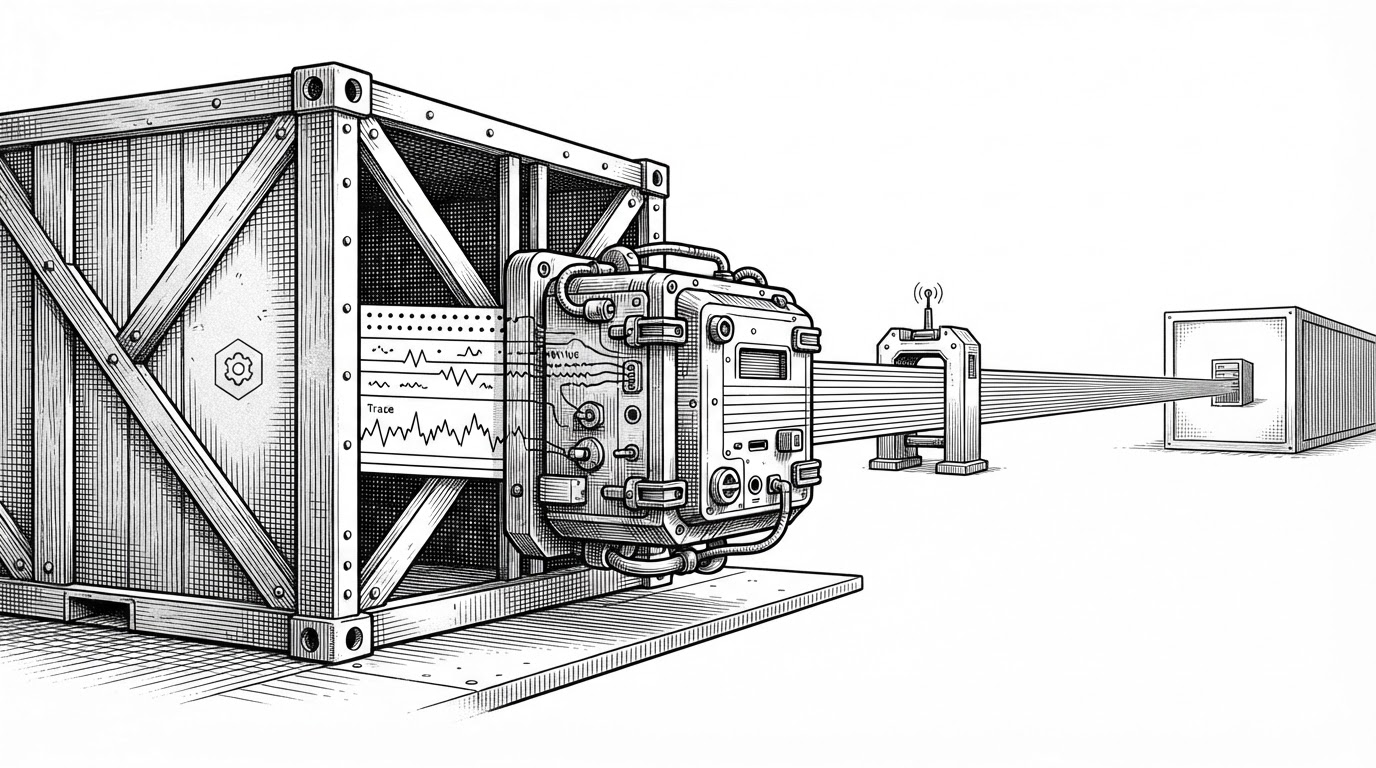
- This repo matters because it turns a generic observability agent into a Railway-ready sidecar with almost no code.
- The important change is not the Datadog image itself, but the networking choice that lets sibling containers reach it.
- The Dockerfile is doing product work, since each line sets the boundary between convenience, reachability, and security.
- The project reads like infrastructure, but it behaves like a golden-path template for fast, repeatable deployment.
The hidden trick: making Datadog visible inside Railway
The surprise here is not that Datadog can collect telemetry. It is that this repo turns the agent into something a Railway app can actually reach. That one shift, from local-only daemon to shared observability endpoint, is the whole point.
In practice, this is a sidecar template. The application runs beside the agent, the agent forwards data to Datadog, and a single networking choice makes the setup work inside a container platform instead of only on a host.
Why a three-file repository is enough
The repo is tiny because it leans on the official Datadog Agent image. The heavy lifting already lives upstream. This wrapper only has to choose a base image, set the right environment variables, and document the deploy path.
What the Dockerfile actually changes
The Dockerfile is the whole implementation. It starts from datadog/agent:7, enables APM, and then changes the traffic model so the agent listens beyond localhost.
FROM datadog/agent:7

ENV DD_APM_ENABLED=true
ENV NON_LOCAL_TRAFFIC=true
ENV DD_DOGSTATSD_NON_LOCAL_TRAFFIC=true

ARG DD_API_KEY
Each line is a decision. DD_APM_ENABLED=true turns on tracing. NON_LOCAL_TRAFFIC=true and DD_DOGSTATSD_NON_LOCAL_TRAFFIC=true widen the listener so other containers can talk to the agent. DD_API_KEY is the injection point for credentials, which keeps secrets out of the image itself.
| Line item | What it changes | Why it matters |
|---|---|---|
| Base image | Uses the official Datadog Agent v7 | The repo inherits a mature runtime instead of rebuilding it |
| APM flag | Enables trace collection | Application performance data is available immediately |
| Non-local traffic | Opens the agent beyond localhost | Sibling containers can send telemetry to the same endpoint |
| API key arg | Defines a credential input | The agent can forward data without hardcoding secrets |
The tradeoff: local safety versus platform convenience
This is the only real tension in the repo. By letting non-local traffic in, the agent becomes more useful inside a multi-container platform. It also becomes a little less narrow from a network perspective.
| Dimension | Traditional host setup | Railway sidecar template |
|---|---|---|
| Setup effort | Manual installation and host configuration | A deployable template with the agent pre-wired |
| Network model | Agent listens locally on the machine | Agent accepts container-to-container telemetry |
| Operational ownership | You manage the host and agent lifecycle | The platform and template absorb most of the setup |
| Security posture | Narrower by default | Slightly wider reach inside the deployment |
| Portability | Tied to a specific environment | Reusable as a template on the target platform |
| Time to first telemetry | Longer | Much shorter |
Now with @𝚖𝚊𝚜𝚝𝚛𝚊/𝚌𝚘𝚛𝚎@𝟷.𝟻𝟻.𝟶 you can use 𝙳𝚊𝚝𝚊𝚍𝚘𝚐𝙱𝚛𝚒𝚍𝚐𝚎 to send your agent traces into Datadog: https://t.co/w0x7ZQUQYh
Why this looks like infrastructure, but reads like product design
This repo behaves like a golden path. It removes decisions, narrows the surface area, and turns a fairly fiddly observability setup into something a developer can launch without reading a playbook.
That is product design work, even when it ships as Dockerfile syntax. The value is not novelty. The value is a repeatable default that saves time and reduces mistakes.
What this repo says about modern observability
The bigger pattern is clear. Observability is increasingly packaged as a deployable primitive, not a manual integration project. The agent, the platform, and the template each do a small part of the job.
That is why this repository can stay so small. Its job is not to invent a new agent. Its job is to choose the right boundary between usability and safety, then make that boundary easy to ship.