OpenAlgo: The Trading OS That Hides 36 Brokers Behind One Stable API
A self-hosted platform that combines broker adapters, Python strategy isolation, visual workflows, and a guarded AI agent into one local-first control layer for traders.
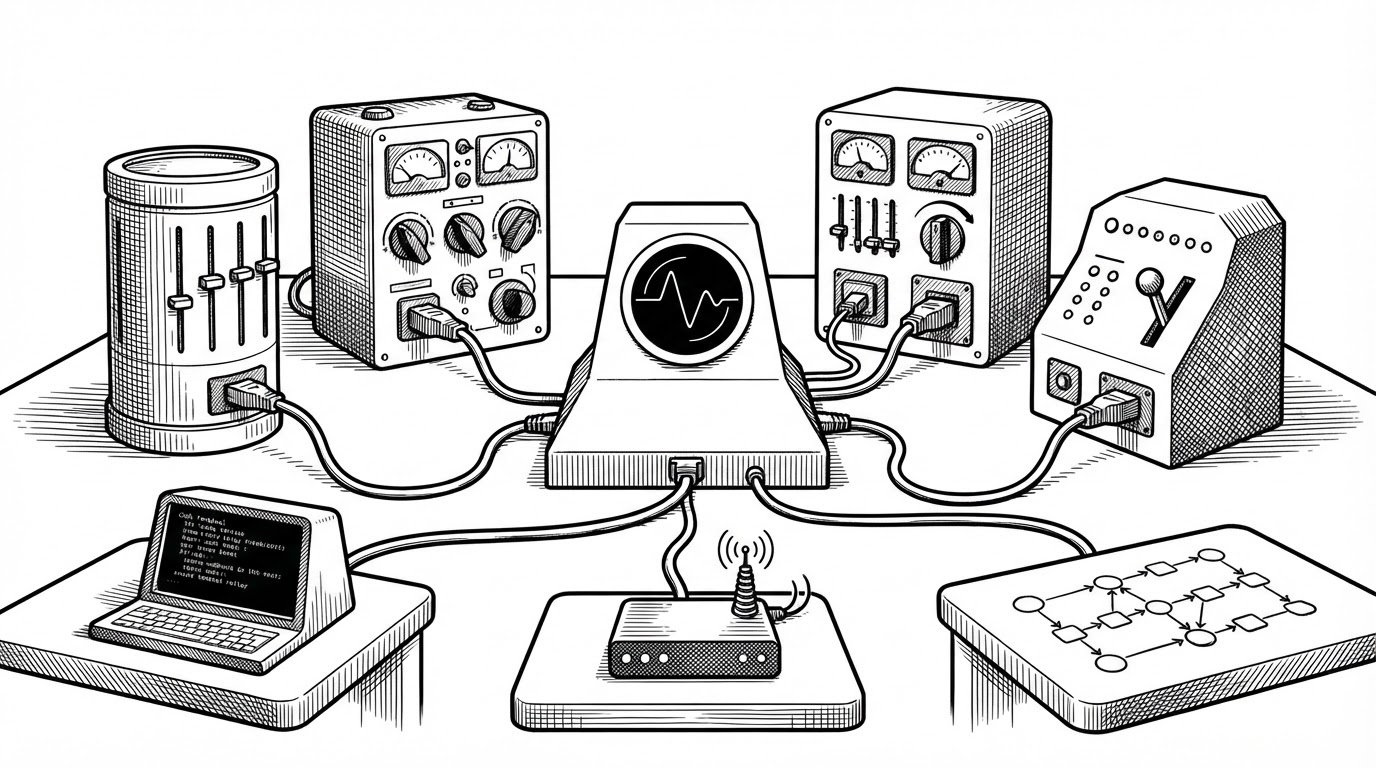
- OpenAlgo solves the N+1 broker problem by making the broker the plugin and the rest of the system the stable product.
- Its real product is a local-first control plane that lets code, workflows, and AI share one execution core without collapsing into a mess.
- Python strategies run as isolated processes, so one broken script does not become a broken platform.
- The AI layer is valuable because it is constrained, audited, and approval-gated, not because it is autonomous.
OpenAlgo is easy to mistake for a broker bridge. It is closer to a trading OS that keeps the messy parts in one place: adapters, execution, workflow validation, process isolation, and AI guardrails. The payoff is simple. You can change brokers without rewriting the rest of your stack.
The hard problem OpenAlgo solves: one trading brain, many brokers
So I rewrote the entire architecture around one idea. Support only one broker at a time. But make it easy to swap any broker. I used the Adapter Pattern. One common symbol format. One standard OpenAlgo API. One generic UI. Only the adapter changes.
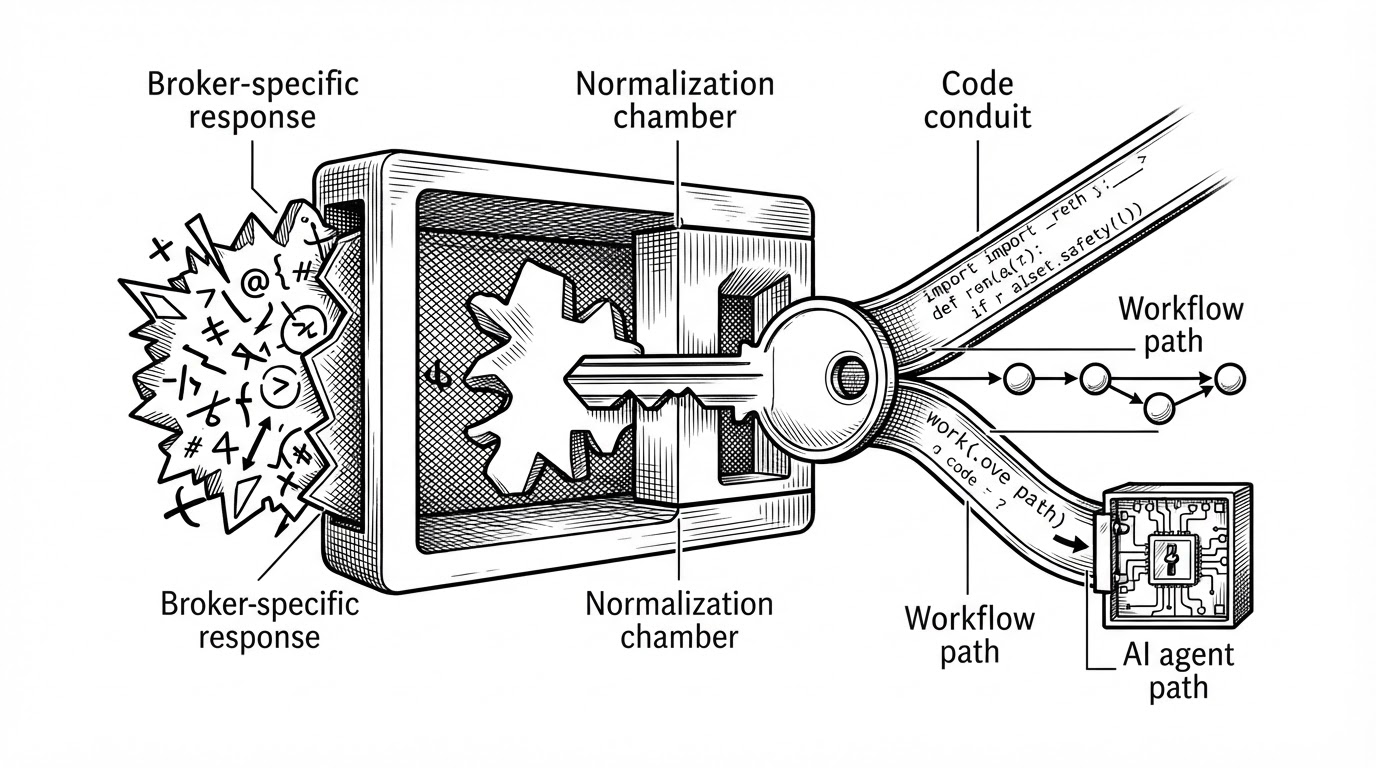
That is the central move. Broker APIs are inconsistent in authentication, order formats, market data, and websocket behavior. OpenAlgo treats that inconsistency as an adapter problem, not a product problem. The rest of the system gets a normalized contract.
| Problem | Typical broker integration | OpenAlgo |
|---|---|---|
| Order placement | Custom code per broker | One normalized API over broker plugins |
| Market data | Different websocket shapes | Mapped into a common data layer |
| Strategy portability | Strategy tied to one broker | Strategy code survives broker swaps |
| Operations | Ad hoc scripts and glue | Self-hosted control plane with shared services |
A platform, not a wrapper
The repo is organized like a full-stack Flask application, but the shape matters more than the labels. Blueprints handle routes, services hold business logic, SQLite stores domain data, and broker folders carry the adapter implementations. ZeroMQ sits underneath the UI-facing layer so market data can move fast without turning HTTP into the transport for everything.
| Layer | What it does | Why it matters |
|---|---|---|
| Blueprints | Route requests into features | Keeps the app modular |
| Services | Apply business rules | Separates validation from transport |
| Database | Persist auth, flow, and trading state | Makes the platform stateful and auditable |
| Broker plugins | Translate to broker-specific APIs | Keeps broker quirks out of the rest of the codebase |
| ZeroMQ | Moves market data internally | Avoids making the web stack do realtime heavy lifting |
Three ways to use the same engine
OpenAlgo exposes one engine through three surfaces. Developers use the REST API. Quants run Python strategies inside the platform. Non-coders build through Flow, a drag-and-drop workflow system. These are not separate products. They are different interfaces to the same execution core.
REST, Python, and Flow are not separate worlds
The benefit of this design is portability. A TradingView alert can trigger a workflow, a Python script can place the same kind of order, and an external tool can speak the same API. The system is trying to reduce translation work, not add another place to maintain logic.
How the broker abstraction actually works
Inside `/broker/*`, each provider lives in its own folder with plugin metadata and broker-specific code. The plugin layer maps proprietary responses into OpenAlgo’s normalized order and market-data shapes. Once that contract exists, the rest of the app can call a standard action like place_order without caring whether the backend is Zerodha, AngelOne, Fyers, or something else.
That is a real architectural choice, not a convenience wrapper. It means the platform can grow across brokers without forcing every feature team to relearn every broker’s quirks. The messy edge stays in one place.
| Approach | Trade-off | Result |
|---|---|---|
| Direct broker integration | Fast to start, hard to scale | Feature code becomes broker-specific |
| Adapter pattern | More upfront structure | Core logic stays stable while brokers change |
| Broker as platform | Easier vendor lock-in | Users inherit the broker’s limits |
Why Python strategies are run like isolated processes
OpenAlgo is no longer just "an API layer in front of your broker." Today it combines four trading surfaces in one self-hosted instance, sharing the active broker session, market-data infrastructure, and six operational data stores across the journey from idea to testing and live execution.
Python strategies are not treated like notebook cells. They are launched with subprocess.Popen, which gives each strategy its own operating-system process. If one fails, the platform survives. That is what trading software should do.
The operational guardrail is just as important. A market-hours enforcer checks timing rules and can stop processes when the market closes. That turns strategy execution into a managed runtime, not an always-on script you hope remembers when to stop.
Flow lowers the floor without lowering the guardrails
Flow gives non-coders a node-based builder on top of the same backend. But it is not a free-form toy. The backend validates the graph before execution, and each workflow gets a webhook token. That means outside signals can trigger automation, but only through a shape the system understands.
This is the right kind of no-code. It reduces friction at the edges and keeps the core opinionated. A visual editor is useful when it does not become a loophole.
The AI agent is useful because it is boxed in
OpenAlgo is not written by one AI. It is orchestrated by multiple AI systems under human supervision. Today: 99.9 percent of the code is written by AI. I only focus on: Architecture. Decisions. Debugging. Edge cases.
The agent layer uses LiteLLM to abstract over model providers, but the more important detail is the boundary. It can inspect data, help with analysis, and propose actions, but execution requires approval. Logs are redaction-first, because a trading assistant that leaks secrets is worse than no assistant at all.
That makes the AI story practical. It is not a fantasy about autonomous trading. It is a controlled interface for analysis and assistance, with human sign-off where the risk matters most.
What OpenAlgo is closer to than its competitors
| Project | Best at | Where OpenAlgo differs |
|---|---|---|
| QuantConnect / LEAN | Cloud-first quant infrastructure | OpenAlgo is self-hosted and broker-native for retail workflows |
| Tradetron | Closed-source no-code trading | OpenAlgo is open and extensible with Python and plugins |
| AlgoTest | Indian retail options workflows | OpenAlgo is broader, more modular, and local-first |
| Hummingbot | Crypto connectors and market making | OpenAlgo is aimed at directional trading across brokers and surfaces |
The clearest position is not that OpenAlgo beats every competitor on every axis. It is that it lives in a different lane. It is self-hosted, broker-agnostic, Indian-market-native, and hybrid across code, webhooks, and visual flow. That combination is rare.
The bigger bet
OpenAlgo reads like a product built around sovereignty. Keep the keys local. Keep the adapters separate. Keep execution explicit. Then let AI help with the work, but not with the final authority. That is a serious answer to a serious operational problem.
The bigger idea is not just that traders can move faster. It is that trading infrastructure can be modular without becoming fragile. OpenAlgo makes that case with structure, not slogans.