OpsPilot: The Agent That Distrusts Itself
A measured triage system that uses LLMs for judgment, then uses deterministic rules, safe execution, and human approval to keep the judgment from going off the rails.

- OpsPilot’s real thesis is not automation, but controlled interpretation: the LLM helps decide what something means, while rules and review decide what happens next.
- The system is built to avoid false certainty, so vague input, praise-only messages, and unsafe tool calls fall back to clarification or skip paths instead of forced action.
- Its strongest idea is a deterministic safety spine that can override model guesses, which makes the workflow legible enough for operations work.
- The benchmark suite matters because it tests judgment, not just runtime, by checking whether categories, priorities, and plan types stay stable across changes.
OpsPilot does not trust the model to be right
Quazmoz describes OpsPilot as an assistant that sits next to your servers and lets you ask questions in plain English, but the code says something more interesting: it refuses to let the model have the last word. The LLM is a layer in a longer chain, not the chain itself.
That matters in ops, where a wrong guess is not a cute product bug. It is a bad ticket, a bad reply, a bad action, or a pager alert that wastes a human’s time.
I manage servers at a call center company and got tired of the same cycle: something breaks at 2am, SSH into the wrong box, forget the exact command, wake up the one guy who knows the system. So I spent the last 6 months building OpsPilot — an AI assistant that sits next to your servers and lets you ask questions in plain English.
The triage pipeline starts by refusing ambiguity
The first important move is the intent router. Instead of forcing every message into a confident answer, it checks whether the input is short, vague, malformed, or simply not actionable. If the system cannot classify it cleanly, it asks for clarification or falls back to a safer path.
That is a small design choice with a big effect. It keeps OpsPilot from inventing details when the user has not given enough signal to earn them.
Normalization is where the system gets opinionated
This is the repo’s center of gravity. The normalization layer does not just pass along the model’s guess. It can override weak classifications with deterministic category rules, and it can filter out praise-only messages so the team does not get noisy pseudo-incidents for simple thanks.
That is the safety spine. The model proposes. The rules dispose.
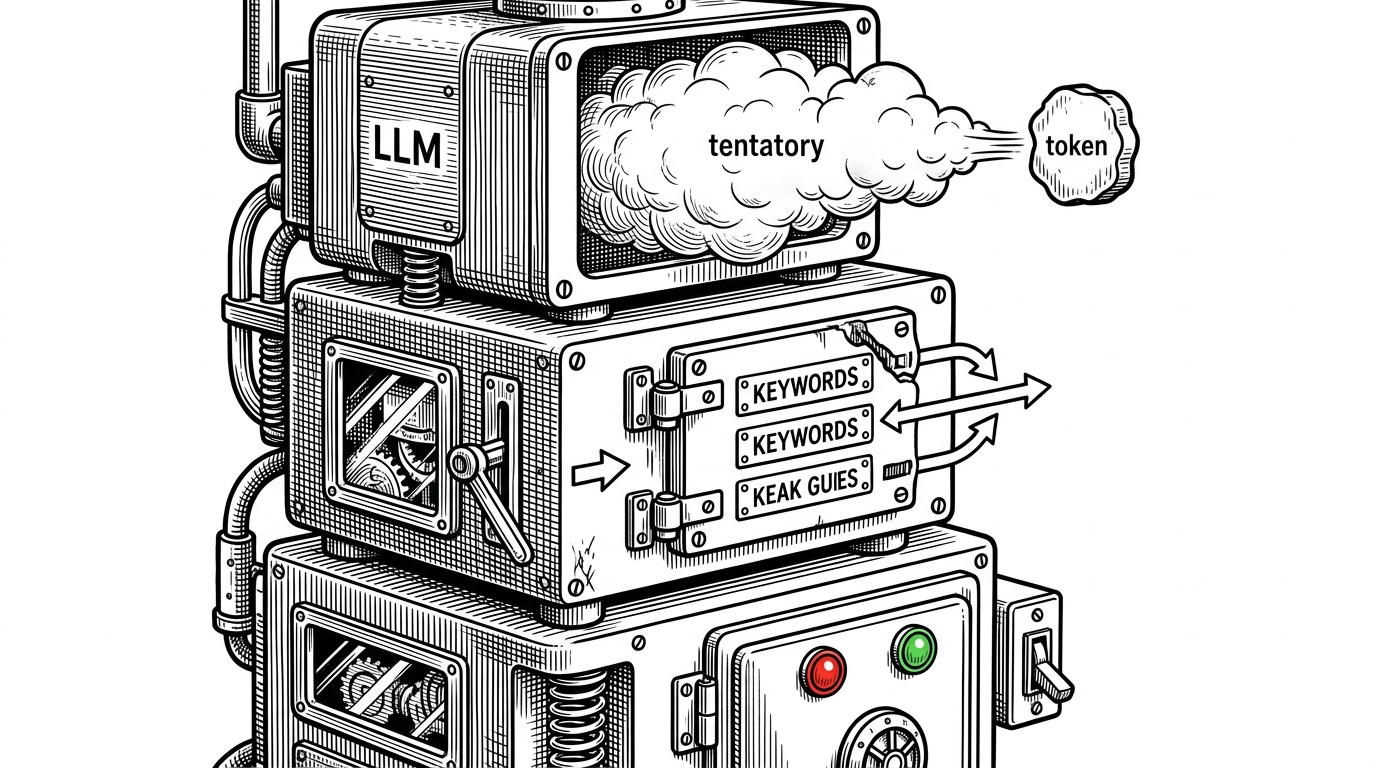
The system is built to downgrade bad input, not salvage it at any cost
The planner has another useful habit: when input is too short or too vague, it does not pretend to understand. It routes toward clarification. That is a subtle but serious rejection of agent theater. The system is optimized to avoid nonsense, not maximize output volume.
In ops, restraint is a feature. A system that says “I need more context” is often more valuable than a system that answers fast and wrong.
Execution is planned, then policed
OpsPilot does not let a planner fire tools blindly. The executor checks suggested actions against a safe allowlist, then records whether each step was executed, skipped, or errored. That trace matters because it makes non-action visible instead of invisible.
This is the difference between a demo and an operations system. A skipped action with a reason is evidence. A silent failure is just smoke.
| Layer | Black-box agent | OpsPilot |
|---|---|---|
| Input style | Any prompt becomes action-oriented reasoning | Input is first classified, normalized, and sometimes rejected |
| Execution model | Model decides and may call tools directly | Planner suggests, executor validates against a safe allowlist |
| Human approval | Optional or bolted on | Core workflow for risky categories |
| Fallback behavior | Often crash, hallucinate, or guess | Clarify, skip, or downgrade to a safer path |
| Best fit | General-purpose assistant demos | Standalone or legacy server operations |
| Main risk | Hidden mistakes | Conservative behavior that may feel less magical |
Human approval is not an exception. It is the workflow
The approval step is not a safety net pasted on after the fact. It is a first-class part of the design. Categories like billing, auth, and security trigger review because those are the places where automation mistakes become expensive quickly.
That makes OpsPilot feel closer to a controlled operations desk than an autonomous agent. The human is not outside the loop. The human is part of the loop by design.
In the following order. No. Fuck no. Kindly fuck off to nowhereville. To be clear I like ai, but just no.
OpsPilot tests judgment, not just code
The benchmark suite is one of the strongest signals in the repo. It does not just check whether the program runs. It checks whether the system still makes the same judgment calls after a change: category, priority, and plan type.
That is harder than ordinary unit testing. It is closer to regression testing for policy.
| Test focus | Simple function test | OpsPilot benchmark |
|---|---|---|
| What it measures | Return values and exceptions | Category, priority, and plan stability |
| Failure signal | Crash or mismatch | Reasoning drift and policy regression |
| Value | Confirms code executes | Confirms the agent still behaves the same way |
| Best for | Deterministic logic | LLM-assisted triage systems |
The benchmark cases, including prompt-injection-style examples, show a team trying to protect behavior, not just syntax. That is the right instinct for a system that sits between messy language and operational action.
Why this matters in a crowded ops market
OpsPilot is not trying to beat Ansible at configuration management, and it is not trying to out-platform enterprise observability suites. Its niche is narrower and more opinionated: lightweight, human-supervised help for standalone or legacy server work.
That is why the project is interesting. It treats AI as a constrained layer over operations, not as a replacement for operational discipline.
| Project | Input style | Execution model | Human approval | Best fit | Main risk |
|---|---|---|---|---|---|
| OpsPilot | Natural language triage | LLM plus deterministic policy plus safe executor | Built in | Standalone or legacy server operations | Conservative behavior |
| Ansible or SaltStack | Declarative or imperative infrastructure definitions | Deterministic automation | Optional review in process | Repeatable config management at scale | Requires structured playbooks |
| Commercial SRE AI | Logs, metrics, alerts, incident data | Platform-driven incident automation | Varies by product | Large observability-heavy environments | Opacity and vendor lock-in |
| Black-box agent | Open-ended prompt | Model-driven tool use | Often optional | Demos and exploratory tasks | Hidden failure modes |
That is the trade. Less magic, more legibility. Less autonomy, more trust.