ios-location-spoofer: The Repo That Fakes iPhone Location by Lying to Apple
A JavaScript MITM tool that rewrites the `/clls/wloc` response, patches protobuf fields, and makes iOS believe its Wi-Fi and cell world is somewhere else.
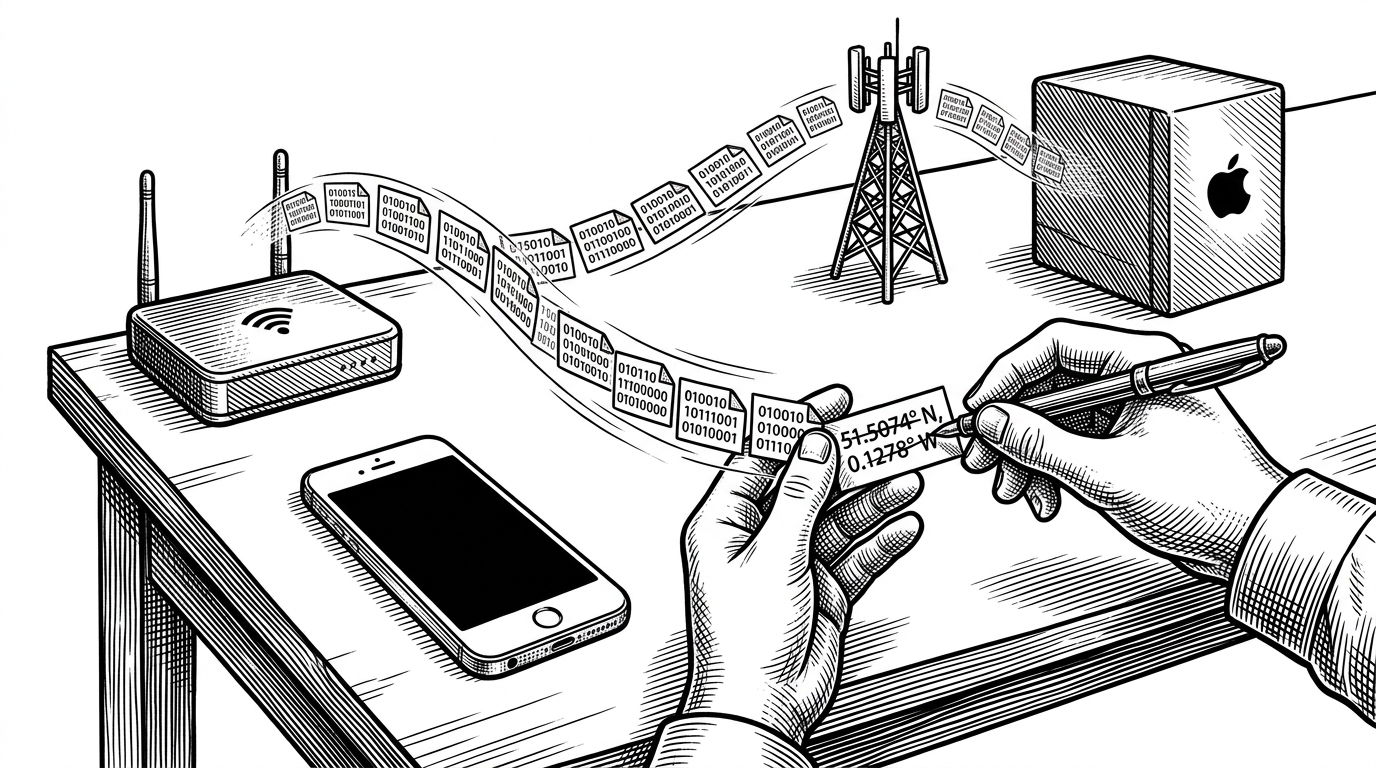
- This repo reframes iPhone location as a network negotiation with Apple, not a pure device sensor reading.
- Its core move is to intercept `/clls/wloc` and rewrite the response before iOS turns it into a location decision.
- The spoof works because it edits the supporting evidence too, including accuracy, altitude, cell coordinates, and motion signals.
- The project’s niche is standalone, no-jailbreak spoofing inside proxy tools, which puts it between desktop tethering and jailbreak tweaks.
The easiest way to miss ios-location-spoofer is to mistake it for another GPS faker. It is stranger than that. The repo’s premise is that iPhone location is partly a conversation with Apple, and if you can sit in the middle of that conversation, you can change the answer.
That is the important inversion. The phone is not being told to invent a new latitude and longitude. It is being handed a forged version of Apple’s own location response, which makes the deception feel native instead of bolted on.
The map is not the territory
In the normal model, location lives on the device. In this repo’s model, location is negotiated across sensors, servers, and trust signals. Nearby Wi-Fi names, cell tower IDs, and Apple’s location service all contribute to what iOS believes is true.
That matters because it changes the threat model. A simple coordinate swap can look fake to any app that checks for motion, altitude, or surrounding network evidence. A forged Apple response is much harder to separate from the rest of the iOS location stack.
What `ios-location-spoofer` actually changes
The core script intercepts the response from /clls/wloc, finds the embedded location message, and rewrites the fields that matter most. The obvious ones are latitude and longitude. The less obvious ones are the ones that make the lie survive longer.
// Core fields rewritten by the spoofing logic
1   // latitude
2   // longitude
3   // horizontal accuracy
11  // altitude
22  // cell tower coordinates
24  // cell tower coordinates
12  // motion activity type
13  // motion activity confidence
That field set is the repo’s real insight. A spoofed point on a map is easy. A believable location story is harder. If accuracy says one thing, altitude says another, and motion activity says the user is walking somewhere else, the lie collapses.

Why the lie has to be so detailed
The repo’s fail-open behavior is a quiet tradeoff worth noticing. If parsing breaks, the original location passes through instead of taking down the connection. That makes the tool more resilient in hostile, changing environments, but it also means the spoof is best effort, not a hard guarantee.
That choice makes sense for proxy environments. This is not a neat laboratory system with stable APIs. It is code that has to survive app quirks, binary formats, and Apple changing the shape of the response without warning.
The detailed rewrite also explains why the project feels more like packet surgery than classic location spoofing. The repo is not chasing one signal. It is trying to stay believable across the whole stack that turns raw radio data into a location decision.
How the code survives hostile environments
The adapters are a big part of the story. Quantumult X handles response bodies as Base64 strings, while Shadowrocket and Surge can work with binary bodies directly. The repo wraps those differences so one spoofing engine can run inside multiple proxy apps.
// Adapter pattern at a glance
// Quantumult X: base64 -> bytes -> rewrite -> bytes -> base64
// Shadowrocket / Surge: binary body -> rewrite -> binary body

function rewriteResponse(body, mode) {
  const bytes = mode === 'base64' ? base64ToBytes(body) : body;
  const patched = patchLocationPayload(bytes);
  return mode === 'base64' ? bytesToBase64(patched) : patched;
}
That portability is the practical differentiator. The repo is not tied to one client, one OS state, or one device setup. It is built to move with the user’s existing network tooling.
What the serverless picker adds
The location-picker/ layer turns a packet trick into a control surface. Instead of hardcoding coordinates, the repo can accept remote selection and persistence, including a Cloudflare Worker deployment path. That matters because the location becomes something you manage, not just something you patch once.
This is also where the project becomes more legible as a product. The core spoof is technical. The picker is operational. Together, they turn a niche exploit into something a user can steer from a browser.
Why this repo occupies a strange niche
| Approach | Jailbreak required? | Computer required? | Where spoofing happens | Main tradeoff |
|---|---|---|---|---|
| ios-location-spoofer | No | No | Network layer, inside proxy traffic | Depends on proxy app and protocol behavior |
| Desktop tethering tools | No | Yes | Developer location APIs over USB | Portable only with a computer nearby |
| Jailbreak tweaks | Yes | No | System-level hooks on-device | Powerful, but device modification is the price |
| Xcode simulation | No | Yes | Developer APIs in a desktop workflow | Great for testing, not a consumer workflow |
That table is the point. The repo does not compete on precision alone. It creates a different class of spoofing altogether, one that lives inside the same proxy tools many power users already trust for traffic control.
The weakest automation is the one that treats every clean input like truth. A trending iOS location-spoofer repo is not a “cool hack” to me. It is a reminder that client-side trust signals are fragile: GPS, IP, device ID, browser fingerprint, app session. If a user can imitate h
The larger lesson is broader than iOS. Systems that look local often depend on remote trust loops. If a client can rewrite what comes back from the network, then the map, the sensor, and the app all become negotiable.
The real takeaway
`ios-location-spoofer` is interesting because it exposes a hidden seam in iPhone location logic. It shows that the device is not just reading the world. It is collaborating with a server that helps define the world first.
That makes the repo useful as a technical artifact, even if you never use it. It is a compact example of how much modern software trusts the network glue around it, and how fragile that trust can be when the glue gets rewritten.