The Database That Thinks in Sentences: Unpacking musetronstar/tagd
How an obscure C++ semantic engine bypasses SQL entirely, using a custom parser and an axiomatic ontology to turn SQLite into a knowledge graph.
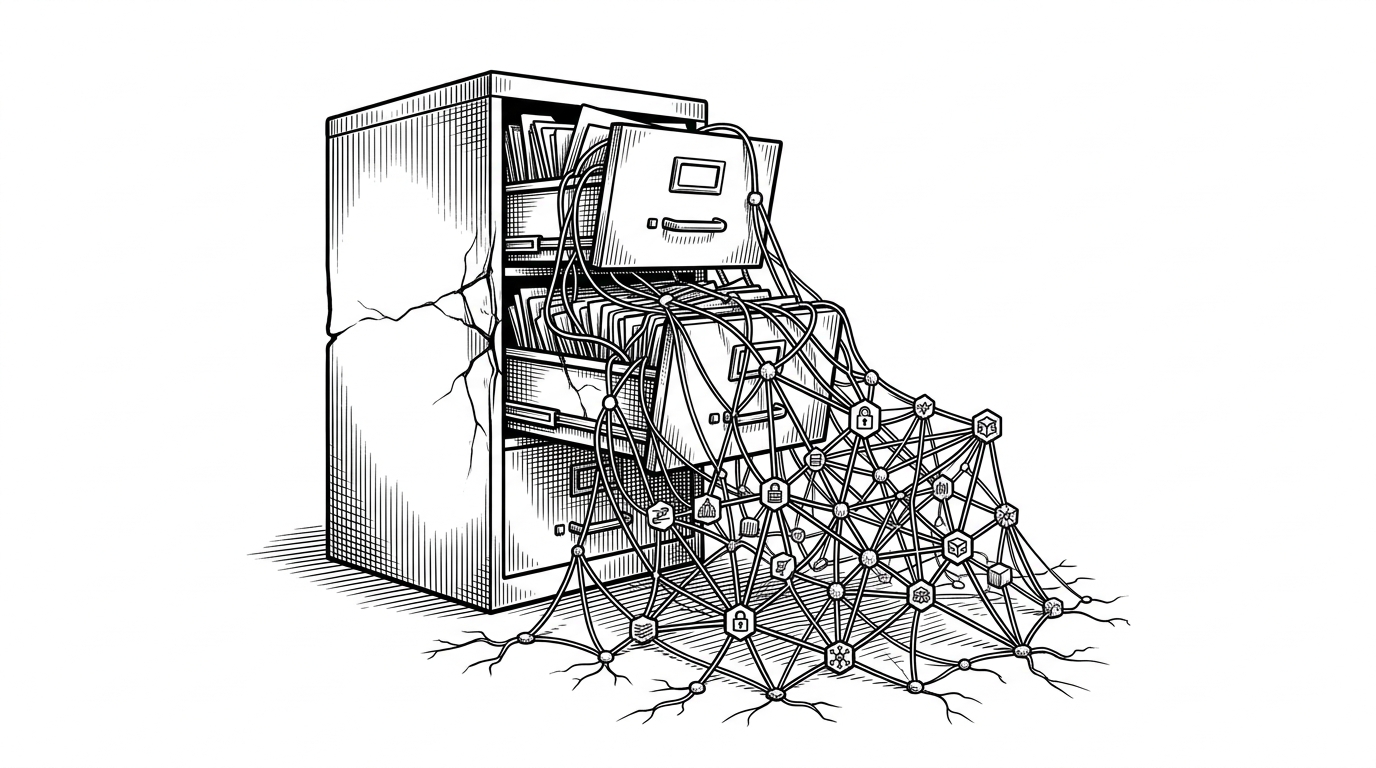
- tagd discards SQL entirely in favor of TAGL, a custom query language that maps information using subject-verb-object semantic triples.
- Unlike blank-slate graph databases, tagd enforces an axiomatic ontology through hard-coded tags like _entity, preventing unstructured chaos.
- The system leverages SQLite purely as a highly reliable, flat block store, relying on aggressive prepared statements to map abstract graphs to relational rows.
- Built with an old-school C++ toolchain including Lemon and re2c, the architecture prioritizes thread safety and a minimal memory footprint over modern conveniences.
The Relational Straitjacket
Relational databases are exceptional at mapping structured data. They are terrible at mapping organic human thought. When building intelligent agents or knowledge management systems, developers inevitably hit a wall trying to force complex, interconnected ideas into rigid tables and columns. The friction of translating reality into SQL becomes a bottleneck.
Enter tagd. This specialized database engine treats information not as tabular data, but as a graph of semantic entities connected by relations. It is designed to interpret subject-verb-object triples, treating information linguistically rather than mathematically.
TAGL and the Death of INSERT INTO
To understand tagd, you must first unlearn SQL. The engine completely discards standard query languages in favor of its own domain-specific syntax called TAGL (Tag Language). Instead of writing complex schema insertions, developers write fluent, human-readable statements.

-- The old way: rigid, tabular relationships
INSERT INTO animals (name, species, legs) VALUES ('dog', 'mammal', 4);

-- The TAGL way: a semantic triple
>> dog _is_a mammal; legs = 4;
When the engine parses a TAGL statement, it resolves it into a semantic triple. It utilizes a unique modifier system to handle numbers and strings contextually, understanding that a modifier like "legs = 4" implies an integer type, not just a raw string, allowing for complex semantic comparisons downstream.
The Axiomatic Foundation
Graph databases like Neo4j give you a blank canvas. While powerful, this freedom often degrades into unstructured chaos at scale. tagd takes a different philosophical approach. It forces a meta-schema through a system of "Hard Tags".
Elements like _entity, _is_a, and _has are hard-coded into the engine's core. Every single tag in the database must inherit from the _entity root. This axiomatic foundation ensures that the graph maintains a coherent, self-aware ontology, preventing the semantic web from collapsing under its own weight.
Tricking SQLite into Storing a Brain
Despite its complex semantic layer, tagd relies on a surprisingly conventional storage mechanism. The tagdb/sqlite module acts as the persistence layer, essentially tricking SQLite into storing a graph.
SQLite serves as a highly reliable, dumb persistence layer. By leveraging aggressive prepared statements, tagd maps its semantic triples into flat relational rows without sacrificing query speed. It bridges the gap between high-level intelligence and low-level disk efficiency.
| Feature | PostgreSQL (Relational) | Neo4j (Graph) | tagd (Semantic) |
|---|---|---|---|
| Base Unit | Row | Node / Edge | Subject-Verb-Object Triple |
| Schema Model | Strict and rigid | Dynamic blank slate | Axiomatic hard-tags |
| Query Language | SQL | Cypher | TAGL |
| Primary Use Case | Transactions | Network Analysis | Knowledge Representation |
A Masterclass in the Old-School Toolchain
The underlying architecture reveals a distinct priority for high-performance C++ systems programming. Rather than relying on standard tools like Flex and Bison, tagd implements its custom parser using Lemon (an LALR(1) parser generator) and re2c.
This deliberate toolchain choice highlights a focus on thread safety, minimal memory footprint, and robust error handling. It is a testament to the power of combining modern C++ abstractions with battle-tested, C-based scanning utilities to build an engine capable of true linguistic parsing.