Real-Time-Multi-Object-Tracking-Re-Identification-System: Real-Time Multi-Object Tracking & Re-Identification System: When a Tracker Learns to Remember
A modular MOT pipeline that keeps IDs stable through occlusion, rewrites lost identities with appearance embeddings, and extends the same logic across two cameras.
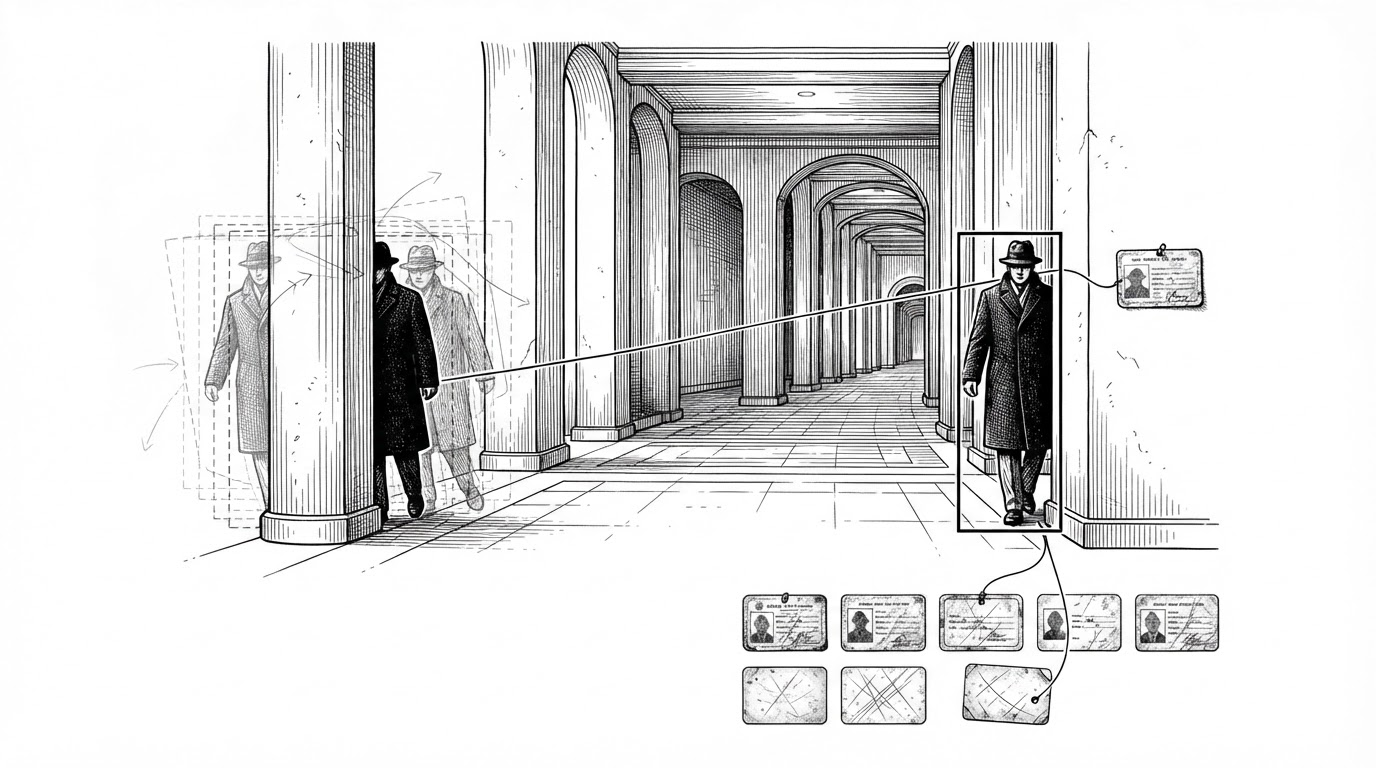
- This repo treats tracking as a memory problem, not a box-drawing problem.
- ByteTrack carries short-term continuity, while OSNet restores long-term identity after occlusion or re-entry.
- The architecture separates tracker state from display identity so the system can correct itself without breaking motion continuity.
- A second matching pass across cameras turns person re-identification into a global assignment problem.
Most trackers are good at the easy part. They can follow a person while the person stays visible and the detector stays confident. The real test comes when the frame breaks the story, and this repo is built around that failure mode.
The Tracker’s Real Job Is Remembering
A bounding box is not the product. Identity is. Once a person walks behind a pillar, leaves the frame, or comes back under new lighting, the tracker has to answer a harder question than "where is the box?" It has to answer, "is this the same person?"
That is the project’s central move. It uses motion to survive brief uncertainty, then uses appearance to recover a lost identity when motion alone is no longer enough.
ByteTrack Handles the Part Most Trackers Throw Away
The first half of the pipeline is deliberately unglamorous. ByteTrack keeps low-confidence detections in play instead of discarding them immediately, which means a partially occluded person still has a chance to stay alive in the tracker.
| Naive tracker | This repo's approach |
|---|---|
| Drops weak detections early | Carries low-confidence boxes forward |
| Treats re-entry as a new identity | Tries to recover the original identity |
| Lets IDs fragment under occlusion | Preserves continuity through motion plus appearance |
| Optimizes for clean frames | Optimizes for messy real scenes |
OSNet Becomes the Long-Term Memory Layer
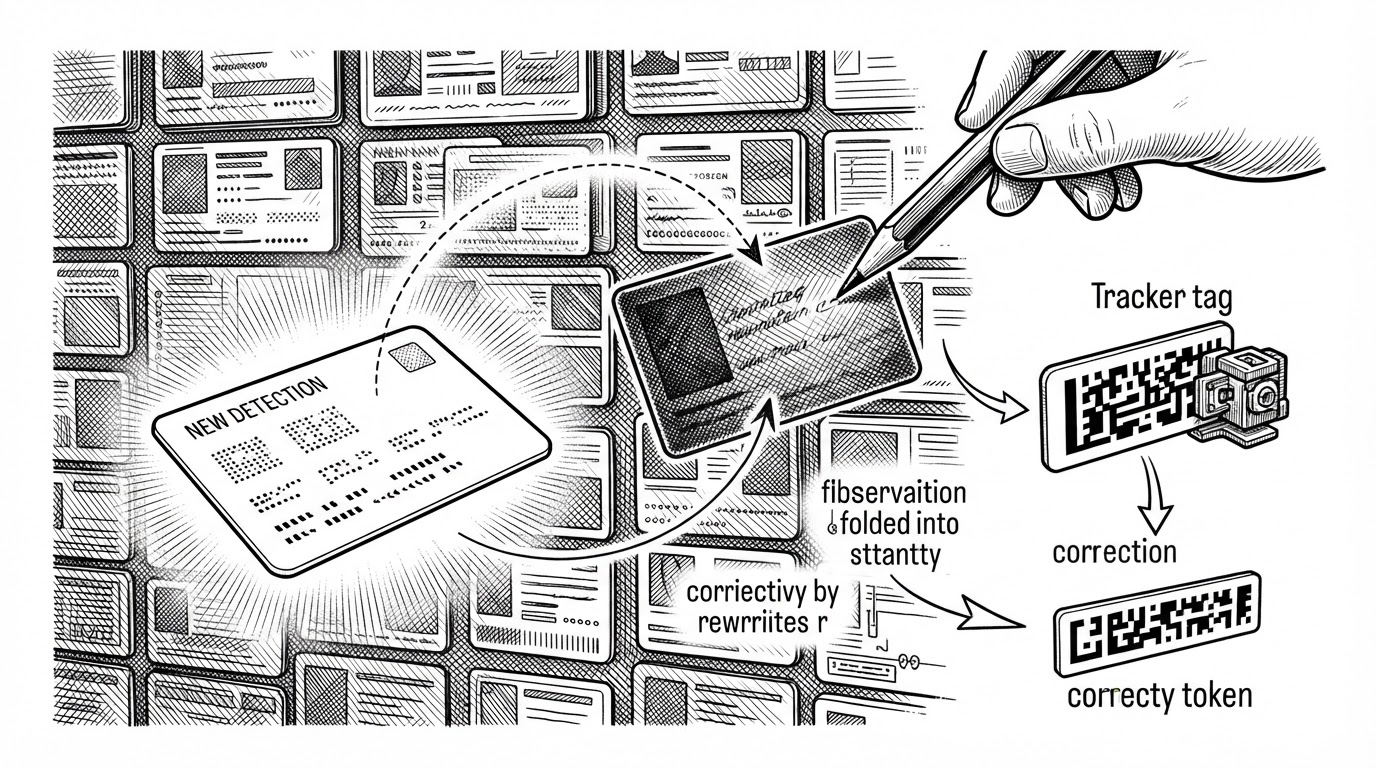
When ByteTrack cannot confidently reconnect a person, the repo extracts an OSNet embedding and compares it against a gallery of lost identities. The match is based on cosine similarity, with a threshold that decides whether the system should merge the new track into a prior identity.
That gallery is not static. The stored embedding is updated with an exponential moving average, so the remembered identity can drift toward new lighting, pose, and camera conditions without losing its core signature. In practice, that means the system keeps learning the same person instead of freezing them in one frame of time.
# Conceptual identity update
stored_emb = alpha * stored_emb + (1 - alpha) * new_emb

# If cosine similarity clears the threshold, merge the new track
# into the remembered identity instead of minting a fresh one.
Identity Is Not the Same as Tracker State
One of the smartest choices here is the split between tracker IDs and display IDs. ByteTrack can keep its Kalman state and motion bookkeeping intact, while the user sees a corrected identity that reflects re-identification logic.
That decoupling matters. It lets the system repair identity continuity without rewriting the entire motion layer every time a person disappears and returns.
| Tracker state | Display identity |
|---|---|
| Optimized for motion continuity | Optimized for human-readable continuity |
| Can remain stable even when the user-facing ID changes | Can be corrected when appearance evidence is stronger |
| Lives inside the tracking pipeline | Lives at the presentation layer |
| Preserves Kalman and association logic | Preserves what the viewer believes is the same person |
Two Cameras, One Identity Space
The multi-camera extension pushes the same idea one level higher. Each camera runs independently, then the system compares the final identity galleries across feeds and greedily matches the best candidates.
That is a practical way to extend re-identification beyond a single scene. The project does not pretend camera topology is solved. It focuses on what the embeddings can justify, which keeps the design honest and the implementation understandable.
| Single-camera tracking | Multi-camera re-identification |
|---|---|
| One scene, one continuity problem | Multiple scenes, one identity problem |
| Recover re-entries inside a view | Reconcile the same person across feeds |
| Motion and appearance resolve local ambiguity | Final galleries resolve global ambiguity |
| Useful for a room or corridor | Useful for a building or campus |
Why the Repo Feels Production-Minded
The project reads like a system that has been repaired in public. It vendors the OSNet architecture instead of depending on a heavier re-identification stack, and it adds a compatibility shim for NumPy and motmetrics rather than freezing the world around older dependencies.
That is a useful signal. It suggests the author is not just proving the idea, but also controlling the failure surface around it. The result is a codebase that feels like a portfolio project with engineering discipline, not a notebook experiment with prettier naming.
The broader structure reinforces that impression. Milestone-driven organization, separate pipeline modules, and evaluation output directories make the repo readable as a system, not just a script.
What This Project Is Really For
This is a reference architecture for situations where identity matters more than raw detection. Retail analytics, security review, lab environments, and any other video workflow that cannot afford to forget a person the moment they leave the frame all benefit from the same pattern.
The interesting part is not that the repo tracks objects. It is that it treats disappearance as a recoverable state, then gives motion and appearance distinct jobs in the recovery process. That is a better mental model than pretending a tracker can do everything alone.