openai/plugins: The File System Is the New App Store for Codex
Manifests, skills, and MCP servers turn AI capability into installable, governable packages. The repo is a blueprint for how agents will be extended.

- openai/plugins treats agent behavior as distributable software, not as prompt glue.
- The repo's real unit of value is a governed bundle made of manifests, skills, agent configs, and MCP endpoints.
- By moving expertise into versioned files, OpenAI makes capability portable, reviewable, and easier to control.
- The stack competes on declarative governance and local verification, not just on integration count.
The folder that behaves like a platform
openai/plugins is not a random plugin directory. It reads like a control plane for Codex, where capability is packaged, named, and allowed or blocked before the model ever touches it. The repository's core idea is simple and radical: an agent should inherit behavior from files, not from tribal knowledge.
That matters because the old pattern, custom prompts plus bespoke scripts, scales badly. Every new integration becomes a one-off. Here, OpenAI is moving the useful parts into manifests, skills, and tool configs, which makes them portable across installs and legible to admins.
Why OpenAI is packaging agent behavior
The repository points to a different operating model for AI software. .agents/marketplace.json acts like a gatekeeper, plugin manifests declare what exists, and the rest of the stack decides how that capability is exposed inside Codex. The interesting move is not discovery alone. It is control over what can be installed, what can be trusted, and what can be used by default.
That is why the governance angle matters. Charlie Dai's take captures it cleanly: centralized control over which plugins are permitted, blocked, or deployed by default directly addresses concerns around security, compliance, and operational consistency.
Centralized control over which plugins are permitted, blocked, or deployed by default directly addresses concerns around security, compliance, and operational consistency
Inside a plugin: manifest, skills, agents, MCP
.agents/marketplace.jsondecides what can be installed or blocked.plugins/<name>/.codex-plugin/plugin.jsonnames the package and its capabilities.skills/holds reusable task instructions and rules.openai.yamlwires the agent to the tools it is allowed to use..mcp.jsonpoints those tools at standardized MCP servers.
That hierarchy turns a plugin into more than a shortcut. It becomes a contract among product policy, model behavior, and external services. The model still reasons, but the surrounding files decide what it is allowed to know, what it may call, and what counts as a valid path to completion.

The sharpest example is the rule-based pattern around React best practices. Instead of burying know-how inside a giant prompt, the repo spreads it across versioned markdown files. The model is not smarter in the abstract. It is better supplied.
That is a different kind of maintainability. You can review a rule, diff a rule, retire a rule, and ship a better rule without rewriting the whole agent persona. In practice, the file system becomes the editorial layer.
How a request turns into action
The runtime flow is the real story. A user request does not go straight to a tool call. It passes through policy, manifest discovery, skill selection, MCP routing, and finally a local verification loop.
That sequence changes the risk profile. It means the model is not improvising its own toolbox every time. The available surface area is declared up front, and the last step is still checked on the machine where the work happened.
What it replaces, and what it competes with
This approach sits between ad hoc automation and the looser plugin ecosystems around other agents. The difference is not just who has more integrations. It is who gets to define the rules of extension, and how much of that extension is declarative instead of bespoke.
| Approach | Packaging unit | Governance | Tooling | Best fit |
|---|---|---|---|---|
| openai/plugins | Manifested plugin bundle with skills and MCP config | Strong, policy driven | Declarative plus standardized MCP | Teams that need controlled extensibility |
| Hand rolled scripts | Ad hoc prompts and shell glue | Weak, usually manual | Custom API work | One off internal automation |
| Claude Code extensions | Extension and skill ecosystem around Claude Code | Moderate, ecosystem oriented | MCP centric | Teams already invested in Claude workflows |
| Gemini CLI extensions | CLI extension layer | Moderate | Integration layer around the CLI | Users inside the Google stack |
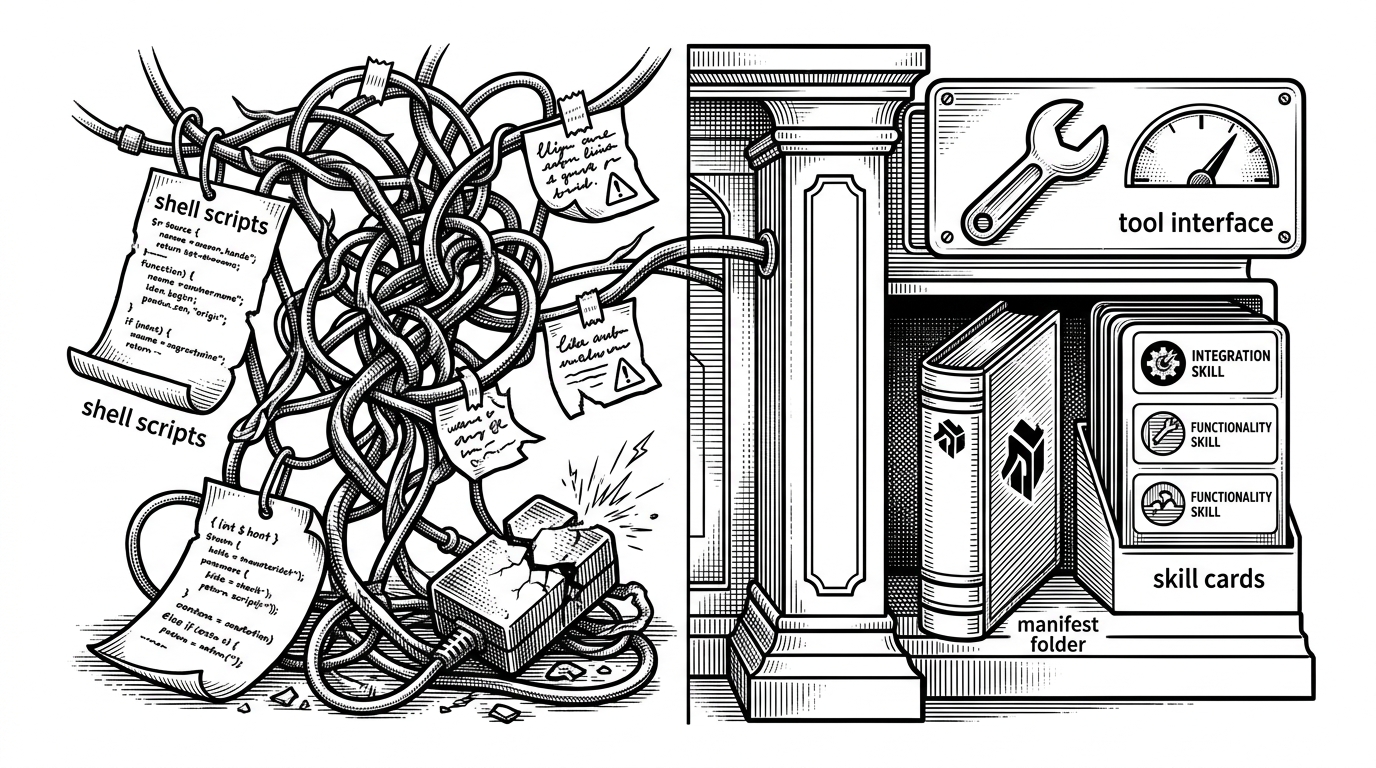
The comparison is really about control. A script can be powerful, but it is usually invisible to the system around it. A plugin bundle can be discovered, constrained, updated, and audited as a unit.
What this says about the future of AI software
If this pattern sticks, AI software will look less like prompt engineering and more like package management. The winning abstraction is not a clever prompt. It is a distributable capability with policy, provenance, and a bounded tool surface.
That is why this repository matters. It is a preview of an app store for agents, but with a stricter contract. The capability is explicit, the permissions are inspectable, and the behavior can change without retraining the model.