flight-reservation-devops: The Repo That Turns Jenkins Into a GitOps Trigger
A flight booking app is the excuse. The real lesson is how CI, Git, Kubernetes, and Argo CD split responsibility into a clean, auditable release pipeline.
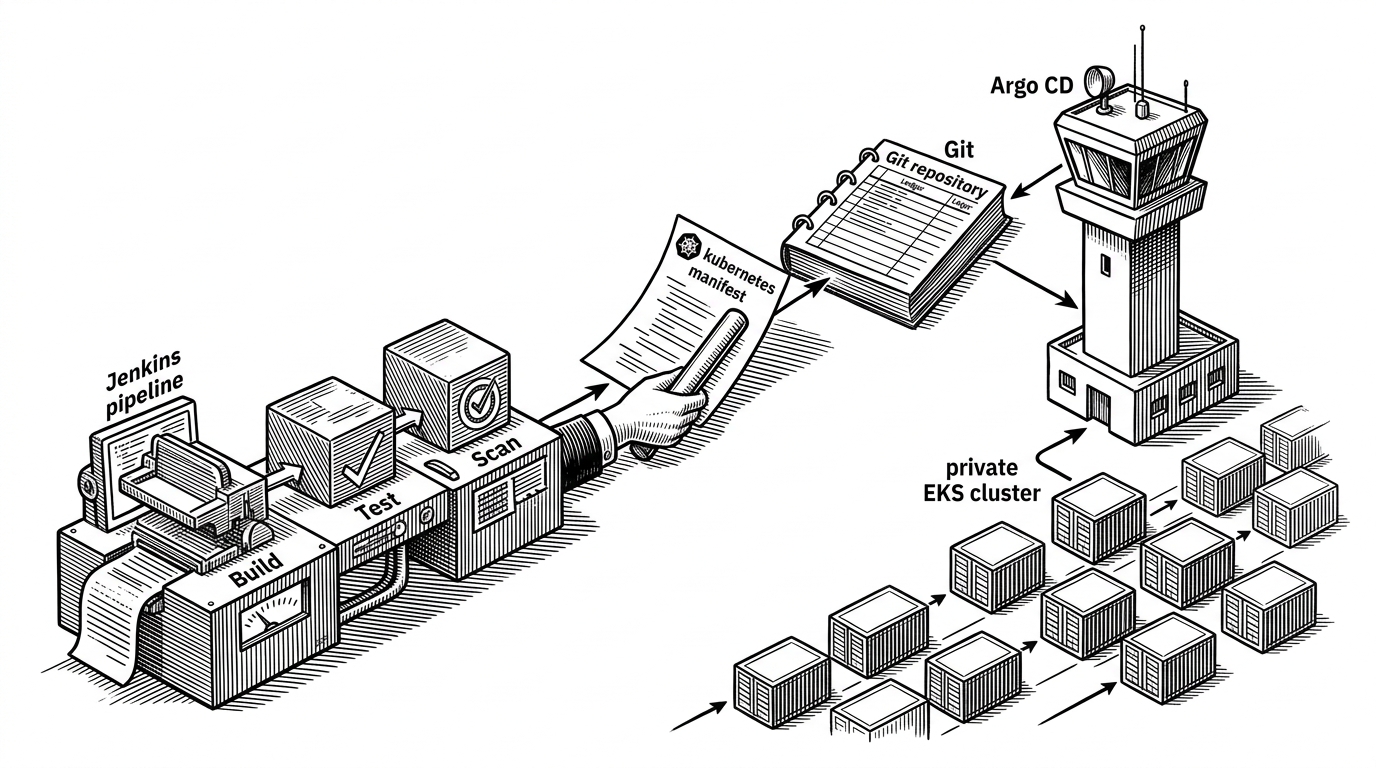
- This repo is memorable because Jenkins stops at Git, which turns the manifest into the release contract and Argo CD into the applier.
- The flight app is intentionally plain, so the reader can see the delivery system instead of getting distracted by business complexity.
- The infrastructure is more production-shaped than most demos because Terraform, Ansible, EKS, RDS, and SonarQube are wired as a coherent stack.
- The frontend gets a simpler S3 path on purpose, which shows pragmatic boundaries rather than forcing every component through Kubernetes.
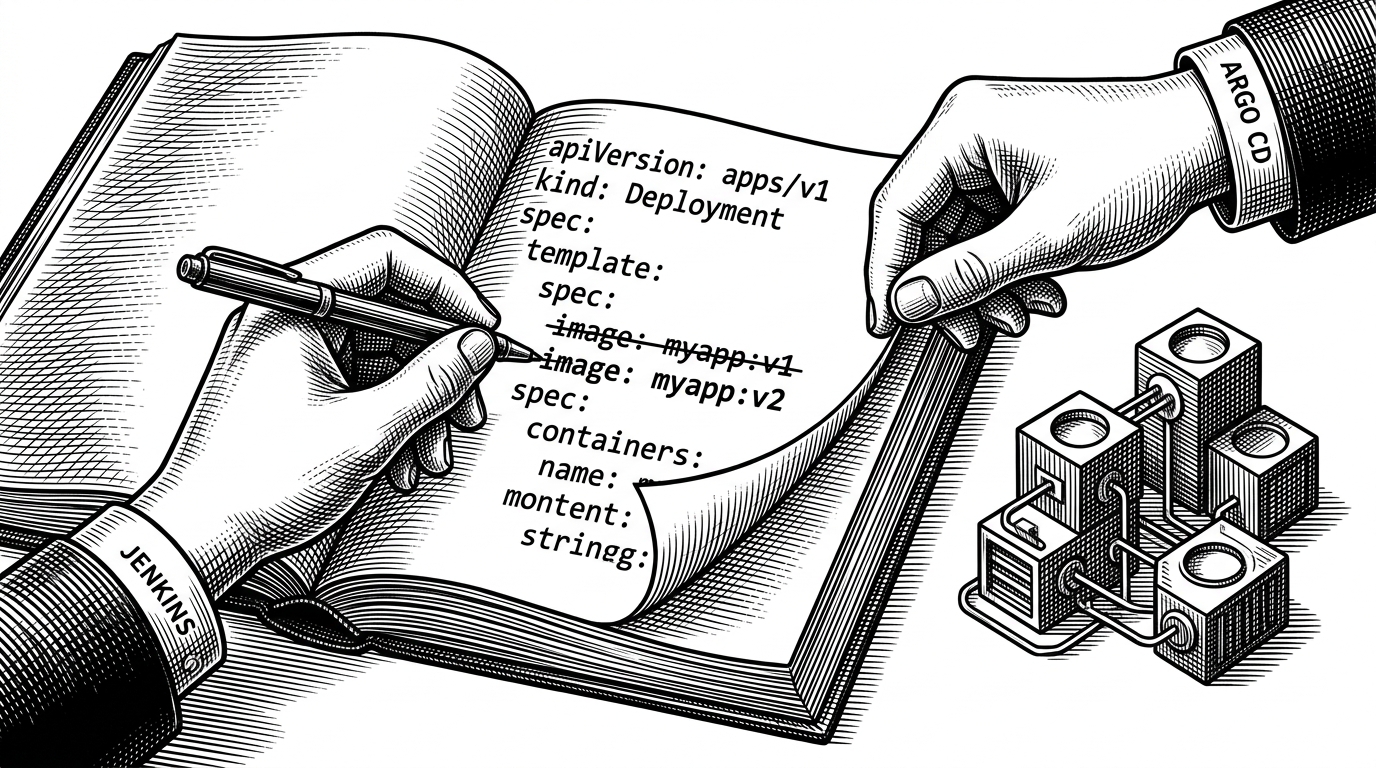
The clever part here is not the flight booking UI. It is the release model. Jenkins builds, tests, scans, then writes the new image tag back into Git. Argo CD watches that repository, sees the changed desired state, and reconciles the cluster.
Why Jenkins Stops at Git
Flight-Reservation-DevOps project is a comprehensive guide to understanding and implementing a complete Devops lifecycle for a web application.
That README line is broad, but it points at the right thing. This repo is not trying to sell a flight product. It is trying to make a full delivery lifecycle legible in one place.
The Flight App Is the Decoy
The application layer is deliberately ordinary. A Spring Boot backend handles booking logic, a React frontend handles the UI, and a check-in service adds just enough domain shape to feel real. The point is not novelty. The point is to keep the DevOps story visible.
What Lives Where
| Layer | What lives there | Why it matters |
|---|---|---|
| Application | Spring Boot, React, check-in service | Keeps the business example small enough to understand |
| Infrastructure | Terraform, Ansible, AWS modules | Makes the repo behave like a real platform build |
| Orchestration | Jenkins, Argo CD, Kubernetes manifests | Separates release computation from cluster reconciliation |
| Observability and quality | SonarQube, Prometheus, Grafana | Adds the day-two discipline most demos skip |
The stack is broad, but the boundaries are clean. Java, JavaScript, HCL, YAML, and shell each do one job. That matters because the repo is teaching composition, not tool collecting.
Inside the infra modules
The Terraform layout reads like a production sketch. VPCs use public and private subnets, NAT keeps private resources reachable without exposing them, EKS runs the compute plane, and RDS holds application data away from the public edge. That is not just cloud decoration. It is a sane shape for a system that expects to grow.
| Choice | What a toy demo does | What this repo does |
|---|---|---|
| Networking | Single flat cluster | Public and private subnet split with NAT |
| Data | In-memory or local DB | Managed RDS for app data |
| Provisioning | Ad hoc scripts | Terraform modules plus Ansible setup |
| Release | kubectl from CI | GitOps handoff through Argo CD |
The Frontend Cheats, and That Is Fine
The frontend deployment is the pragmatic exception that proves the rule. Instead of forcing static assets into Kubernetes, the pipeline builds the React app and syncs the output to S3. That keeps the frontend simple, cheap, and easy to reason about.
| Path | Backend | Frontend |
|---|---|---|
| Artifact | Container image | Static assets |
| Deployment target | EKS via Argo CD | S3 website hosting |
| Release trigger | Manifest tag change in Git | S3 sync after build |
| Operational burden | Higher | Lower |
Security Is Stateless on Purpose
The backend security setup is what you want in a modern API. JWT auth makes sessions stateless, the security filter chain permits only the flows that need to be public, and role checks gate administrative actions. CSRF is disabled because the API is token driven, not browser session driven.
@Bean
public SecurityFilterChain securityFilterChain(HttpSecurity http) throws Exception {
    http.csrf(csrf -> csrf.disable())
        .sessionManagement(sm -> sm.sessionCreationPolicy(SessionCreationPolicy.STATELESS))
        .authorizeHttpRequests(auth -> auth
            .requestMatchers("/auth/**").permitAll()
            .requestMatchers("/admin/**").hasRole("ADMIN")
            .anyRequest().authenticated());
    return http.build();
}
That is a useful signal. The repo is not pretending that infrastructure alone equals maturity. It also has application security choices that match the delivery model.
The Toolchain Feels Enterprise Because It Is
SonarQube, Nexus, Prometheus, Grafana, Jenkins, Ansible, and Terraform are not there as logo wallpaper. They create the same sort of boring, durable guardrails used in many internal platform teams: code quality checks, artifact handling, metrics, and server bootstrap. The SonarQube setup even includes kernel tuning, which is the kind of detail that separates a demo from something that has at least touched real operations.
This project is designed for beginners to intermediate DevOps engineers to understand how different tools work together to automate the entire software development lifecycle.
| Signal | Minimal demo | This repo |
|---|---|---|
| Quality gate | Usually skipped | SonarQube included in the flow |
| Artifact management | Often omitted | Nexus is part of the stack |
| Monitoring | Optional screenshots | Prometheus and Grafana included |
| Host bootstrap | Manual | Ansible playbooks and system tuning |
How It Compares to the Usual Demos
Compared with Sock Shop, Online Boutique, example-voting-app, and spring-petclinic-cloud, this repo is smaller and less theatrical. That is its advantage. It is closer to the kind of stack a single engineer can actually reproduce, and closer to the enterprise patterns many teams want to learn without inheriting a monster.
| Repo | Scope | Primary goal | Deployment style | Beginner friendliness | Enterprise realism |
|---|---|---|---|---|---|
| flight-reservation-devops | Focused | Teach a full GitOps delivery pipeline | Jenkins to Git to Argo CD | High | High |
| Sock Shop | Broad | Show microservices at scale | Kubernetes showcase | Medium | Medium |
| Online Boutique | Broad | Demonstrate cloud-native patterns | GKE showcase | Medium | Medium |
| example-voting-app | Narrow | Teach containers and orchestration | Docker and swarm style | High | Low |
| spring-petclinic-cloud | Focused | Show Spring cloud-native design | Cloud-native service mesh style | Medium | Medium |
The repo wins by being teachable and specific. It does not try to be the biggest demo on the internet. It tries to be the clearest explanation of how a modern release pipeline fits together.