QuickBite_Food_Delivery: QuickBite: The MERN Food Delivery App That Treats Orders Like a Live State Machine
Inside a three-sided marketplace where Socket.io rooms, guarded status transitions, and OTP handoffs keep restaurants, drivers, and customers in sync.
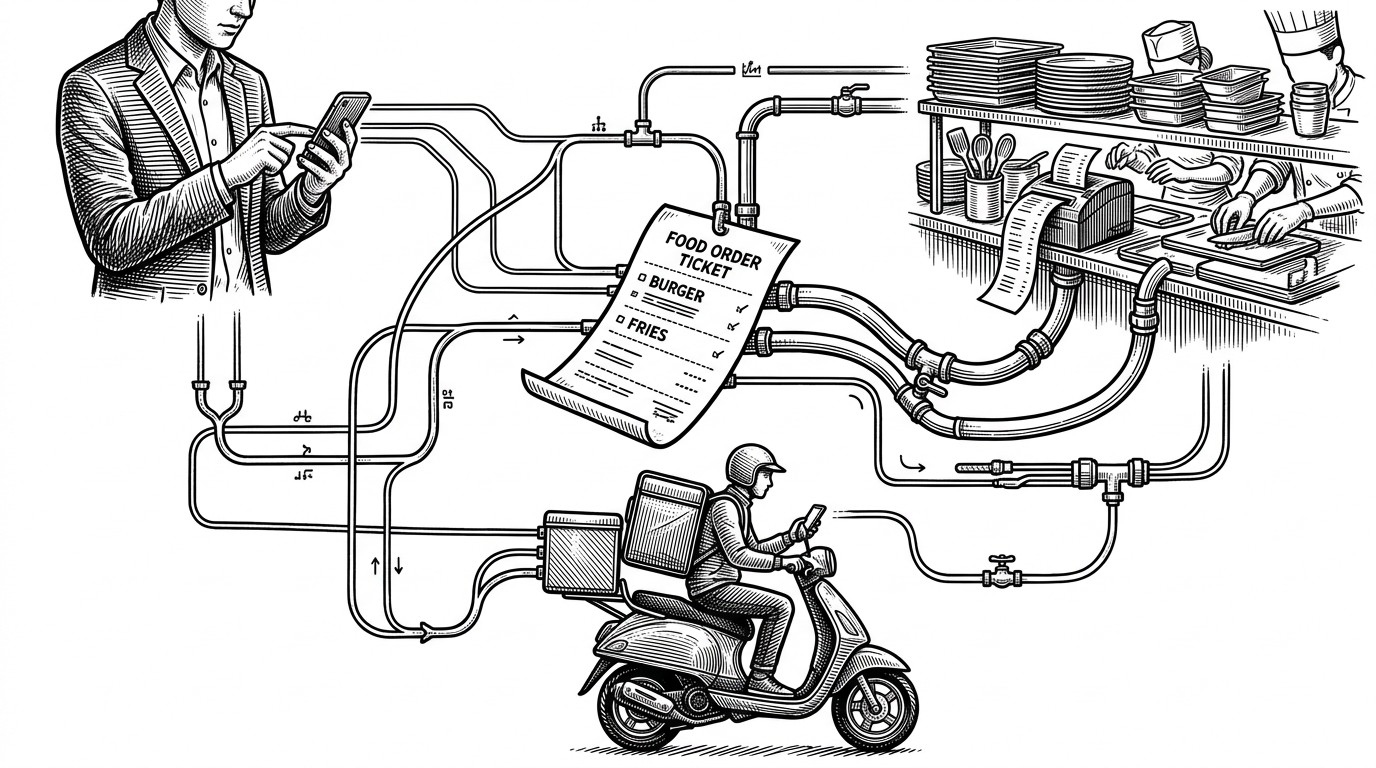
- QuickBite’s real novelty is its coordination model, not its UI, because it routes one order through private realtime channels instead of a noisy global feed.
- The app behaves like a guarded logistics system, with order transitions, status history, and OTP handoffs preventing impossible states from slipping through.
- A single user model, role-based auth, and HTTP-only tokens make the marketplace easier to operate without collapsing the security boundary.
- The repo is most useful as a teaching project because it shows how a food delivery app becomes credible only when it starts enforcing operational correctness.
A Food Delivery App That Behaves Like a Dispatch System
Most food delivery demos stop at placement and status labels. QuickBite goes further. It treats each order as a live object that has to stay consistent across a customer, a restaurant owner, and a delivery partner, which is a much harder problem than rendering a menu card.
That is why the repo feels more like a dispatch system than a CRUD app. The interesting work is not in the pages. It is in the coordination logic that keeps the marketplace coherent while things are moving.
The Private Room Trick That Makes Realtime Targeted
The key move is simple and strong: authenticate the socket, identify the user, and place them in a private room like user_${user._id}. That lets the server notify a specific restaurant owner, customer, or driver with surgical precision.
This matters because food delivery is not chat. A status change belongs to exactly one or two parties, not the whole network. QuickBite’s room pattern keeps the system quiet by default and selective when it needs to speak.
Order Placement Is Not One Action. It Is a Choreographed Sequence
The placeOrder flow is the repo’s center of gravity. It validates the restaurant, computes the totals, creates the delivery record, clears the cart, persists the order, and triggers notifications in one logical chain.
// Simplified flow based on the repository's service layer
async function placeOrder(userId, restaurantId, items) {
  const restaurant = await Restaurant.findById(restaurantId);
  if (!restaurant || !restaurant.isAvailable) {
    throw new ApiError(400, 'Restaurant unavailable');
  }

  const totals = calculateTotals(items, restaurant);
  const order = await Order.create({
    user: userId,
    restaurant: restaurantId,
    items,
    ...totals,
    status: 'Pending',
    statusHistory: [{ status: 'Pending', at: new Date() }]
  });

  await Cart.findOneAndDelete({ user: userId });
  await Delivery.create({ order: order._id, status: 'AVAILABLE' });
  notifyRestaurantOwner(restaurant.ownerId, order);
  return order;
}
That is the right shape for a production-minded system even if it is not wrapped in a database transaction. The repo makes the lifecycle explicit, which is already a big step up from apps that just flip a status field and hope for the best.
The State Machine Prevents Bad Reality
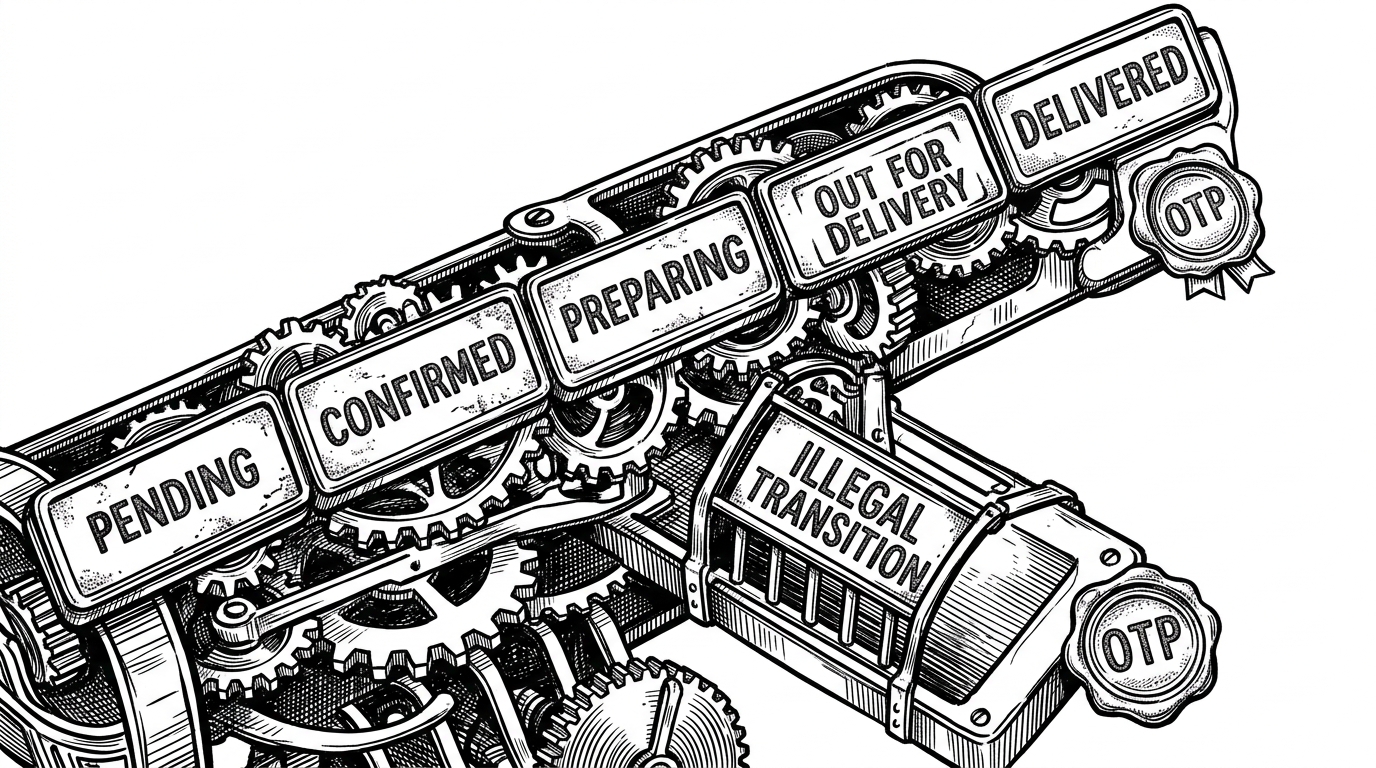
QuickBite does not let an order jump from Pending to Out for Delivery just because someone clicked fast enough. The allowed transitions act like a gatekeeper, and the status history acts like a ledger.
That combination is the difference between a demo and an operational model. You get two things at once: fewer impossible states, and a trace of what happened when something did change.
| Naive flow | QuickBite flow |
|---|---|
| Status changes are freeform and easy to break. | Transitions are constrained by an allowed map. |
| No durable record of each step. | Status history preserves each state change. |
| Handoffs are informal. | OTP verifies the final delivery handoff. |
| Errors surface late. | Bad transitions are rejected early. |
One User Model, Three Jobs
The repo uses one User schema for customers, restaurant owners, and delivery partners. That reduces schema sprawl and keeps identity consistent across the app, while still allowing conditional fields for delivery-specific data like vehicle number and availability.
The trade-off is obvious. You gain simplicity in the core model, but you have to be disciplined about role checks and validation. QuickBite appears to do that with centralized auth and role-aware routing instead of scattering the logic across the UI.
| Single user model | Separate role tables |
|---|---|
| One identity layer with conditional fields. | More schemas, more joins, more drift. |
| Easier auth and room mapping. | More explicit separation of responsibilities. |
| Requires careful role validation. | Roles are isolated structurally. |
| Good fit for a marketplace prototype that wants to stay coherent. | Good fit when roles diverge heavily at scale. |
Security Is Built Into the Transport Layer
This is where the repo stops looking like a classroom project. QuickBite uses HTTP-only cookies, refresh tokens, Bearer fallback, bcryptjs, Passport Google OAuth, and centralized middleware to keep auth concerns in one place.
That design reduces the usual fragility of demo stacks. Tokens are not left lying around in the browser, and the socket handshake is authenticated before realtime traffic starts flowing.
| Weak dev-pattern | QuickBite pattern |
|---|---|
| Tokens in localStorage. | HTTP-only cookies plus refresh tokens. |
| Ad hoc auth checks in each route. | Centralized middleware and role-aware guards. |
| Unauthenticated sockets. | JWT validation during handshake. |
| One login path only. | Google OAuth and token-based login together. |
Why This Repo Feels More Mature Than a Demo
A few details push the codebase into a more serious category: graceful shutdown, async handler wrappers, consistent ApiError usage, status constants, and the service-controller-model split. None of those are flashy. All of them matter.
They are the kind of choices that make a repo easier to read, easier to extend, and less likely to fall apart when it meets real traffic. The point is not just that QuickBite works. The point is that it is organized like something that expects to keep working.
What QuickBite Gets Right Compared With Typical Food Apps
Against a tutorial-grade food delivery app, QuickBite is more stateful, more explicit, and more defensive. Against packaged platforms, it is more code-level and more customizable. Its edge is not breadth. Its edge is operational correctness.
| Category | Typical tutorial app | Packaged platform | QuickBite |
|---|---|---|---|
| Realtime behavior | Usually a global status feed. | Often productized but opaque. | Private Socket.io rooms per user. |
| Order model | Simple CRUD states. | Defined by the vendor. | Guarded state machine with history. |
| Identity | Often one generic user type. | Platform-specific abstractions. | Single model with role-specific fields. |
| Extensibility | Easy to demo, hard to trust. | Fast to adopt, harder to bend. | Readable codebase you can shape. |
| Best for | Learning the surface area. | Buying a finished solution. | Studying how dispatch logic actually works. |
QuickBite is worth studying because it shows how a food delivery app becomes interesting only when it starts behaving like a dispatch system.