CodersAbode Turns a Developer Portfolio Into a Search Engine
A Django prototype that treats projects, profiles, and reviews as structured signals, not static pages.

- CodersAbode is strongest when you read it as infrastructure for discovery, not as a portfolio theme.
- Its real product idea is structured identity, where projects, tags, reviews, and profile data become searchable signals.
- Django signals, UUIDs, and model relationships do the invisible work that makes the platform feel coordinated.
- The codebase is still prototype-grade, but it already shows a coherent system for turning work into ranked, queryable evidence.
Most portfolio sites display proof. CodersAbode tries to organize it. That difference matters because recruiters, collaborators, and curious peers do not just want a homepage. They want a way to find the right person from the right work, fast.
This repo’s ambition is subtle. It takes ordinary Django pieces, then arranges them like a discovery layer: profiles, projects, reviews, votes, tags, search, and pagination. The result is less a showcase and more a tiny talent graph.
A Portfolio That Wants to Be Discovered
The premise is simple to state and hard to execute well. CodersAbode is a social platform for developers, but it behaves like a search tool for talent. Projects are not decorative tiles. They are signals that can be indexed, filtered, and compared.
That gives the project a rare product shape. It is a portfolio site that also wants to be useful to the person scanning dozens of profiles. In that sense, it treats developer identity as structured data, not a static biography.
The Platform Is Built Around Signals, Not Forms
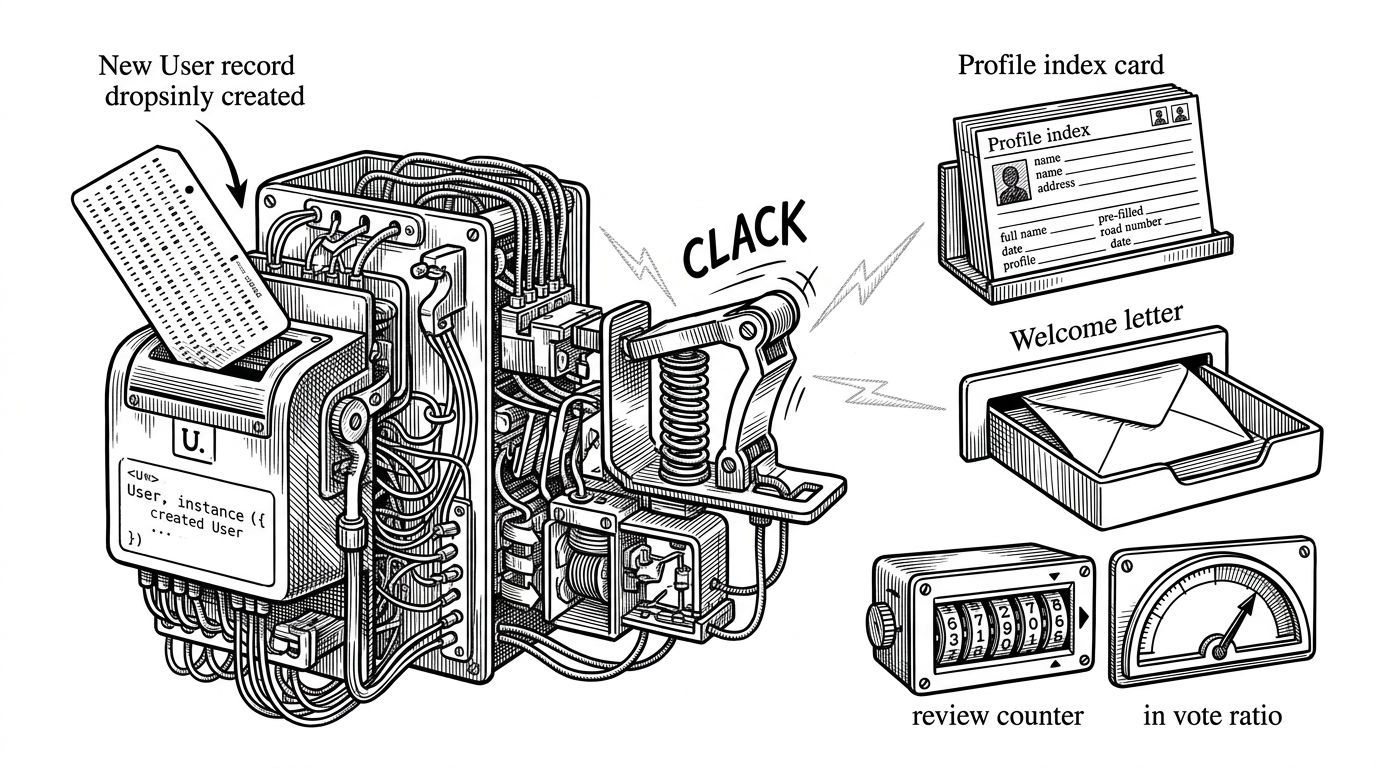
The signal pattern is the repo’s quiet win. A user registers, Django saves the user, and a `post_save` hook creates the profile automatically. The same background path also sends a welcome email and keeps profile edits synchronized back to the core user record.
@receiver(post_save, sender=User)
def createProfile(sender, instance, created, **kwargs):
    if created:
        user = instance
        profile = Profile.objects.create(
            user=user,
            name=user.first_name,
            username=user.username,
            email=user.email,
        )
        sendMail(profile.email, 'Welcome to CodersAbode')


def updateProfile(sender, instance, created, **kwargs):
    profile = instance
    user = profile.user
    if not created:
        user.first_name = profile.name
        user.username = profile.username
        user.email = profile.email
        user.save()
That separation of concerns is the point. The view stays thin. The lifecycle logic lives where it belongs, in the model layer and signal handlers. For a small app, that is a strong architectural instinct.
Why UUIDs, Profile Models, and Vote Ratios Matter
CodersAbode’s data model is doing more work than a typical CRUD demo. UUID primary keys reduce the chance of easy ID enumeration. The `Profile` model extends Django’s built-in `User` cleanly with a one-to-one relationship. That keeps authentication separate from developer metadata.
The review system matters too. A `vote_ratio` and `vote_total` turn community feedback into a compact quality signal. The `getVoteCount` property makes that summary available without forcing the database to store redundant state by hand.
class Project(models.Model):
    id = models.UUIDField(default=uuid.uuid4, unique=True, primary_key=True, editable=False)

    @property
    def getVoteCount(self):
        total = self.review_set.all().count()
        helpful = self.review_set.filter(value='up').count()
        ratio = helpful / total * 100 if total else 0
        self.vote_ratio = ratio
        self.vote_total = total
        return {'ratio': ratio, 'total': total}
That is what moves the project out of hobby territory. It is not just storing profiles and projects. It is encoding reputation, identity, and discoverability into the schema itself.
Search Is the Real Product
The search layer is where the thesis becomes obvious. `searchProjects` uses Django `Q` objects to search across titles, descriptions, owner names, and tags. `distinct()` cleans up duplicate hits. That makes the app feel like a discovery engine instead of a directory.
| System | What it stores | How discovery works | Who benefits |
|---|---|---|---|
| Basic portfolio | Projects and a bio | Manual browsing | Visitors who already know where to look |
| Generic social profile | People and posts | Feed-driven attention | Existing followers |
| CodersAbode | Projects, tags, reviews, skills, profile metadata | Search across structured signals | Recruiters, collaborators, and builders |
This is the sharpest contrast in the repo. A normal portfolio says, “Here is my work.” CodersAbode says, “Here is my work, and here is how to find the right person through it.”
A Vanilla CSS Stack That Tries to Behave Like a Design System
The UI layer is more disciplined than flashy. A modular CSS structure under `static/uikit/styles/modules/` suggests the project is trying to keep components consistent without introducing a heavy frontend framework. That is a useful middle ground for a Django app.
It also signals intent. The author is not just shipping pages. They are organizing the visual system so the site can grow without collapsing into one-off styling decisions. For a prototype, that is a good sign.
What Keeps It in Prototype Territory
| Strength | Gap |
|---|---|
| Coherent Django structure | Empty tests leave behavior unverified |
| Signal-driven user lifecycle | Hardcoded secret key is a serious risk |
| Structured search and review logic | SQLite limits production realism |
| Modular CSS organization | Limited public evidence of deployment maturity |
None of that cancels the idea. It just places the repo correctly. This is a functional proof of concept with real architectural instincts, not a production platform.
What CodersAbode Gets Right
The project succeeds because its parts line up around one concept. Signals automate onboarding. UUIDs reduce exposure. Profile models keep identity extensible. Search turns content into queryable evidence. CSS modules keep the interface from drifting.
Together, those choices make the app feel more like infrastructure than a theme. That is the real lesson here. A solo developer can build something small that still behaves like a platform, as long as the data model and the product idea reinforce each other.